

orbital overlap between TiO 2 and graphene. The CB flat band potential of TiO 2 is
more negative than the reduction potential of CO 2 /CH 4 , indicating that the photogenerated electrons and holes on the irradiated rGO–TiO 2 composites could react
with adsorbed CO 2 and H 2 O to produce CH 4 via an eight-electron reaction.
Our previous work also developed the application on the solar light-driven CO 2
photoreduction by using modified TiO 2 /graphene composite as the photocatalyst.
Highly dispersed boron-doped graphene nanosheets loaded with TiO 2 nanoparticles
were synthesized in our lab by using a simple mixing method [48]. The prepared
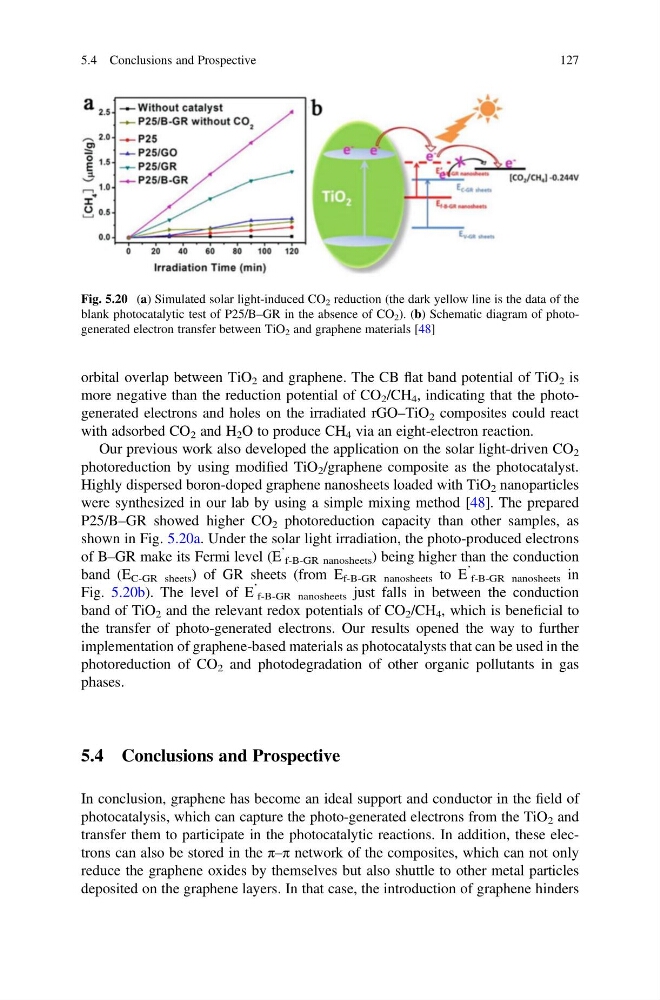
P25/B–GR showed higher CO 2 photoreduction capacity than other samples, as
shown in Fig. 5.20a. Under the solar light irradiation, the photo-produced electrons
of B–GR make its Fermi level (E
’
f-B-GR nanosheets ) being higher than the conduction
band (E C-GR sheets ) of GR sheets (from E f-B-GR nanosheets to E
’
f-B-GR nanosheets in
Fig. 5.20b). The level of E
’
f-B-GR nanosheets just falls in between the conduction
band of TiO 2 and the relevant redox potentials of CO 2 /CH 4 , which is beneficial to
the transfer of photo-generated electrons. Our results opened the way to further
implementation of graphene-based materials as photocatalysts that can be used in the
photoreduction of CO 2 and photodegradation of other organic pollutants in gas
phases.
5.4 Conclusions and Prospective
In conclusion, graphene has become an ideal support and conductor in the field of
photocatalysis, which can capture the photo-generated electrons from the TiO 2 and
transfer them to participate in the photocatalytic reactions. In addition, these electrons can also be stored in the π–π network of the composites, which can not only
reduce the graphene oxides by themselves but also shuttle to other metal particles
deposited on the graphene layers. In that case, the introduction of graphene hinders
Fig. 5.20 (a) Simulated solar light-induced CO 2 reduction (the dark yellow line is the data of the
blank photocatalytic test of P25/B–GR in the absence of CO 2 ). (b) Schematic diagram of photogenerated electron transfer between TiO 2 and graphene materials [48]
5.4 Conclusions and Prospective
127
more negative than the reduction potential of CO 2 /CH 4 , indicating that the photogenerated electrons and holes on the irradiated rGO–TiO 2 composites could react
with adsorbed CO 2 and H 2 O to produce CH 4 via an eight-electron reaction.
Our previous work also developed the application on the solar light-driven CO 2
photoreduction by using modified TiO 2 /graphene composite as the photocatalyst.
Highly dispersed boron-doped graphene nanosheets loaded with TiO 2 nanoparticles
were synthesized in our lab by using a simple mixing method [48]. The prepared
P25/B–GR showed higher CO 2 photoreduction capacity than other samples, as
shown in Fig. 5.20a. Under the solar light irradiation, the photo-produced electrons
of B–GR make its Fermi level (E
’
f-B-GR nanosheets ) being higher than the conduction
band (E C-GR sheets ) of GR sheets (from E f-B-GR nanosheets to E
’
f-B-GR nanosheets in
Fig. 5.20b). The level of E
’
f-B-GR nanosheets just falls in between the conduction
band of TiO 2 and the relevant redox potentials of CO 2 /CH 4 , which is beneficial to
the transfer of photo-generated electrons. Our results opened the way to further
implementation of graphene-based materials as photocatalysts that can be used in the
photoreduction of CO 2 and photodegradation of other organic pollutants in gas
phases.
5.4 Conclusions and Prospective
In conclusion, graphene has become an ideal support and conductor in the field of
photocatalysis, which can capture the photo-generated electrons from the TiO 2 and
transfer them to participate in the photocatalytic reactions. In addition, these electrons can also be stored in the π–π network of the composites, which can not only
reduce the graphene oxides by themselves but also shuttle to other metal particles
deposited on the graphene layers. In that case, the introduction of graphene hinders
Fig. 5.20 (a) Simulated solar light-induced CO 2 reduction (the dark yellow line is the data of the
blank photocatalytic test of P25/B–GR in the absence of CO 2 ). (b) Schematic diagram of photogenerated electron transfer between TiO 2 and graphene materials [48]
5.4 Conclusions and Prospective
127