

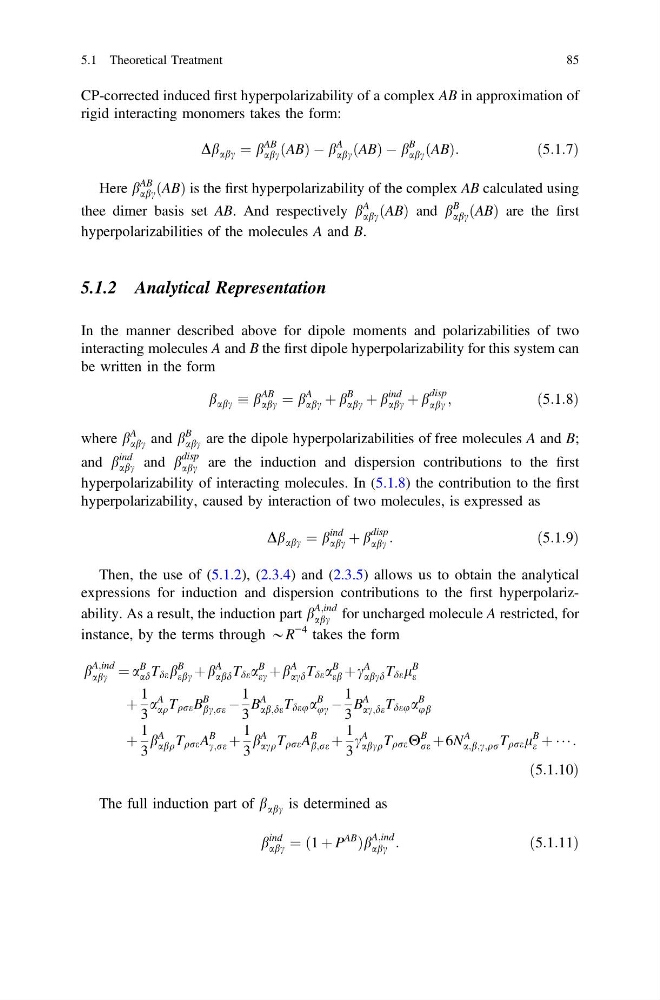
CP-corrected induced first hyperpolarizability of a complex AB in approximation of
rigid interacting monomers takes the form:
Db abc ¼ b
AB
abc ðABÞ À b
A
abc ðABÞ À b
B
abc ðABÞ:
ð5:1:7Þ
Here b
AB
abc ðABÞ is the first hyperpolarizability of the complex AB calculated using
thee dimer basis set AB. And respectively b
A
abc ðABÞ and b
B
abc ðABÞ are the first
hyperpolarizabilities of the molecules A and B.
5.1.2 Analytical Representation
In the manner described above for dipole moments and polarizabilities of two
interacting molecules A and B the first dipole hyperpolarizability for this system can
be written in the form
b abc b
AB
abc ¼ b
A
abc þ b
B
abc þ b
ind
abc þ b
disp
abc ;
ð5:1:8Þ
where b
A
abc and b
B
abc are the dipole hyperpolarizabilities of free molecules A and B;
and b
ind
abc and b
disp
abc are the induction and dispersion contributions to the first
hyperpolarizability of interacting molecules. In (5.1.8) the contribution to the first
hyperpolarizability, caused by interaction of two molecules, is expressed as
Db abc ¼ b
ind
abc þ b
disp
abc :
ð5:1:9Þ
Then, the use of (5.1.2), (2.3.4) and (2.3.5) allows us to obtain the analytical
expressions for induction and dispersion contributions to the first hyperpolarizability. As a result, the induction part b
A;ind
abc for uncharged molecule A restricted, for
instance, by the terms through *R
−4 takes the form
b
A;ind
abc ¼ a
B
ad T de b
B
ebc þ b
A
abd T de a
B
ec þ b
A
acd T de a
B
eb þ c
A
abcd T de l
B
e
þ
1
3
a
A
aq T qre B
B
bc;re À
1
3
B
A
ab;de T deu a
B
uc À
1
3
B
A
ac;de T deu a
B
ub
þ
1
3
b
A
abq T qre A
B
c;re þ
1
3
b
A
acq T qre A
B
b;re þ
1
3
c
A
abcq T qre H
B
re þ 6N
A
a;b;c;qr T qre l
B
e þ ÁÁÁ:
ð5:1:10Þ
The full induction part of b abc is determined as
b
ind
abc ¼ ð1 þ P
AB
Þb
A;ind
abc :
ð5:1:11Þ
5.1 Theoretical Treatment
85
rigid interacting monomers takes the form:
Db abc ¼ b
AB
abc ðABÞ À b
A
abc ðABÞ À b
B
abc ðABÞ:
ð5:1:7Þ
Here b
AB
abc ðABÞ is the first hyperpolarizability of the complex AB calculated using
thee dimer basis set AB. And respectively b
A
abc ðABÞ and b
B
abc ðABÞ are the first
hyperpolarizabilities of the molecules A and B.
5.1.2 Analytical Representation
In the manner described above for dipole moments and polarizabilities of two
interacting molecules A and B the first dipole hyperpolarizability for this system can
be written in the form
b abc b
AB
abc ¼ b
A
abc þ b
B
abc þ b
ind
abc þ b
disp
abc ;
ð5:1:8Þ
where b
A
abc and b
B
abc are the dipole hyperpolarizabilities of free molecules A and B;
and b
ind
abc and b
disp
abc are the induction and dispersion contributions to the first
hyperpolarizability of interacting molecules. In (5.1.8) the contribution to the first
hyperpolarizability, caused by interaction of two molecules, is expressed as
Db abc ¼ b
ind
abc þ b
disp
abc :
ð5:1:9Þ
Then, the use of (5.1.2), (2.3.4) and (2.3.5) allows us to obtain the analytical
expressions for induction and dispersion contributions to the first hyperpolarizability. As a result, the induction part b
A;ind
abc for uncharged molecule A restricted, for
instance, by the terms through *R
−4 takes the form
b
A;ind
abc ¼ a
B
ad T de b
B
ebc þ b
A
abd T de a
B
ec þ b
A
acd T de a
B
eb þ c
A
abcd T de l
B
e
þ
1
3
a
A
aq T qre B
B
bc;re À
1
3
B
A
ab;de T deu a
B
uc À
1
3
B
A
ac;de T deu a
B
ub
þ
1
3
b
A
abq T qre A
B
c;re þ
1
3
b
A
acq T qre A
B
b;re þ
1
3
c
A
abcq T qre H
B
re þ 6N
A
a;b;c;qr T qre l
B
e þ ÁÁÁ:
ð5:1:10Þ
The full induction part of b abc is determined as
b
ind
abc ¼ ð1 þ P
AB
Þb
A;ind
abc :
ð5:1:11Þ
5.1 Theoretical Treatment
85