

5.1 Theoretical Treatment
5.1.1 Computational Details
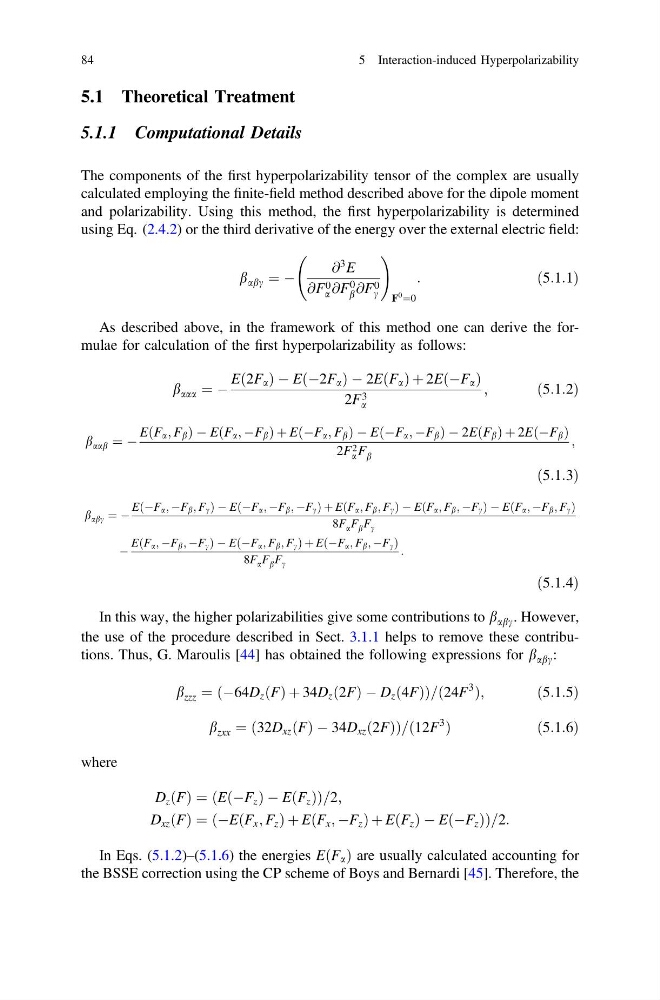
The components of the first hyperpolarizability tensor of the complex are usually
calculated employing the finite-field method described above for the dipole moment
and polarizability. Using this method, the first hyperpolarizability is determined
using Eq. (2.4.2) or the third derivative of the energy over the external electric field:
b abc ¼ À
@
3 E
@F 0
a @F 0
b @F 0
c
!
F
0 ¼0
:
ð5:1:1Þ
As described above, in the framework of this method one can derive the formulae for calculation of the first hyperpolarizability as follows:
b aaa ¼ À
Eð2F a Þ À EðÀ2F a Þ À 2EðF a Þ þ 2EðÀF a Þ
2F 3
a
;
ð5:1:2Þ
b aab ¼ À
EðF a ; F b Þ À EðF a ; ÀF b Þ þ EðÀF a ; F b Þ À EðÀF a ; ÀF b Þ À 2EðF b Þ þ 2EðÀF b Þ
2F 2
a F b
;
ð5:1:3Þ
b abc ¼ À
EðÀF a ; ÀF b ; F c Þ À EðÀF a ; ÀF b ; ÀF c Þ þ EðF a ; F b ; F c Þ À EðF a ; F b ; ÀF c Þ À EðF a ; ÀF b ; F c Þ
8F a F b F c
À
EðF a ; ÀF b ; ÀF c Þ À EðÀF a ; F b ; F c Þ þ EðÀF a ; F b ; ÀF c Þ
8F a F b F c
:
ð5:1:4Þ
In this way, the higher polarizabilities give some contributions to b abc . However,
the use of the procedure described in Sect. 3.1.1 helps to remove these contributions. Thus, G. Maroulis [44] has obtained the following expressions for b abc :
b zzz ¼ ðÀ64D z ðFÞ þ 34D z ð2FÞ À D z ð4FÞÞ=ð24F
3
Þ;
ð5:1:5Þ
b zxx ¼ ð32D xz ðFÞ À 34D xz ð2FÞÞ=ð12F
3
Þ
ð 5:1:6Þ
where
D z ðFÞ ¼ ðEðÀF z Þ À EðF z ÞÞ=2;
D xz ðFÞ ¼ ðÀEðF x ; F z Þ þ EðF x ; ÀF z Þ þ EðF z Þ À EðÀF z ÞÞ=2:
In Eqs. (5.1.2)–(5.1.6) the energies EðF a Þ are usually calculated accounting for
the BSSE correction using the CP scheme of Boys and Bernardi [45]. Therefore, the
84
5 Interaction-induced Hyperpolarizability
5.1.1 Computational Details
The components of the first hyperpolarizability tensor of the complex are usually
calculated employing the finite-field method described above for the dipole moment
and polarizability. Using this method, the first hyperpolarizability is determined
using Eq. (2.4.2) or the third derivative of the energy over the external electric field:
b abc ¼ À
@
3 E
@F 0
a @F 0
b @F 0
c
!
F
0 ¼0
:
ð5:1:1Þ
As described above, in the framework of this method one can derive the formulae for calculation of the first hyperpolarizability as follows:
b aaa ¼ À
Eð2F a Þ À EðÀ2F a Þ À 2EðF a Þ þ 2EðÀF a Þ
2F 3
a
;
ð5:1:2Þ
b aab ¼ À
EðF a ; F b Þ À EðF a ; ÀF b Þ þ EðÀF a ; F b Þ À EðÀF a ; ÀF b Þ À 2EðF b Þ þ 2EðÀF b Þ
2F 2
a F b
;
ð5:1:3Þ
b abc ¼ À
EðÀF a ; ÀF b ; F c Þ À EðÀF a ; ÀF b ; ÀF c Þ þ EðF a ; F b ; F c Þ À EðF a ; F b ; ÀF c Þ À EðF a ; ÀF b ; F c Þ
8F a F b F c
À
EðF a ; ÀF b ; ÀF c Þ À EðÀF a ; F b ; F c Þ þ EðÀF a ; F b ; ÀF c Þ
8F a F b F c
:
ð5:1:4Þ
In this way, the higher polarizabilities give some contributions to b abc . However,
the use of the procedure described in Sect. 3.1.1 helps to remove these contributions. Thus, G. Maroulis [44] has obtained the following expressions for b abc :
b zzz ¼ ðÀ64D z ðFÞ þ 34D z ð2FÞ À D z ð4FÞÞ=ð24F
3
Þ;
ð5:1:5Þ
b zxx ¼ ð32D xz ðFÞ À 34D xz ð2FÞÞ=ð12F
3
Þ
ð 5:1:6Þ
where
D z ðFÞ ¼ ðEðÀF z Þ À EðF z ÞÞ=2;
D xz ðFÞ ¼ ðÀEðF x ; F z Þ þ EðF x ; ÀF z Þ þ EðF z Þ À EðÀF z ÞÞ=2:
In Eqs. (5.1.2)–(5.1.6) the energies EðF a Þ are usually calculated accounting for
the BSSE correction using the CP scheme of Boys and Bernardi [45]. Therefore, the
84
5 Interaction-induced Hyperpolarizability