

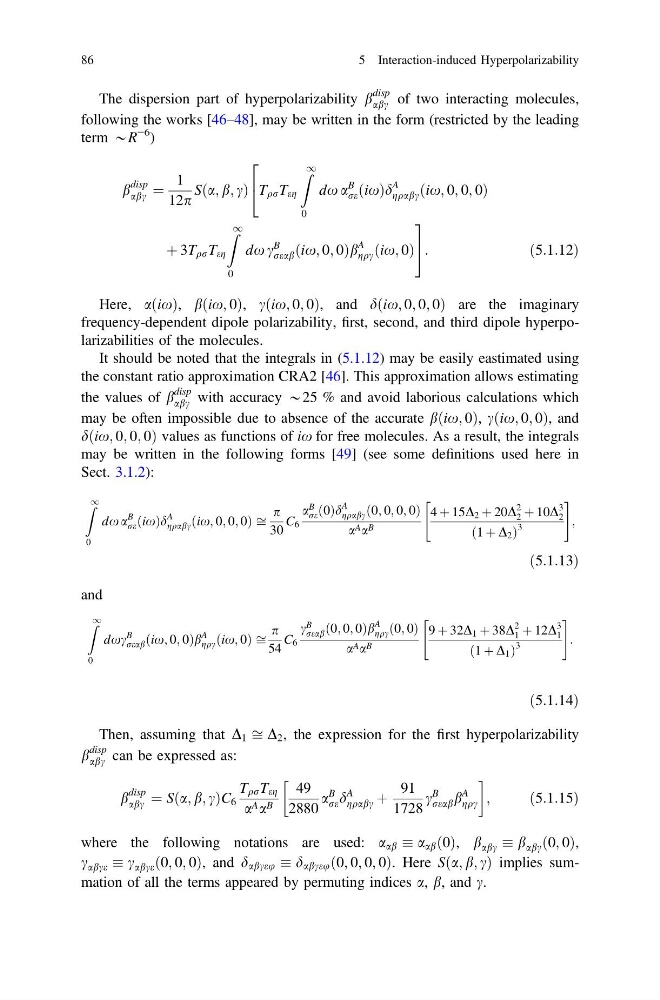
The dispersion part of hyperpolarizability b
disp
abc of two interacting molecules,
following the works [46–48], may be written in the form (restricted by the leading
term *R
−6 )
b
disp
abc ¼
1
12p
Sða; b; cÞ T qr T eg
Z 1
0
dx a
B
re ðixÞd
A
gqabc ðix; 0; 0; 0Þ
2
4
þ 3T qr T eg
Z 1
0
dx c
B
reab ðix; 0; 0Þb
A
gqc ðix; 0Þ
3
5 :
ð5:1:12Þ
Here, aðixÞ, bðix; 0Þ, cðix; 0; 0Þ, and dðix; 0; 0; 0Þ are the imaginary
frequency-dependent dipole polarizability, first, second, and third dipole hyperpolarizabilities of the molecules.
It should be noted that the integrals in (5.1.12) may be easily eastimated using
the constant ratio approximation CRA2 [46]. This approximation allows estimating
the values of b
disp
abc with accuracy *25 % and avoid laborious calculations which
may be often impossible due to absence of the accurate bðix; 0Þ, cðix; 0; 0Þ, and
dðix; 0; 0; 0Þ values as functions of ix for free molecules. As a result, the integrals
may be written in the following forms [49] (see some definitions used here in
Sect. 3.1.2):
Z 1
0
dx a
B
re ðixÞd
A
gqabc ðix; 0; 0; 0Þ ffi
p
30
C 6
a
B
re ð0Þd
A
gqabc ð0; 0; 0; 0Þ
a A a B
4 þ 15D 2 þ 20D
2
2 þ 10D
3
2
ð1 þ D 2 Þ
3
"
#
;
ð5:1:13Þ
and
Z 1
0
dxc
B
reab ðix; 0; 0Þb
A
gqc ðix; 0Þ ffi
p
54
C 6
c
B
reab ð0; 0; 0Þb
A
gqc ð0; 0Þ
a A a B
9 þ 32D 1 þ 38D
2
1 þ 12D
3
1
ð1 þ D 1 Þ
3
"
#
:
ð5:1:14Þ
Then, assuming that D 1 ffi D 2 , the expression for the first hyperpolarizability
b
disp
abc can be expressed as:
b
disp
abc ¼ Sða; b; cÞC 6
T qr T eg
a A a B
49
2880
a
B
re d
A
gqabc þ
91
1728
c
B
reab b
A
gqc
!
;
ð5:1:15Þ
where the following notations are used: a ab a ab ð0Þ, b abc b abc ð0; 0Þ,
c abce c abce ð0; 0; 0Þ, and d abceu d abceu ð0; 0; 0; 0Þ. Here Sða; b; cÞ implies summation of all the terms appeared by permuting indices a, b, and c.
86
5 Interaction-induced Hyperpolarizability
disp
abc of two interacting molecules,
following the works [46–48], may be written in the form (restricted by the leading
term *R
−6 )
b
disp
abc ¼
1
12p
Sða; b; cÞ T qr T eg
Z 1
0
dx a
B
re ðixÞd
A
gqabc ðix; 0; 0; 0Þ
2
4
þ 3T qr T eg
Z 1
0
dx c
B
reab ðix; 0; 0Þb
A
gqc ðix; 0Þ
3
5 :
ð5:1:12Þ
Here, aðixÞ, bðix; 0Þ, cðix; 0; 0Þ, and dðix; 0; 0; 0Þ are the imaginary
frequency-dependent dipole polarizability, first, second, and third dipole hyperpolarizabilities of the molecules.
It should be noted that the integrals in (5.1.12) may be easily eastimated using
the constant ratio approximation CRA2 [46]. This approximation allows estimating
the values of b
disp
abc with accuracy *25 % and avoid laborious calculations which
may be often impossible due to absence of the accurate bðix; 0Þ, cðix; 0; 0Þ, and
dðix; 0; 0; 0Þ values as functions of ix for free molecules. As a result, the integrals
may be written in the following forms [49] (see some definitions used here in
Sect. 3.1.2):
Z 1
0
dx a
B
re ðixÞd
A
gqabc ðix; 0; 0; 0Þ ffi
p
30
C 6
a
B
re ð0Þd
A
gqabc ð0; 0; 0; 0Þ
a A a B
4 þ 15D 2 þ 20D
2
2 þ 10D
3
2
ð1 þ D 2 Þ
3
"
#
;
ð5:1:13Þ
and
Z 1
0
dxc
B
reab ðix; 0; 0Þb
A
gqc ðix; 0Þ ffi
p
54
C 6
c
B
reab ð0; 0; 0Þb
A
gqc ð0; 0Þ
a A a B
9 þ 32D 1 þ 38D
2
1 þ 12D
3
1
ð1 þ D 1 Þ
3
"
#
:
ð5:1:14Þ
Then, assuming that D 1 ffi D 2 , the expression for the first hyperpolarizability
b
disp
abc can be expressed as:
b
disp
abc ¼ Sða; b; cÞC 6
T qr T eg
a A a B
49
2880
a
B
re d
A
gqabc þ
91
1728
c
B
reab b
A
gqc
!
;
ð5:1:15Þ
where the following notations are used: a ab a ab ð0Þ, b abc b abc ð0; 0Þ,
c abce c abce ð0; 0; 0Þ, and d abceu d abceu ð0; 0; 0; 0Þ. Here Sða; b; cÞ implies summation of all the terms appeared by permuting indices a, b, and c.
86
5 Interaction-induced Hyperpolarizability