

Analytical calculations allow us also to estimate easily the contributions of the
different induction and dispersion interactions to Da ii of the complex CH 4 –N 2.
Their analysis shows (see details in [97]) that the leading contributions to the
polarizability for any complex configuration from Fig. 3.6 are due to
dipole-induced-dipole interactions or to terms with a
A
a
B
* R
−3 in (4.2.18). The
other induction terms (*R
−4
ðA
A
a
B
Þ and *R
−5 (E
A
a
B , a
A E
B and B
A
h
B ), and also
the terms *R
−6 caused by the dipole-induced-dipole interaction (a
A
a
B
a
A
þ
a
B
a
A
a
B )) and dispersion terms (*R
−6 ) are significantly smaller and are of comparable values. It should be noticed that the induction term with b
A
h
B (*R
−4 ) is
very small for all considered configurations.
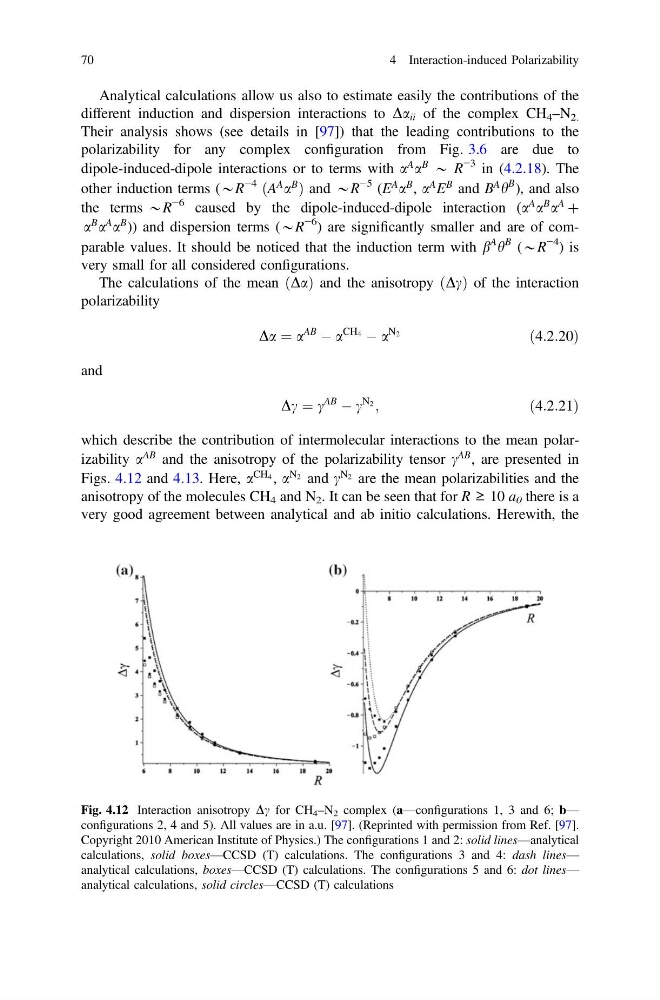
The calculations of the mean ðDaÞ and the anisotropy ðDcÞ of the interaction
polarizability
Da ¼ a
AB
À a
CH 4 À a
N 2
ð4:2:20Þ
and
Dc ¼ c
AB
À c
N 2 ;
ð4:2:21Þ
which describe the contribution of intermolecular interactions to the mean polarizability a
AB and the anisotropy of the polarizability tensor c
AB , are presented in
Figs. 4.12 and 4.13. Here, a
CH 4 , a
N 2 and c
N 2 are the mean polarizabilities and the
anisotropy of the molecules CH 4 and N 2 . It can be seen that for R ≥ 10 a 0 there is a
very good agreement between analytical and ab initio calculations. Herewith, the
Fig. 4.12 Interaction anisotropy Dc for CH 4 –N 2 complex (a—configurations 1, 3 and 6; b—
configurations 2, 4 and 5). All values are in a.u. [97]. (Reprinted with permission from Ref. [97].
Copyright 2010 American Institute of Physics.) The configurations 1 and 2: solid lines—analytical
calculations, solid boxes—CCSD (T) calculations. The configurations 3 and 4: dash lines—
analytical calculations, boxes—CCSD (T) calculations. The configurations 5 and 6: dot lines—
analytical calculations, solid circles—CCSD (T) calculations
70
4 Interaction-induced Polarizability
different induction and dispersion interactions to Da ii of the complex CH 4 –N 2.
Their analysis shows (see details in [97]) that the leading contributions to the
polarizability for any complex configuration from Fig. 3.6 are due to
dipole-induced-dipole interactions or to terms with a
A
a
B
* R
−3 in (4.2.18). The
other induction terms (*R
−4
ðA
A
a
B
Þ and *R
−5 (E
A
a
B , a
A E
B and B
A
h
B ), and also
the terms *R
−6 caused by the dipole-induced-dipole interaction (a
A
a
B
a
A
þ
a
B
a
A
a
B )) and dispersion terms (*R
−6 ) are significantly smaller and are of comparable values. It should be noticed that the induction term with b
A
h
B (*R
−4 ) is
very small for all considered configurations.
The calculations of the mean ðDaÞ and the anisotropy ðDcÞ of the interaction
polarizability
Da ¼ a
AB
À a
CH 4 À a
N 2
ð4:2:20Þ
and
Dc ¼ c
AB
À c
N 2 ;
ð4:2:21Þ
which describe the contribution of intermolecular interactions to the mean polarizability a
AB and the anisotropy of the polarizability tensor c
AB , are presented in
Figs. 4.12 and 4.13. Here, a
CH 4 , a
N 2 and c
N 2 are the mean polarizabilities and the
anisotropy of the molecules CH 4 and N 2 . It can be seen that for R ≥ 10 a 0 there is a
very good agreement between analytical and ab initio calculations. Herewith, the
Fig. 4.12 Interaction anisotropy Dc for CH 4 –N 2 complex (a—configurations 1, 3 and 6; b—
configurations 2, 4 and 5). All values are in a.u. [97]. (Reprinted with permission from Ref. [97].
Copyright 2010 American Institute of Physics.) The configurations 1 and 2: solid lines—analytical
calculations, solid boxes—CCSD (T) calculations. The configurations 3 and 4: dash lines—
analytical calculations, boxes—CCSD (T) calculations. The configurations 5 and 6: dot lines—
analytical calculations, solid circles—CCSD (T) calculations
70
4 Interaction-induced Polarizability