

a
ind
ab ¼ a
A
ac T cd a
B
db þ a
B
ac T cd a
A
db þ
1
3
b
A
abc T cde H
B
de À
1
3
A
A
a;cd T cde a
B
eb À
1
3
a
B
ac T cde A
A
b;de
þ
1
15
a
A
ac T cdeu E
B
b;deu þ
1
15
E
B
a;cde T cdeu a
A
ub þ
1
15
E
A
a;cde T cdeu a
B
ub þ
1
15
a
B
ac T cdeu E
A
b;deu
À
1
9
B
A
ab;cd T cdeu H
B
eu þ a
A
ac T cd a
B
de T eu a
A
ub þ a
B
ac T cd a
A
de T eu a
B
ub þ ÁÁÁ
ð4:2:18Þ
In Eq. (4.2.18) the long-range multipolar induction contributions up to
terms *R
−5 inclusively and terms *R
−6 caused by back induction effect due to
dipole-induced-dipole interaction have been fully accounted. The contribution of
dispersion interactions to the polarizability of the interacting molecules can also be
calculated in the manner described in Sect. 4.1.2.
For comparison of the results of ab initio and analytical calculations, it is convenient to use the interaction polarizabilities Da ab defined as
Da ab ¼ a
AB
ab À a
A
ab À a
B
ab a
AB
ab ðRÞ À a
AB
ab ð1Þ:
ð4:2:19Þ
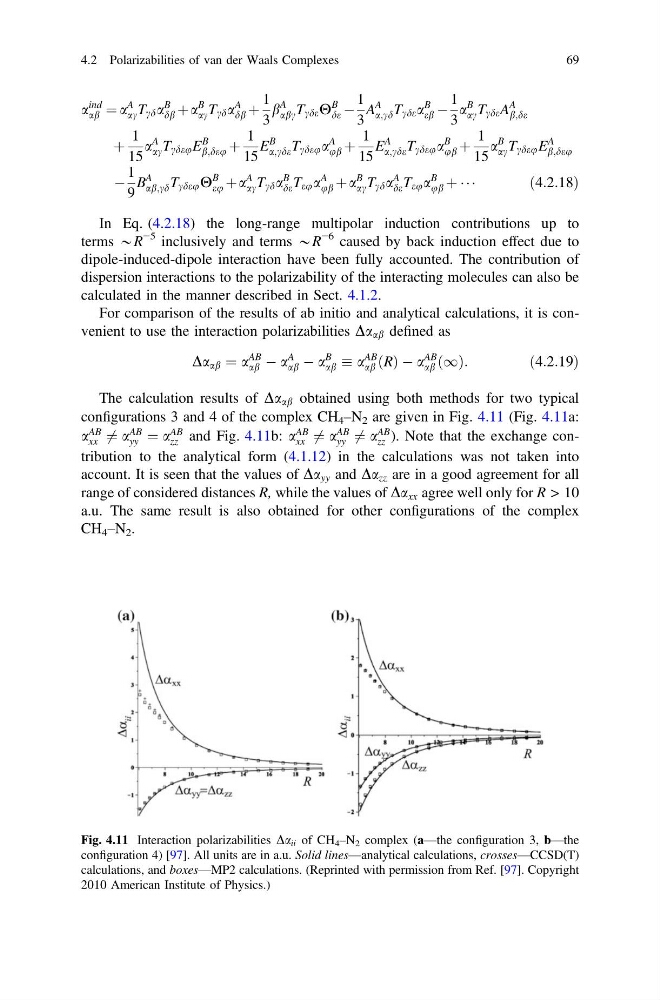
The calculation results of Da ab obtained using both methods for two typical
configurations 3 and 4 of the complex CH 4 –N 2 are given in Fig. 4.11 (Fig. 4.11a:
a
AB
xx 6 ¼ a
AB
yy ¼ a
AB
zz and Fig. 4.11b: a
AB
xx 6 ¼ a
AB
yy 6 ¼ a
AB
zz ). Note that the exchange contribution to the analytical form (4.1.12) in the calculations was not taken into
account. It is seen that the values of Da yy and Da zz are in a good agreement for all
range of considered distances R, while the values of Da xx agree well only for R > 10
a.u. The same result is also obtained for other configurations of the complex
CH 4 –N 2 .
Fig. 4.11 Interaction polarizabilities Da ii of CH 4 –N 2 complex (a—the configuration 3, b—the
configuration 4) [97]. All units are in a.u. Solid lines—analytical calculations, crosses—CCSD(T)
calculations, and boxes—MP2 calculations. (Reprinted with permission from Ref. [97]. Copyright
2010 American Institute of Physics.)
4.2 Polarizabilities of van der Waals Complexes
69
ind
ab ¼ a
A
ac T cd a
B
db þ a
B
ac T cd a
A
db þ
1
3
b
A
abc T cde H
B
de À
1
3
A
A
a;cd T cde a
B
eb À
1
3
a
B
ac T cde A
A
b;de
þ
1
15
a
A
ac T cdeu E
B
b;deu þ
1
15
E
B
a;cde T cdeu a
A
ub þ
1
15
E
A
a;cde T cdeu a
B
ub þ
1
15
a
B
ac T cdeu E
A
b;deu
À
1
9
B
A
ab;cd T cdeu H
B
eu þ a
A
ac T cd a
B
de T eu a
A
ub þ a
B
ac T cd a
A
de T eu a
B
ub þ ÁÁÁ
ð4:2:18Þ
In Eq. (4.2.18) the long-range multipolar induction contributions up to
terms *R
−5 inclusively and terms *R
−6 caused by back induction effect due to
dipole-induced-dipole interaction have been fully accounted. The contribution of
dispersion interactions to the polarizability of the interacting molecules can also be
calculated in the manner described in Sect. 4.1.2.
For comparison of the results of ab initio and analytical calculations, it is convenient to use the interaction polarizabilities Da ab defined as
Da ab ¼ a
AB
ab À a
A
ab À a
B
ab a
AB
ab ðRÞ À a
AB
ab ð1Þ:
ð4:2:19Þ
The calculation results of Da ab obtained using both methods for two typical
configurations 3 and 4 of the complex CH 4 –N 2 are given in Fig. 4.11 (Fig. 4.11a:
a
AB
xx 6 ¼ a
AB
yy ¼ a
AB
zz and Fig. 4.11b: a
AB
xx 6 ¼ a
AB
yy 6 ¼ a
AB
zz ). Note that the exchange contribution to the analytical form (4.1.12) in the calculations was not taken into
account. It is seen that the values of Da yy and Da zz are in a good agreement for all
range of considered distances R, while the values of Da xx agree well only for R > 10
a.u. The same result is also obtained for other configurations of the complex
CH 4 –N 2 .
Fig. 4.11 Interaction polarizabilities Da ii of CH 4 –N 2 complex (a—the configuration 3, b—the
configuration 4) [97]. All units are in a.u. Solid lines—analytical calculations, crosses—CCSD(T)
calculations, and boxes—MP2 calculations. (Reprinted with permission from Ref. [97]. Copyright
2010 American Institute of Physics.)
4.2 Polarizabilities of van der Waals Complexes
69