

polarizability at low computational costs compared to the CCSD(T) level of theory.
Indeed, the polarizability components, for example, for the most stable configuration of the CH 4 –N 2 complex calculated at the MP2 and CCSD(T) levels of theory
with the aug-cc-pVTZ basis set differ of less than *1 %.
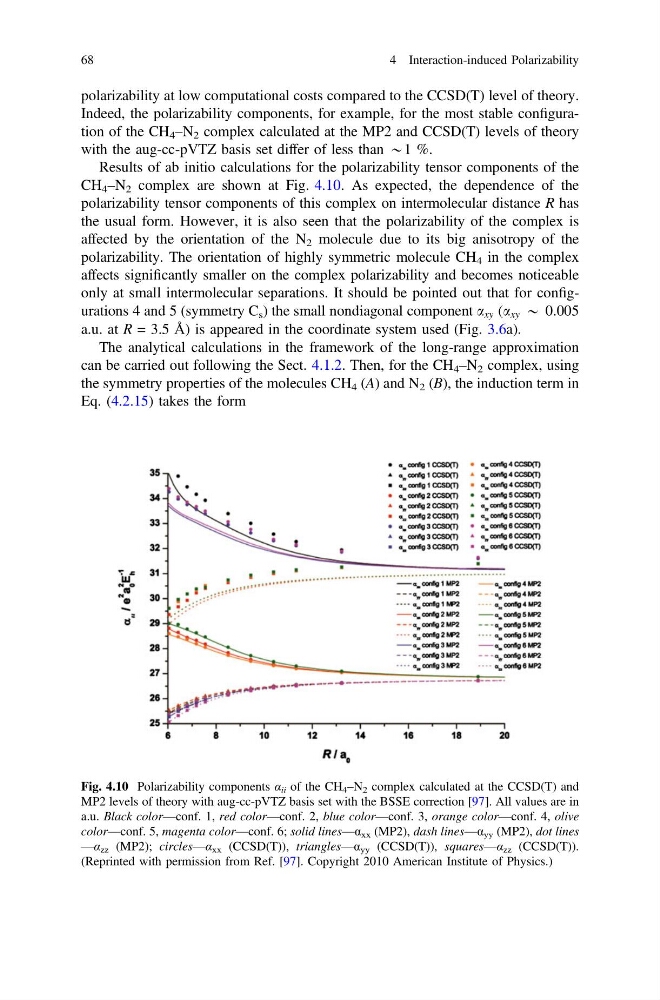
Results of ab initio calculations for the polarizability tensor components of the
CH 4 –N 2 complex are shown at Fig. 4.10. As expected, the dependence of the
polarizability tensor components of this complex on intermolecular distance R has
the usual form. However, it is also seen that the polarizability of the complex is
affected by the orientation of the N 2 molecule due to its big anisotropy of the
polarizability. The orientation of highly symmetric molecule CH 4 in the complex
affects significantly smaller on the complex polarizability and becomes noticeable
only at small intermolecular separations. It should be pointed out that for configurations 4 and 5 (symmetry C s ) the small nondiagonal component a xy (a xy * 0.005
a.u. at R = 3.5 Å) is appeared in the coordinate system used (Fig. 3.6a).
The analytical calculations in the framework of the long-range approximation
can be carried out following the Sect. 4.1.2. Then, for the CH 4 –N 2 complex, using
the symmetry properties of the molecules CH 4 (A) and N 2 (B), the induction term in
Eq. (4.2.15) takes the form
Fig. 4.10 Polarizability components α ii of the CH 4 –N 2 complex calculated at the CCSD(T) and
MP2 levels of theory with aug-cc-pVTZ basis set with the BSSE correction [97]. All values are in
a.u. Black color—conf. 1, red color—conf. 2, blue color—conf. 3, orange color—conf. 4, olive
color—conf. 5, magenta color—conf. 6; solid lines—α xx (MP2), dash lines—α yy (MP2), dot lines
—α zz (MP2); circles—α xx (CCSD(T)), triangles—α yy (CCSD(T)), squares—α zz (CCSD(T)).
(Reprinted with permission from Ref. [97]. Copyright 2010 American Institute of Physics.)
68
4 Interaction-induced Polarizability
Indeed, the polarizability components, for example, for the most stable configuration of the CH 4 –N 2 complex calculated at the MP2 and CCSD(T) levels of theory
with the aug-cc-pVTZ basis set differ of less than *1 %.
Results of ab initio calculations for the polarizability tensor components of the
CH 4 –N 2 complex are shown at Fig. 4.10. As expected, the dependence of the
polarizability tensor components of this complex on intermolecular distance R has
the usual form. However, it is also seen that the polarizability of the complex is
affected by the orientation of the N 2 molecule due to its big anisotropy of the
polarizability. The orientation of highly symmetric molecule CH 4 in the complex
affects significantly smaller on the complex polarizability and becomes noticeable
only at small intermolecular separations. It should be pointed out that for configurations 4 and 5 (symmetry C s ) the small nondiagonal component a xy (a xy * 0.005
a.u. at R = 3.5 Å) is appeared in the coordinate system used (Fig. 3.6a).
The analytical calculations in the framework of the long-range approximation
can be carried out following the Sect. 4.1.2. Then, for the CH 4 –N 2 complex, using
the symmetry properties of the molecules CH 4 (A) and N 2 (B), the induction term in
Eq. (4.2.15) takes the form
Fig. 4.10 Polarizability components α ii of the CH 4 –N 2 complex calculated at the CCSD(T) and
MP2 levels of theory with aug-cc-pVTZ basis set with the BSSE correction [97]. All values are in
a.u. Black color—conf. 1, red color—conf. 2, blue color—conf. 3, orange color—conf. 4, olive
color—conf. 5, magenta color—conf. 6; solid lines—α xx (MP2), dash lines—α yy (MP2), dot lines
—α zz (MP2); circles—α xx (CCSD(T)), triangles—α yy (CCSD(T)), squares—α zz (CCSD(T)).
(Reprinted with permission from Ref. [97]. Copyright 2010 American Institute of Physics.)
68
4 Interaction-induced Polarizability