

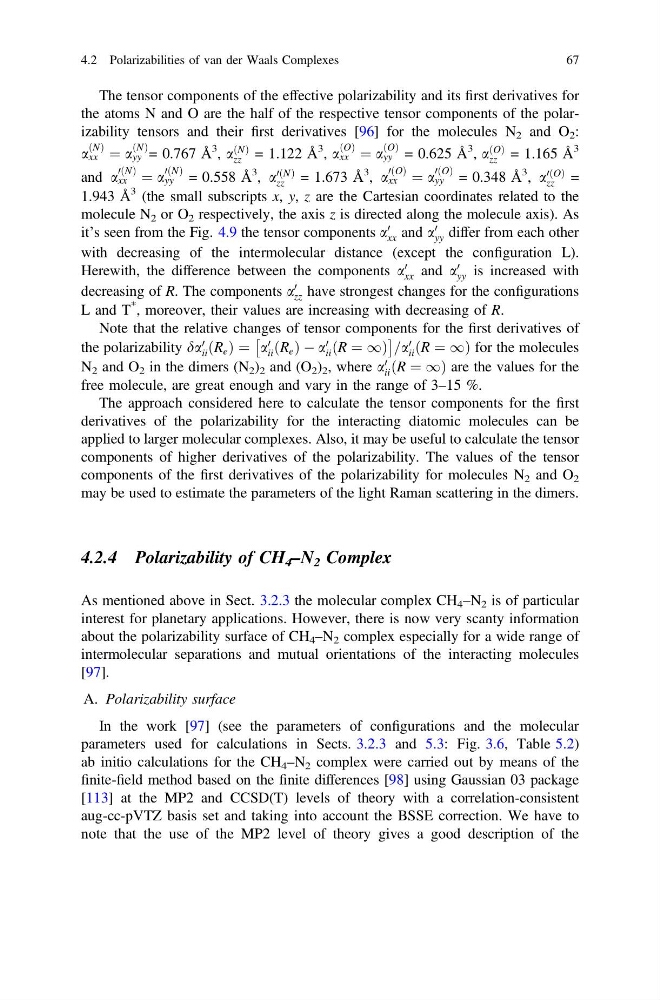
The tensor components of the effective polarizability and its first derivatives for
the atoms N and O are the half of the respective tensor components of the polarizability tensors and their first derivatives [96] for the molecules N 2 and O 2 :
a
ðNÞ
xx ¼ a
ðNÞ
yy = 0.767 Å
3 , a
ðNÞ
zz = 1.122 Å
3 , a
ðOÞ
xx ¼ a
ðOÞ
yy = 0.625 Å
3 , a
ðOÞ
zz = 1.165 Å
3
and a
0ðNÞ
xx ¼ a
0ðNÞ
yy = 0.558 Å
3 , a
0ðNÞ
zz
= 1.673 Å
3 , a
0ðOÞ
xx ¼ a
0ðOÞ
yy = 0.348 Å
3 , a
0ðOÞ
zz
=
1.943 Å
3 (the small subscripts x, y, z are the Cartesian coordinates related to the
molecule N 2 or O 2 respectively, the axis z is directed along the molecule axis). As
it’s seen from the Fig. 4.9 the tensor components a
0
xx and a
0
yy differ from each other
with decreasing of the intermolecular distance (except the configuration L).
Herewith, the difference between the components a
0
xx and a
0
yy is increased with
decreasing of R. The components a
0
zz have strongest changes for the configurations
L and T
* , moreover, their values are increasing with decreasing of R.
Note that the relative changes of tensor components for the first derivatives of
the polarizability da
0
ii ðR e Þ ¼ a
0
ii ðR e Þ À a
0
ii ðR ¼ 1Þ
Â
à =a
0
ii ðR ¼ 1Þ for the molecules
N 2 and O 2 in the dimers (N 2 ) 2 and (O 2 ) 2 , where a
0
ii ðR ¼ 1Þ are the values for the
free molecule, are great enough and vary in the range of 3–15 %.
The approach considered here to calculate the tensor components for the first
derivatives of the polarizability for the interacting diatomic molecules can be
applied to larger molecular complexes. Also, it may be useful to calculate the tensor
components of higher derivatives of the polarizability. The values of the tensor
components of the first derivatives of the polarizability for molecules N 2 and O 2
may be used to estimate the parameters of the light Raman scattering in the dimers.
4.2.4 Polarizability of CH 4 –N 2 Complex
As mentioned above in Sect. 3.2.3 the molecular complex CH 4 –N 2 is of particular
interest for planetary applications. However, there is now very scanty information
about the polarizability surface of CH 4 –N 2 complex especially for a wide range of
intermolecular separations and mutual orientations of the interacting molecules
[97].
A. Polarizability surface
In the work [97] (see the parameters of configurations and the molecular
parameters used for calculations in Sects. 3.2.3 and 5.3: Fig. 3.6, Table 5.2)
ab initio calculations for the CH 4 –N 2 complex were carried out by means of the
finite-field method based on the finite differences [98] using Gaussian 03 package
[113] at the MP2 and CCSD(T) levels of theory with a correlation-consistent
aug-cc-pVTZ basis set and taking into account the BSSE correction. We have to
note that the use of the MP2 level of theory gives a good description of the
4.2 Polarizabilities of van der Waals Complexes
67
the atoms N and O are the half of the respective tensor components of the polarizability tensors and their first derivatives [96] for the molecules N 2 and O 2 :
a
ðNÞ
xx ¼ a
ðNÞ
yy = 0.767 Å
3 , a
ðNÞ
zz = 1.122 Å
3 , a
ðOÞ
xx ¼ a
ðOÞ
yy = 0.625 Å
3 , a
ðOÞ
zz = 1.165 Å
3
and a
0ðNÞ
xx ¼ a
0ðNÞ
yy = 0.558 Å
3 , a
0ðNÞ
zz
= 1.673 Å
3 , a
0ðOÞ
xx ¼ a
0ðOÞ
yy = 0.348 Å
3 , a
0ðOÞ
zz
=
1.943 Å
3 (the small subscripts x, y, z are the Cartesian coordinates related to the
molecule N 2 or O 2 respectively, the axis z is directed along the molecule axis). As
it’s seen from the Fig. 4.9 the tensor components a
0
xx and a
0
yy differ from each other
with decreasing of the intermolecular distance (except the configuration L).
Herewith, the difference between the components a
0
xx and a
0
yy is increased with
decreasing of R. The components a
0
zz have strongest changes for the configurations
L and T
* , moreover, their values are increasing with decreasing of R.
Note that the relative changes of tensor components for the first derivatives of
the polarizability da
0
ii ðR e Þ ¼ a
0
ii ðR e Þ À a
0
ii ðR ¼ 1Þ
Â
à =a
0
ii ðR ¼ 1Þ for the molecules
N 2 and O 2 in the dimers (N 2 ) 2 and (O 2 ) 2 , where a
0
ii ðR ¼ 1Þ are the values for the
free molecule, are great enough and vary in the range of 3–15 %.
The approach considered here to calculate the tensor components for the first
derivatives of the polarizability for the interacting diatomic molecules can be
applied to larger molecular complexes. Also, it may be useful to calculate the tensor
components of higher derivatives of the polarizability. The values of the tensor
components of the first derivatives of the polarizability for molecules N 2 and O 2
may be used to estimate the parameters of the light Raman scattering in the dimers.
4.2.4 Polarizability of CH 4 –N 2 Complex
As mentioned above in Sect. 3.2.3 the molecular complex CH 4 –N 2 is of particular
interest for planetary applications. However, there is now very scanty information
about the polarizability surface of CH 4 –N 2 complex especially for a wide range of
intermolecular separations and mutual orientations of the interacting molecules
[97].
A. Polarizability surface
In the work [97] (see the parameters of configurations and the molecular
parameters used for calculations in Sects. 3.2.3 and 5.3: Fig. 3.6, Table 5.2)
ab initio calculations for the CH 4 –N 2 complex were carried out by means of the
finite-field method based on the finite differences [98] using Gaussian 03 package
[113] at the MP2 and CCSD(T) levels of theory with a correlation-consistent
aug-cc-pVTZ basis set and taking into account the BSSE correction. We have to
note that the use of the MP2 level of theory gives a good description of the
4.2 Polarizabilities of van der Waals Complexes
67