

induction terms a
A
a
B (*R
−3 ) gives the leading contribution to the interaction
anisotropy of the complex for R ≥ 10 a 0 while for R ≤ 10 a 0 the substantial contribution to Dc is caused by dispersion and induction terms of higher orders. As to
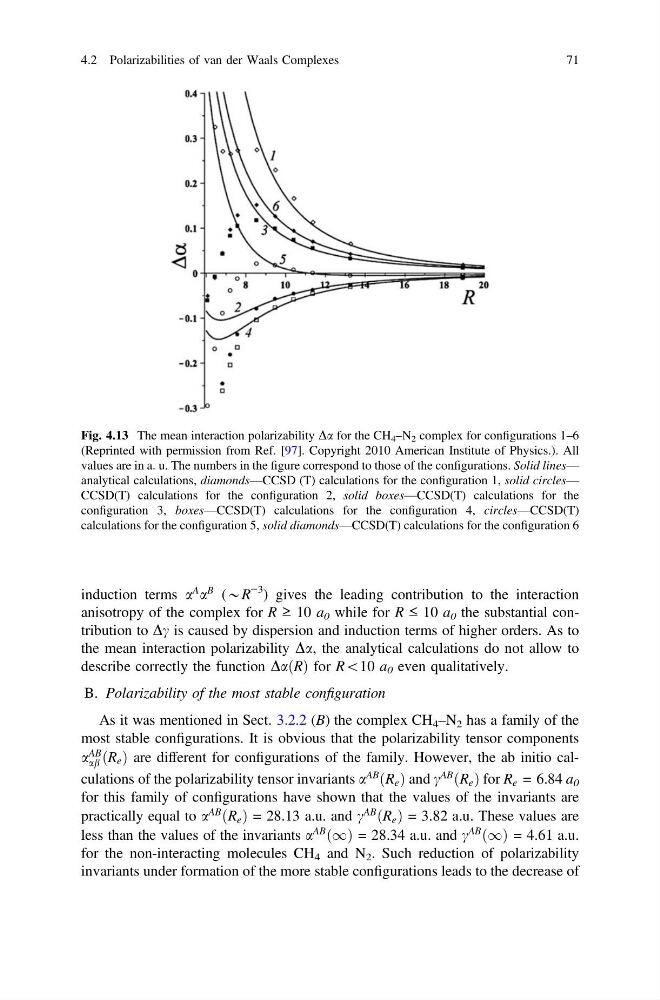
the mean interaction polarizability Da, the analytical calculations do not allow to
describe correctly the function DaðRÞ for R\10 a 0 even qualitatively.
B. Polarizability of the most stable configuration
As it was mentioned in Sect. 3.2.2 (B) the complex CH 4 –N 2 has a family of the
most stable configurations. It is obvious that the polarizability tensor components
a
AB
ab ðR e Þ are different for configurations of the family. However, the ab initio calculations of the polarizability tensor invariants a
AB
ðR e Þ and c
AB
ðR e Þ for R e = 6.84 a 0
for this family of configurations have shown that the values of the invariants are
practically equal to a
AB
ðR e Þ = 28.13 a.u. and c
AB
ðR e Þ = 3.82 a.u. These values are
less than the values of the invariants a
AB
ð1Þ = 28.34 a.u. and c
AB
ð1Þ = 4.61 a.u.
for the non-interacting molecules CH 4 and N 2 . Such reduction of polarizability
invariants under formation of the more stable configurations leads to the decrease of
Fig. 4.13 The mean interaction polarizability Da for the CH 4 –N 2 complex for configurations 1–6
(Reprinted with permission from Ref. [97]. Copyright 2010 American Institute of Physics.). All
values are in a. u. The numbers in the figure correspond to those of the configurations. Solid lines—
analytical calculations, diamonds—CCSD (T) calculations for the configuration 1, solid circles—
CCSD(T) calculations for the configuration 2, solid boxes—CCSD(T) calculations for the
configuration 3, boxes—CCSD(T) calculations for the configuration 4, circles—CCSD(T)
calculations for the configuration 5, solid diamonds—CCSD(T) calculations for the configuration 6
4.2 Polarizabilities of van der Waals Complexes
71
A
a
B (*R
−3 ) gives the leading contribution to the interaction
anisotropy of the complex for R ≥ 10 a 0 while for R ≤ 10 a 0 the substantial contribution to Dc is caused by dispersion and induction terms of higher orders. As to
the mean interaction polarizability Da, the analytical calculations do not allow to
describe correctly the function DaðRÞ for R\10 a 0 even qualitatively.
B. Polarizability of the most stable configuration
As it was mentioned in Sect. 3.2.2 (B) the complex CH 4 –N 2 has a family of the
most stable configurations. It is obvious that the polarizability tensor components
a
AB
ab ðR e Þ are different for configurations of the family. However, the ab initio calculations of the polarizability tensor invariants a
AB
ðR e Þ and c
AB
ðR e Þ for R e = 6.84 a 0
for this family of configurations have shown that the values of the invariants are
practically equal to a
AB
ðR e Þ = 28.13 a.u. and c
AB
ðR e Þ = 3.82 a.u. These values are
less than the values of the invariants a
AB
ð1Þ = 28.34 a.u. and c
AB
ð1Þ = 4.61 a.u.
for the non-interacting molecules CH 4 and N 2 . Such reduction of polarizability
invariants under formation of the more stable configurations leads to the decrease of
Fig. 4.13 The mean interaction polarizability Da for the CH 4 –N 2 complex for configurations 1–6
(Reprinted with permission from Ref. [97]. Copyright 2010 American Institute of Physics.). All
values are in a. u. The numbers in the figure correspond to those of the configurations. Solid lines—
analytical calculations, diamonds—CCSD (T) calculations for the configuration 1, solid circles—
CCSD(T) calculations for the configuration 2, solid boxes—CCSD(T) calculations for the
configuration 3, boxes—CCSD(T) calculations for the configuration 4, circles—CCSD(T)
calculations for the configuration 5, solid diamonds—CCSD(T) calculations for the configuration 6
4.2 Polarizabilities of van der Waals Complexes
71