

systems [48, 50, 54, 89–94] or NO dimer [95]. Consider below the less-studied
problem of influence of nuclear vibrations on the polarizability of such dimers.
A. Influence of nuclear vibrations on the (N 2 ) 2 and (O 2 ) 2 dimer polarizability
We are restricted here by the terms in (4.2.7) related to the modified DID model
discussed above. In the framework of this model for (N 2 ) 2 and (O 2 ) 2 complexes the
effective polarizability of the atoms N and O is determined as a half of the polarizability for the N 2 and O 2 molecules respectively. It’s evident, that the effective
polarizability of atoms N and O determined by such a way is anisotropic and
depends on the internuclear distance of the molecules, and, as a result, the polarizability of the complex is the function of the internuclear distances of the molecules forming it, which allows one to calculate the tensor of the polarizability
derivatives of the complex for different configurations.
The polarizability tensor of these free oriented interacting molecules depends on
the Euler angles h 1 ; h 2 ; u ¼ u 1 À u 2 for both molecules, the intermolecular distance R, and the internuclear distances in the molecules r 1 and r 2 . For considered
model the total induced dipole moment of atomic system is written as
l a ¼
X
m
l
m
a ¼ a ab E
0
b ;
ð4:2:14Þ
where l
m
a is the induced dipole moment of the atom m and the polarizability of the
complex included N atoms is
a ab ¼
X N
m¼1
a
m
ab þ
X N
m;n¼1
a
m
ad T
mn
dc a
n
cb þ
X N
m;n;k¼1
a
m
ad T
mn
dc a
n
ce T
nk
eq a
k
qb þ Á Á Á :
ð4:2:15Þ
The Euler angles determine the orientation of the first and the second molecules
relative to the coordinate system related to the molecular complex. In the case of
diatomic molecules each component of the polarizability tensor of two interacting
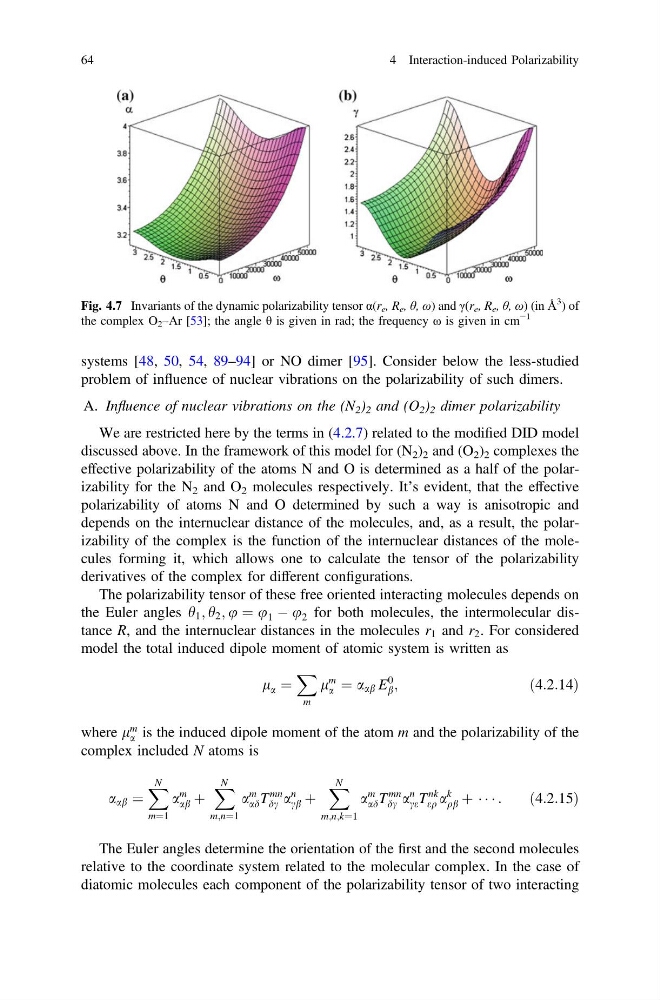
Fig. 4.7 Invariants of the dynamic polarizability tensor α(r e , R e , θ, ω) and γ(r e , R e , θ, ω) (in Å
3
) of
the complex O 2 –Ar [53]; the angle θ is given in rad; the frequency ω is given in cm
−1
64
4 Interaction-induced Polarizability
problem of influence of nuclear vibrations on the polarizability of such dimers.
A. Influence of nuclear vibrations on the (N 2 ) 2 and (O 2 ) 2 dimer polarizability
We are restricted here by the terms in (4.2.7) related to the modified DID model
discussed above. In the framework of this model for (N 2 ) 2 and (O 2 ) 2 complexes the
effective polarizability of the atoms N and O is determined as a half of the polarizability for the N 2 and O 2 molecules respectively. It’s evident, that the effective
polarizability of atoms N and O determined by such a way is anisotropic and
depends on the internuclear distance of the molecules, and, as a result, the polarizability of the complex is the function of the internuclear distances of the molecules forming it, which allows one to calculate the tensor of the polarizability
derivatives of the complex for different configurations.
The polarizability tensor of these free oriented interacting molecules depends on
the Euler angles h 1 ; h 2 ; u ¼ u 1 À u 2 for both molecules, the intermolecular distance R, and the internuclear distances in the molecules r 1 and r 2 . For considered
model the total induced dipole moment of atomic system is written as
l a ¼
X
m
l
m
a ¼ a ab E
0
b ;
ð4:2:14Þ
where l
m
a is the induced dipole moment of the atom m and the polarizability of the
complex included N atoms is
a ab ¼
X N
m¼1
a
m
ab þ
X N
m;n¼1
a
m
ad T
mn
dc a
n
cb þ
X N
m;n;k¼1
a
m
ad T
mn
dc a
n
ce T
nk
eq a
k
qb þ Á Á Á :
ð4:2:15Þ
The Euler angles determine the orientation of the first and the second molecules
relative to the coordinate system related to the molecular complex. In the case of
diatomic molecules each component of the polarizability tensor of two interacting
Fig. 4.7 Invariants of the dynamic polarizability tensor α(r e , R e , θ, ω) and γ(r e , R e , θ, ω) (in Å
3
) of
the complex O 2 –Ar [53]; the angle θ is given in rad; the frequency ω is given in cm
−1
64
4 Interaction-induced Polarizability