

diatomic molecules is a surface in the space of the variables h 1 ; h 2 ; u; r 1 ; r 2 (Z-axis
is directed through the centers of mass of interacting molecules). The analytical
description of this surface is cumbersome in the general case. For the specific
configurations of the interacting molecules the components of the polarizability
tensor depend on R only and may be represented as
a ij ðr 1 ; r 2 ; RÞ ¼ c
ð0Þ
ij ðr 1 ; r 2 Þ þ
c
ð3Þ
ij ðr 1 ; r 2 Þ
R 3
þ
c
ð5Þ
ij ðr 1 ; r 2 Þ
R 5
þ
c
ð6Þ
ij ðr 1 ; r 2 Þ
R 6
þ
c
ð7Þ
ij ðr 1 ; r 2 Þ
R 7
þ
c
ð8Þ
ij ðr 1 ; r 2 Þ
R 8
þ Á Á Á ;
ð4:2:16Þ
where the coefficients c
ðkÞ
ij ðr 1 ; r 2 Þ depend on the relative orientation of the interacting molecules and their intramolecular distances r 1 and r 2 . Expanding the
function a ij ðr 1 ; r 2 ; RÞ into the Taylor series at the equilibrium points r
0
1 and r
0
2 of the
first and the second molecules, the following expression for the tensor of the first
derivatives of polarizability a
0
ij ðRÞ ¼ @a ij ðr 1 ; r 2 ; RÞ=@n
Â
Ã
r 1 ¼r 0
1
;r 2 ¼r 0
2
for the complex
may be written as
a
0
ij ðRÞ ¼ d
ð0Þ
ij þ
d
ð3Þ
ij
R 3 þ
d
ð5Þ
ij
R 5 þ
d
ð6Þ
ij
R 6 þ
d
ð7Þ
ij
R 7 þ
d
ð8Þ
ij
R 8 þ Á Á Á ;
ð4:2:17Þ
where d
ðkÞ
ij ¼ @c
ðkÞ
ij ðr 1 ; r 2 Þ=@n
h
i
r 1 ¼r 0
1
;r 2 ¼r 0
2
and n ¼ r À r
0
ð
Þ=r
0 .
The results of calculations of the tensor components for the first derivatives of
the polarizability for the N 2 and O 2 molecules, being on the left side in configurations H, X, T, T
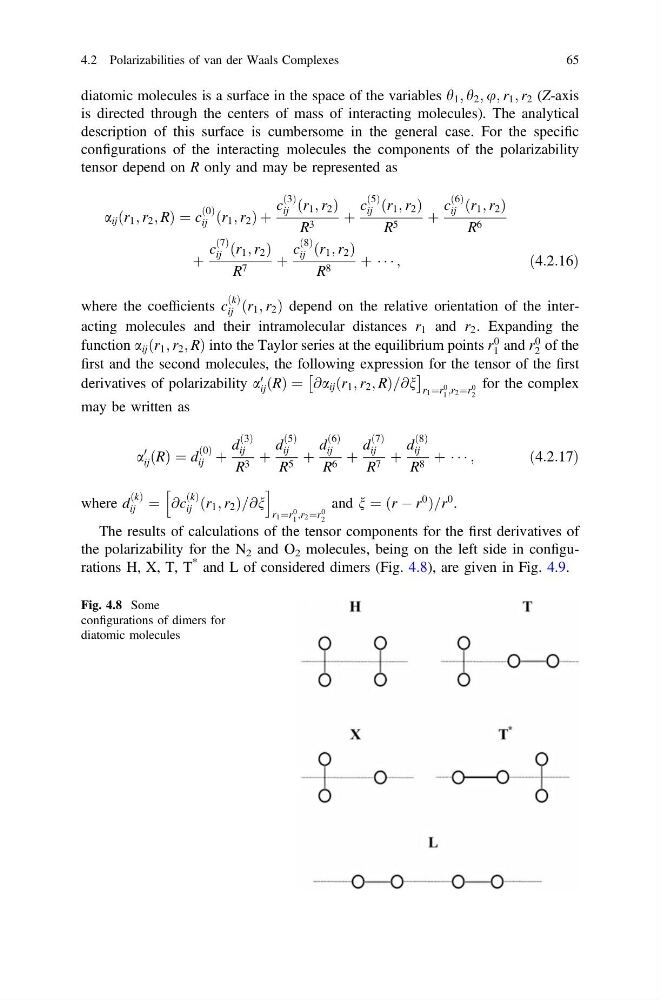
* and L of considered dimers (Fig. 4.8), are given in Fig. 4.9.
Fig. 4.8 Some
configurations of dimers for
diatomic molecules
4.2 Polarizabilities of van der Waals Complexes
65
is directed through the centers of mass of interacting molecules). The analytical
description of this surface is cumbersome in the general case. For the specific
configurations of the interacting molecules the components of the polarizability
tensor depend on R only and may be represented as
a ij ðr 1 ; r 2 ; RÞ ¼ c
ð0Þ
ij ðr 1 ; r 2 Þ þ
c
ð3Þ
ij ðr 1 ; r 2 Þ
R 3
þ
c
ð5Þ
ij ðr 1 ; r 2 Þ
R 5
þ
c
ð6Þ
ij ðr 1 ; r 2 Þ
R 6
þ
c
ð7Þ
ij ðr 1 ; r 2 Þ
R 7
þ
c
ð8Þ
ij ðr 1 ; r 2 Þ
R 8
þ Á Á Á ;
ð4:2:16Þ
where the coefficients c
ðkÞ
ij ðr 1 ; r 2 Þ depend on the relative orientation of the interacting molecules and their intramolecular distances r 1 and r 2 . Expanding the
function a ij ðr 1 ; r 2 ; RÞ into the Taylor series at the equilibrium points r
0
1 and r
0
2 of the
first and the second molecules, the following expression for the tensor of the first
derivatives of polarizability a
0
ij ðRÞ ¼ @a ij ðr 1 ; r 2 ; RÞ=@n
Â
Ã
r 1 ¼r 0
1
;r 2 ¼r 0
2
for the complex
may be written as
a
0
ij ðRÞ ¼ d
ð0Þ
ij þ
d
ð3Þ
ij
R 3 þ
d
ð5Þ
ij
R 5 þ
d
ð6Þ
ij
R 6 þ
d
ð7Þ
ij
R 7 þ
d
ð8Þ
ij
R 8 þ Á Á Á ;
ð4:2:17Þ
where d
ðkÞ
ij ¼ @c
ðkÞ
ij ðr 1 ; r 2 Þ=@n
h
i
r 1 ¼r 0
1
;r 2 ¼r 0
2
and n ¼ r À r
0
ð
Þ=r
0 .
The results of calculations of the tensor components for the first derivatives of
the polarizability for the N 2 and O 2 molecules, being on the left side in configurations H, X, T, T
* and L of considered dimers (Fig. 4.8), are given in Fig. 4.9.
Fig. 4.8 Some
configurations of dimers for
diatomic molecules
4.2 Polarizabilities of van der Waals Complexes
65