

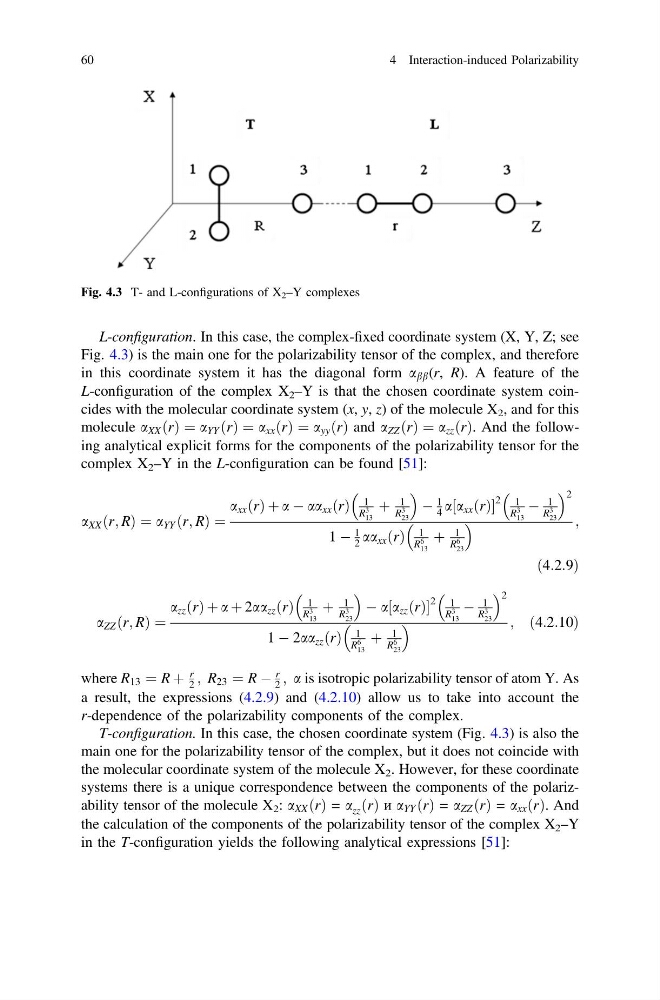
L-configuration. In this case, the complex-fixed coordinate system (X, Y, Z; see
Fig. 4.3) is the main one for the polarizability tensor of the complex, and therefore
in this coordinate system it has the diagonal form a bb (r, R). A feature of the
L-configuration of the complex X 2 –Y is that the chosen coordinate system coincides with the molecular coordinate system (x, y, z) of the molecule X 2 , and for this
molecule a XX ðrÞ ¼ a YY ðrÞ ¼ a xx ðrÞ ¼ a yy ðrÞ and a ZZ ðrÞ ¼ a zz ðrÞ. And the following analytical explicit forms for the components of the polarizability tensor for the
complex X 2 –Y in the L-configuration can be found [51]:
a XX r; R
ð Þ ¼ a YY r; R
ð Þ ¼
a xx ðrÞ þ a À aa xx ðrÞ
1
R
3
13
þ
1
R
3
23
À
1
4 a a xx r
ð Þ
½
2 1
R
3
13
À
1
R
3
23
2
1 À
1
2 aa xx ðrÞ
1
R
6
13
þ
1
R
6
23
;
ð4:2:9Þ
a ZZ r; R
ð Þ ¼
a zz ðrÞ þ a þ 2aa zz ðrÞ
1
R
3
13
þ
1
R
3
23
À a a zz ðrÞ
½
2 1
R
3
13
À
1
R
3
23
2
1 À 2aa zz ðrÞ
1
R
6
13
þ
1
R
6
23
; ð4:2:10Þ
where R 13 ¼ R þ
r
2 ; R 23 ¼ R À
r
2 ; a is isotropic polarizability tensor of atom Y. As
a result, the expressions (4.2.9) and (4.2.10) allow us to take into account the
r-dependence of the polarizability components of the complex.
T-configuration. In this case, the chosen coordinate system (Fig. 4.3) is also the
main one for the polarizability tensor of the complex, but it does not coincide with
the molecular coordinate system of the molecule X 2 . However, for these coordinate
systems there is a unique correspondence between the components of the polarizability tensor of the molecule X 2 : a XX ðrÞ = a zz ðrÞ и a YY ðrÞ = a ZZ ðrÞ = a xx ðrÞ. And
the calculation of the components of the polarizability tensor of the complex X 2 –Y
in the T-configuration yields the following analytical expressions [51]:
Fig. 4.3 T- and L-configurations of X 2 –Y complexes
60
4 Interaction-induced Polarizability
Fig. 4.3) is the main one for the polarizability tensor of the complex, and therefore
in this coordinate system it has the diagonal form a bb (r, R). A feature of the
L-configuration of the complex X 2 –Y is that the chosen coordinate system coincides with the molecular coordinate system (x, y, z) of the molecule X 2 , and for this
molecule a XX ðrÞ ¼ a YY ðrÞ ¼ a xx ðrÞ ¼ a yy ðrÞ and a ZZ ðrÞ ¼ a zz ðrÞ. And the following analytical explicit forms for the components of the polarizability tensor for the
complex X 2 –Y in the L-configuration can be found [51]:
a XX r; R
ð Þ ¼ a YY r; R
ð Þ ¼
a xx ðrÞ þ a À aa xx ðrÞ
1
R
3
13
þ
1
R
3
23
À
1
4 a a xx r
ð Þ
½
2 1
R
3
13
À
1
R
3
23
2
1 À
1
2 aa xx ðrÞ
1
R
6
13
þ
1
R
6
23
;
ð4:2:9Þ
a ZZ r; R
ð Þ ¼
a zz ðrÞ þ a þ 2aa zz ðrÞ
1
R
3
13
þ
1
R
3
23
À a a zz ðrÞ
½
2 1
R
3
13
À
1
R
3
23
2
1 À 2aa zz ðrÞ
1
R
6
13
þ
1
R
6
23
; ð4:2:10Þ
where R 13 ¼ R þ
r
2 ; R 23 ¼ R À
r
2 ; a is isotropic polarizability tensor of atom Y. As
a result, the expressions (4.2.9) and (4.2.10) allow us to take into account the
r-dependence of the polarizability components of the complex.
T-configuration. In this case, the chosen coordinate system (Fig. 4.3) is also the
main one for the polarizability tensor of the complex, but it does not coincide with
the molecular coordinate system of the molecule X 2 . However, for these coordinate
systems there is a unique correspondence between the components of the polarizability tensor of the molecule X 2 : a XX ðrÞ = a zz ðrÞ и a YY ðrÞ = a ZZ ðrÞ = a xx ðrÞ. And
the calculation of the components of the polarizability tensor of the complex X 2 –Y
in the T-configuration yields the following analytical expressions [51]:
Fig. 4.3 T- and L-configurations of X 2 –Y complexes
60
4 Interaction-induced Polarizability