

a XX r; R
ð Þ ¼
a zz r
ð Þ þ a þ 2aa zz r
ð Þ
r 2
2 ÀR
2
R 2 þ
r 2
4
ð
Þ
5=2 À
9
4 aa xx r
ð Þa zz r
ð Þ
r
2 R
2
R 2 þ
r 2
4
ð
Þ
5
1 À aa zz r
ð Þ
r 2
2 ÀR 2
ð
Þ
2
R 2 þ
r 2
4
ð
Þ
5 À
9
4 aa xx r
ð Þ
r 2 R 2
R 2 þ
r 2
4
ð
Þ
5
; ð4:2:11Þ
a YY r; R
ð Þ ¼
a xx r
ð Þ þ a À 2aa xx r
ð Þ
1
R 2 þ
r 2
4
ð
Þ
3=2
1 À aa xx r
ð Þ
1
R 2 þ
r 2
4
ð
Þ
3
;
ð4:2:12Þ
a ZZ ðr; RÞ ¼
a
M
xx ðrÞ þ a þ 2aa xx ðrÞ
2R
2 À
r 2
4
R 2 þ
r 2
4
ð
Þ
5=2 À
9
4 aa xx ðrÞa zz ðrÞ
r
2 R
2
R 2 þ
r 2
4
ð
Þ
5
1 À aa xx ðrÞ
2R 2 À
r 2
4
ð
Þ
2
R 2 þ
r 2
4
ð
Þ
5 À
9
4 aa zz ðrÞ
r 2 R 2
R 2 þ
r 2
4
ð
Þ
5
: ð4:2:13Þ
Thus, the polarizability of the stable configurations of the complex X 2 –Y is
determined by the polarizability tensor a aa ðrÞ of the molecule X 2 , dependent on its
internuclear separation r, the polarizability of the noble gas atom a, and the distance
R. Note that at r = 0 Eqs. (4.2.9)–(4.2.13) coincide with the corresponding equations for the components of the polarizability tensor of two interacting anisotropic
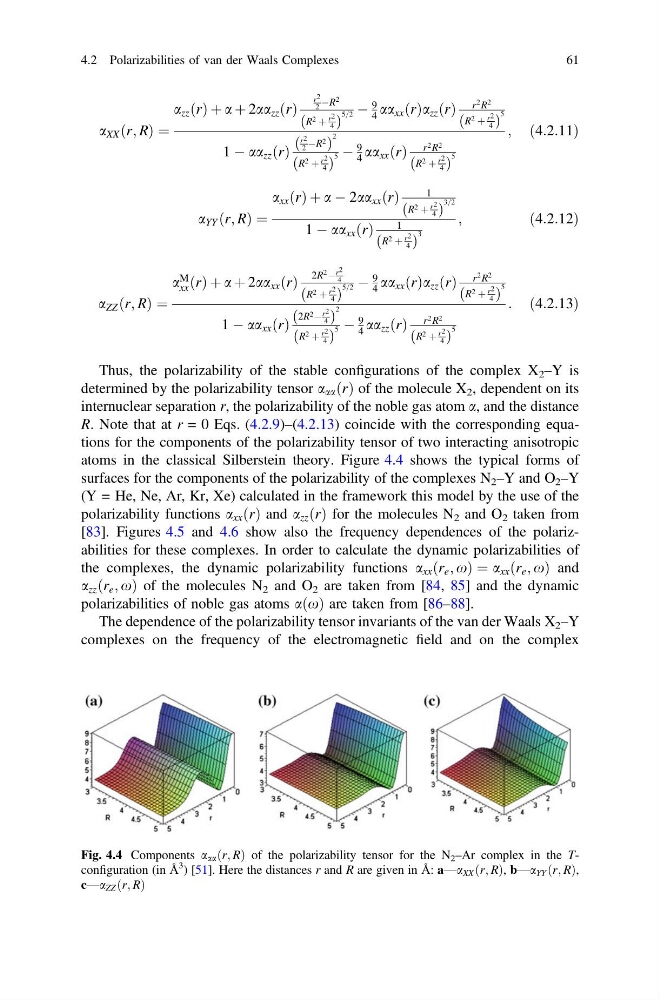
atoms in the classical Silberstein theory. Figure 4.4 shows the typical forms of
surfaces for the components of the polarizability of the complexes N 2 –Y and O 2 –Y
(Y = He, Ne, Ar, Kr, Xe) calculated in the framework this model by the use of the
polarizability functions a xx ðrÞ and a zz ðrÞ for the molecules N 2 and O 2 taken from
[83]. Figures 4.5 and 4.6 show also the frequency dependences of the polarizabilities for these complexes. In order to calculate the dynamic polarizabilities of
the complexes, the dynamic polarizability functions a xx ðr e ; xÞ ¼ a xx ðr e ; xÞ and
a zz ðr e ; xÞ of the molecules N 2 and O 2 are taken from [84, 85] and the dynamic
polarizabilities of noble gas atoms aðxÞ are taken from [86–88].
The dependence of the polarizability tensor invariants of the van der Waals X 2 –Y
complexes on the frequency of the electromagnetic field and on the complex
Fig. 4.4 Components a aa ðr; RÞ of the polarizability tensor for the N 2 –Ar complex in the Tconfiguration (in Å
3
) [51]. Here the distances r and R are given in Å: a—a XX r; R
ð Þ, b—a YY r; R
ð Þ,
c—a ZZ r; R
ð Þ
4.2 Polarizabilities of van der Waals Complexes
61
ð Þ ¼
a zz r
ð Þ þ a þ 2aa zz r
ð Þ
r 2
2 ÀR
2
R 2 þ
r 2
4
ð
Þ
5=2 À
9
4 aa xx r
ð Þa zz r
ð Þ
r
2 R
2
R 2 þ
r 2
4
ð
Þ
5
1 À aa zz r
ð Þ
r 2
2 ÀR 2
ð
Þ
2
R 2 þ
r 2
4
ð
Þ
5 À
9
4 aa xx r
ð Þ
r 2 R 2
R 2 þ
r 2
4
ð
Þ
5
; ð4:2:11Þ
a YY r; R
ð Þ ¼
a xx r
ð Þ þ a À 2aa xx r
ð Þ
1
R 2 þ
r 2
4
ð
Þ
3=2
1 À aa xx r
ð Þ
1
R 2 þ
r 2
4
ð
Þ
3
;
ð4:2:12Þ
a ZZ ðr; RÞ ¼
a
M
xx ðrÞ þ a þ 2aa xx ðrÞ
2R
2 À
r 2
4
R 2 þ
r 2
4
ð
Þ
5=2 À
9
4 aa xx ðrÞa zz ðrÞ
r
2 R
2
R 2 þ
r 2
4
ð
Þ
5
1 À aa xx ðrÞ
2R 2 À
r 2
4
ð
Þ
2
R 2 þ
r 2
4
ð
Þ
5 À
9
4 aa zz ðrÞ
r 2 R 2
R 2 þ
r 2
4
ð
Þ
5
: ð4:2:13Þ
Thus, the polarizability of the stable configurations of the complex X 2 –Y is
determined by the polarizability tensor a aa ðrÞ of the molecule X 2 , dependent on its
internuclear separation r, the polarizability of the noble gas atom a, and the distance
R. Note that at r = 0 Eqs. (4.2.9)–(4.2.13) coincide with the corresponding equations for the components of the polarizability tensor of two interacting anisotropic
atoms in the classical Silberstein theory. Figure 4.4 shows the typical forms of
surfaces for the components of the polarizability of the complexes N 2 –Y and O 2 –Y
(Y = He, Ne, Ar, Kr, Xe) calculated in the framework this model by the use of the
polarizability functions a xx ðrÞ and a zz ðrÞ for the molecules N 2 and O 2 taken from
[83]. Figures 4.5 and 4.6 show also the frequency dependences of the polarizabilities for these complexes. In order to calculate the dynamic polarizabilities of
the complexes, the dynamic polarizability functions a xx ðr e ; xÞ ¼ a xx ðr e ; xÞ and
a zz ðr e ; xÞ of the molecules N 2 and O 2 are taken from [84, 85] and the dynamic
polarizabilities of noble gas atoms aðxÞ are taken from [86–88].
The dependence of the polarizability tensor invariants of the van der Waals X 2 –Y
complexes on the frequency of the electromagnetic field and on the complex
Fig. 4.4 Components a aa ðr; RÞ of the polarizability tensor for the N 2 –Ar complex in the Tconfiguration (in Å
3
) [51]. Here the distances r and R are given in Å: a—a XX r; R
ð Þ, b—a YY r; R
ð Þ,
c—a ZZ r; R
ð Þ
4.2 Polarizabilities of van der Waals Complexes
61