

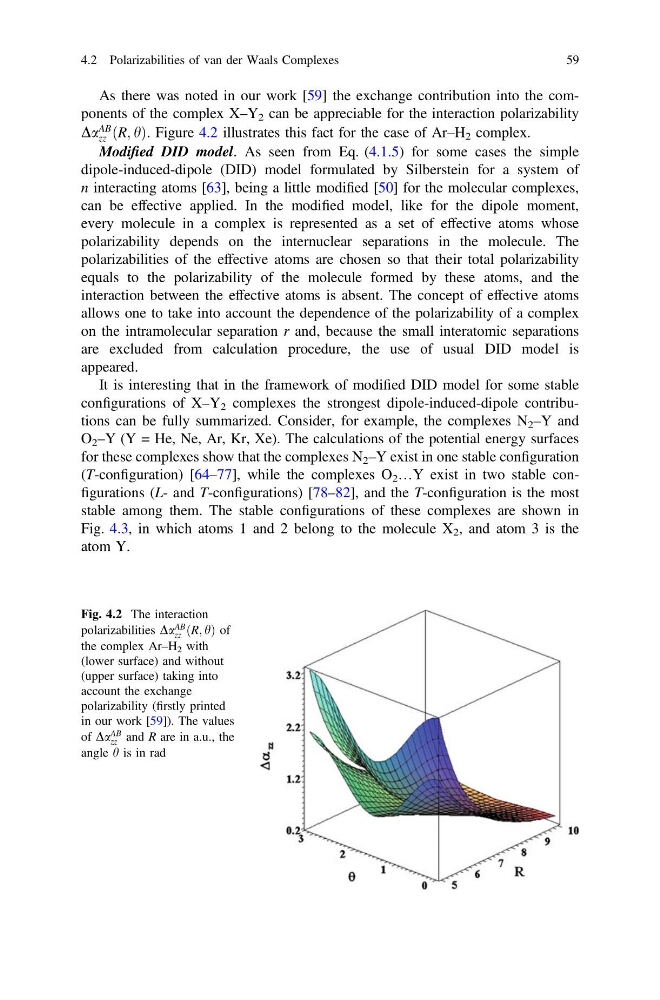
As there was noted in our work [59] the exchange contribution into the components of the complex X–Y 2 can be appreciable for the interaction polarizability
Da
AB
zz ðR; hÞ. Figure 4.2 illustrates this fact for the case of Ar–H 2 complex.
Modified DID model. As seen from Eq. (4.1.5) for some cases the simple
dipole-induced-dipole (DID) model formulated by Silberstein for a system of
n interacting atoms [63], being a little modified [50] for the molecular complexes,
can be effective applied. In the modified model, like for the dipole moment,
every molecule in a complex is represented as a set of effective atoms whose
polarizability depends on the internuclear separations in the molecule. The
polarizabilities of the effective atoms are chosen so that their total polarizability
equals to the polarizability of the molecule formed by these atoms, and the
interaction between the effective atoms is absent. The concept of effective atoms
allows one to take into account the dependence of the polarizability of a complex
on the intramolecular separation r and, because the small interatomic separations
are excluded from calculation procedure, the use of usual DID model is
appeared.
It is interesting that in the framework of modified DID model for some stable
configurations of X–Y 2 complexes the strongest dipole-induced-dipole contributions can be fully summarized. Consider, for example, the complexes N 2 –Y and
O 2 –Y (Y = He, Ne, Ar, Kr, Xe). The calculations of the potential energy surfaces
for these complexes show that the complexes N 2 –Y exist in one stable configuration
(T-configuration) [64–77], while the complexes O 2 …Y exist in two stable configurations (L- and T-configurations) [78–82], and the T-configuration is the most
stable among them. The stable configurations of these complexes are shown in
Fig. 4.3, in which atoms 1 and 2 belong to the molecule X 2 , and atom 3 is the
atom Y.
Fig. 4.2 The interaction
polarizabilities Da
AB
zz ðR; hÞ of
the complex Ar–H 2 with
(lower surface) and without
(upper surface) taking into
account the exchange
polarizability (firstly printed
in our work [59]). The values
of Da
AB
zz and R are in a.u., the
angle h is in rad
4.2 Polarizabilities of van der Waals Complexes
59
Da
AB
zz ðR; hÞ. Figure 4.2 illustrates this fact for the case of Ar–H 2 complex.
Modified DID model. As seen from Eq. (4.1.5) for some cases the simple
dipole-induced-dipole (DID) model formulated by Silberstein for a system of
n interacting atoms [63], being a little modified [50] for the molecular complexes,
can be effective applied. In the modified model, like for the dipole moment,
every molecule in a complex is represented as a set of effective atoms whose
polarizability depends on the internuclear separations in the molecule. The
polarizabilities of the effective atoms are chosen so that their total polarizability
equals to the polarizability of the molecule formed by these atoms, and the
interaction between the effective atoms is absent. The concept of effective atoms
allows one to take into account the dependence of the polarizability of a complex
on the intramolecular separation r and, because the small interatomic separations
are excluded from calculation procedure, the use of usual DID model is
appeared.
It is interesting that in the framework of modified DID model for some stable
configurations of X–Y 2 complexes the strongest dipole-induced-dipole contributions can be fully summarized. Consider, for example, the complexes N 2 –Y and
O 2 –Y (Y = He, Ne, Ar, Kr, Xe). The calculations of the potential energy surfaces
for these complexes show that the complexes N 2 –Y exist in one stable configuration
(T-configuration) [64–77], while the complexes O 2 …Y exist in two stable configurations (L- and T-configurations) [78–82], and the T-configuration is the most
stable among them. The stable configurations of these complexes are shown in
Fig. 4.3, in which atoms 1 and 2 belong to the molecule X 2 , and atom 3 is the
atom Y.
Fig. 4.2 The interaction
polarizabilities Da
AB
zz ðR; hÞ of
the complex Ar–H 2 with
(lower surface) and without
(upper surface) taking into
account the exchange
polarizability (firstly printed
in our work [59]). The values
of Da
AB
zz and R are in a.u., the
angle h is in rad
4.2 Polarizabilities of van der Waals Complexes
59