

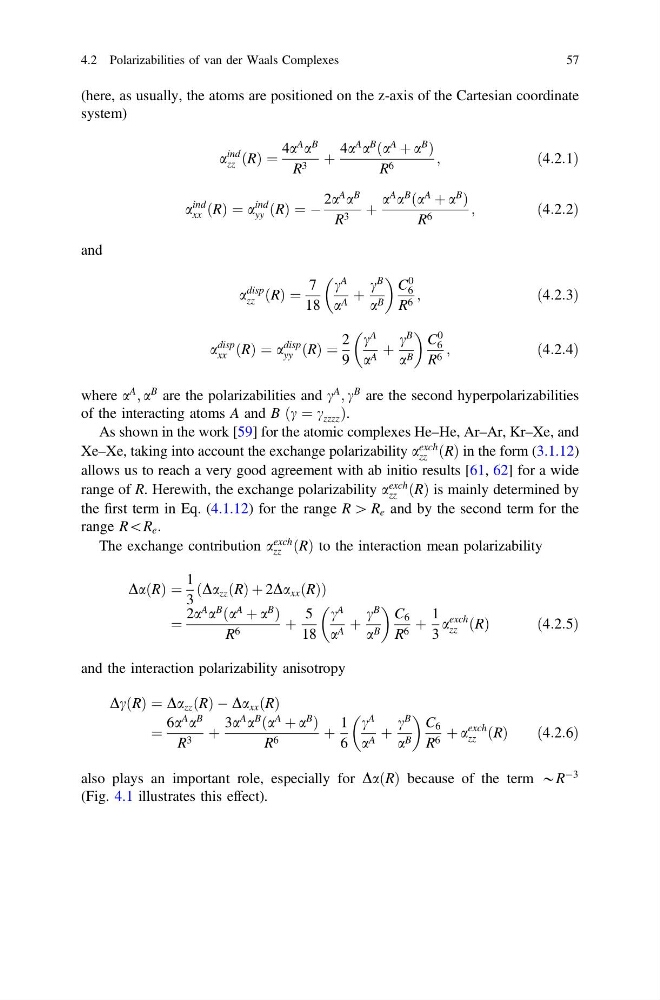
(here, as usually, the atoms are positioned on the z-axis of the Cartesian coordinate
system)
a
ind
zz ðRÞ ¼
4a
A
a
B
R 3 þ
4a
A
a
B
ða
A
þ a
B
Þ
R 6
;
ð4:2:1Þ
a
ind
xx ðRÞ ¼ a
ind
yy ðRÞ ¼ À
2a
A
a
B
R 3 þ
a
A
a
B
ða
A
þ a
B
Þ
R 6
;
ð4:2:2Þ
and
a
disp
zz ðRÞ ¼
7
18
c
A
a A þ
c
B
a B
C
0
6
R 6 ;
ð4:2:3Þ
a
disp
xx ðRÞ ¼ a
disp
yy ðRÞ ¼
2
9
c
A
a A þ
c
B
a B
C
0
6
R 6 ;
ð4:2:4Þ
where a
A
; a
B are the polarizabilities and c
A
; c
B are the second hyperpolarizabilities
of the interacting atoms A and B ðc ¼ c zzzz Þ.
As shown in the work [59] for the atomic complexes He–He, Ar–Ar, Kr–Xe, and
Xe–Xe, taking into account the exchange polarizability a
exch
zz ðRÞ in the form (3.1.12)
allows us to reach a very good agreement with ab initio results [61, 62] for a wide
range of R. Herewith, the exchange polarizability a
exch
zz ðRÞ is mainly determined by
the first term in Eq. (4.1.12) for the range R [ R e and by the second term for the
range R\R e .
The exchange contribution a
exch
zz ðRÞ to the interaction mean polarizability
DaðRÞ ¼
1
3
Da zz ðRÞ þ 2Da xx ðRÞ
ð
Þ
¼
2a
A
a
B
ða
A
þ a
B
Þ
R 6
þ
5
18
c
A
a A þ
c
B
a B
C 6
R 6 þ
1
3
a
exch
zz ðRÞ
ð 4:2:5Þ
and the interaction polarizability anisotropy
DcðRÞ ¼ Da zz ðRÞ À Da xx ðRÞ
¼
6a
A
a
B
R 3 þ
3a
A
a
B
ða
A
þ a
B
Þ
R 6
þ
1
6
c
A
a A þ
c
B
a B
C 6
R 6 þ a
exch
zz ðRÞ
ð4:2:6Þ
also plays an important role, especially for DaðRÞ because of the term *R
À3
(Fig. 4.1 illustrates this effect).
4.2 Polarizabilities of van der Waals Complexes
57
system)
a
ind
zz ðRÞ ¼
4a
A
a
B
R 3 þ
4a
A
a
B
ða
A
þ a
B
Þ
R 6
;
ð4:2:1Þ
a
ind
xx ðRÞ ¼ a
ind
yy ðRÞ ¼ À
2a
A
a
B
R 3 þ
a
A
a
B
ða
A
þ a
B
Þ
R 6
;
ð4:2:2Þ
and
a
disp
zz ðRÞ ¼
7
18
c
A
a A þ
c
B
a B
C
0
6
R 6 ;
ð4:2:3Þ
a
disp
xx ðRÞ ¼ a
disp
yy ðRÞ ¼
2
9
c
A
a A þ
c
B
a B
C
0
6
R 6 ;
ð4:2:4Þ
where a
A
; a
B are the polarizabilities and c
A
; c
B are the second hyperpolarizabilities
of the interacting atoms A and B ðc ¼ c zzzz Þ.
As shown in the work [59] for the atomic complexes He–He, Ar–Ar, Kr–Xe, and
Xe–Xe, taking into account the exchange polarizability a
exch
zz ðRÞ in the form (3.1.12)
allows us to reach a very good agreement with ab initio results [61, 62] for a wide
range of R. Herewith, the exchange polarizability a
exch
zz ðRÞ is mainly determined by
the first term in Eq. (4.1.12) for the range R [ R e and by the second term for the
range R\R e .
The exchange contribution a
exch
zz ðRÞ to the interaction mean polarizability
DaðRÞ ¼
1
3
Da zz ðRÞ þ 2Da xx ðRÞ
ð
Þ
¼
2a
A
a
B
ða
A
þ a
B
Þ
R 6
þ
5
18
c
A
a A þ
c
B
a B
C 6
R 6 þ
1
3
a
exch
zz ðRÞ
ð 4:2:5Þ
and the interaction polarizability anisotropy
DcðRÞ ¼ Da zz ðRÞ À Da xx ðRÞ
¼
6a
A
a
B
R 3 þ
3a
A
a
B
ða
A
þ a
B
Þ
R 6
þ
1
6
c
A
a A þ
c
B
a B
C 6
R 6 þ a
exch
zz ðRÞ
ð4:2:6Þ
also plays an important role, especially for DaðRÞ because of the term *R
À3
(Fig. 4.1 illustrates this effect).
4.2 Polarizabilities of van der Waals Complexes
57