

a
AB
ab ðRÞ ¼ 2
X
m6 ¼n
n
h jl a m
j i m
h jl b n
j i
E m À E n
ð4:1:9Þ
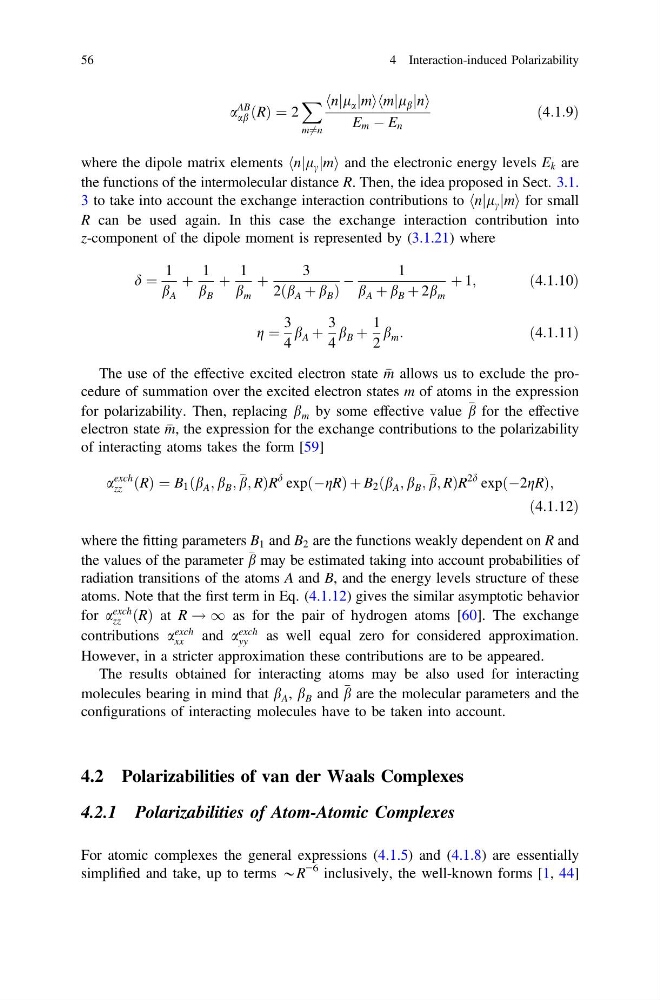
where the dipole matrix elements n
h jl c m
j i and the electronic energy levels E k are
the functions of the intermolecular distance R. Then, the idea proposed in Sect. 3.1.
3 to take into account the exchange interaction contributions to n
h jl c m
j i for small
R can be used again. In this case the exchange interaction contribution into
z-component of the dipole moment is represented by (3.1.21) where
d ¼
1
b A
þ
1
b B
þ
1
b m
þ
3
2 b A þ b B
ð
Þ
À
1
b A þ b B þ 2b m
þ 1;
ð4:1:10Þ
g ¼
3
4
b A þ
3
4
b B þ
1
2
b m :
ð4:1:11Þ
The use of the effective excited electron state
m allows us to exclude the procedure of summation over the excited electron states m of atoms in the expression
for polarizability. Then, replacing b m by some effective value
b for the effective
electron state
m, the expression for the exchange contributions to the polarizability
of interacting atoms takes the form [59]
a
exch
zz ðRÞ ¼ B 1 ðb A ; b B ;
b; RÞR
d expðÀgRÞ þ B 2 ðb A ; b B ;
b; RÞR
2d expðÀ2gRÞ;
ð4:1:12Þ
where the fitting parameters B 1 and B 2 are the functions weakly dependent on R and
the values of the parameter
b may be estimated taking into account probabilities of
radiation transitions of the atoms A and B, and the energy levels structure of these
atoms. Note that the first term in Eq. (4.1.12) gives the similar asymptotic behavior
for a
exch
zz ðRÞ at R ! 1 as for the pair of hydrogen atoms [60]. The exchange
contributions a
exch
xx
and a
exch
yy
as well equal zero for considered approximation.
However, in a stricter approximation these contributions are to be appeared.
The results obtained for interacting atoms may be also used for interacting
molecules bearing in mind that b A , b B and
b are the molecular parameters and the
configurations of interacting molecules have to be taken into account.
4.2 Polarizabilities of van der Waals Complexes
4.2.1 Polarizabilities of Atom-Atomic Complexes
For atomic complexes the general expressions (4.1.5) and (4.1.8) are essentially
simplified and take, up to terms *R
−6 inclusively, the well-known forms [1, 44]
56
4 Interaction-induced Polarizability
AB
ab ðRÞ ¼ 2
X
m6 ¼n
n
h jl a m
j i m
h jl b n
j i
E m À E n
ð4:1:9Þ
where the dipole matrix elements n
h jl c m
j i and the electronic energy levels E k are
the functions of the intermolecular distance R. Then, the idea proposed in Sect. 3.1.
3 to take into account the exchange interaction contributions to n
h jl c m
j i for small
R can be used again. In this case the exchange interaction contribution into
z-component of the dipole moment is represented by (3.1.21) where
d ¼
1
b A
þ
1
b B
þ
1
b m
þ
3
2 b A þ b B
ð
Þ
À
1
b A þ b B þ 2b m
þ 1;
ð4:1:10Þ
g ¼
3
4
b A þ
3
4
b B þ
1
2
b m :
ð4:1:11Þ
The use of the effective excited electron state
m allows us to exclude the procedure of summation over the excited electron states m of atoms in the expression
for polarizability. Then, replacing b m by some effective value
b for the effective
electron state
m, the expression for the exchange contributions to the polarizability
of interacting atoms takes the form [59]
a
exch
zz ðRÞ ¼ B 1 ðb A ; b B ;
b; RÞR
d expðÀgRÞ þ B 2 ðb A ; b B ;
b; RÞR
2d expðÀ2gRÞ;
ð4:1:12Þ
where the fitting parameters B 1 and B 2 are the functions weakly dependent on R and
the values of the parameter
b may be estimated taking into account probabilities of
radiation transitions of the atoms A and B, and the energy levels structure of these
atoms. Note that the first term in Eq. (4.1.12) gives the similar asymptotic behavior
for a
exch
zz ðRÞ at R ! 1 as for the pair of hydrogen atoms [60]. The exchange
contributions a
exch
xx
and a
exch
yy
as well equal zero for considered approximation.
However, in a stricter approximation these contributions are to be appeared.
The results obtained for interacting atoms may be also used for interacting
molecules bearing in mind that b A , b B and
b are the molecular parameters and the
configurations of interacting molecules have to be taken into account.
4.2 Polarizabilities of van der Waals Complexes
4.2.1 Polarizabilities of Atom-Atomic Complexes
For atomic complexes the general expressions (4.1.5) and (4.1.8) are essentially
simplified and take, up to terms *R
−6 inclusively, the well-known forms [1, 44]
56
4 Interaction-induced Polarizability