

a
disp;A
ab
¼
1
2p
Z 1
0
dx T cd c
A
deab ðix; 0; 0ÞT eg a
B
gc ðixÞ
h
i
:
ð4:1:7Þ
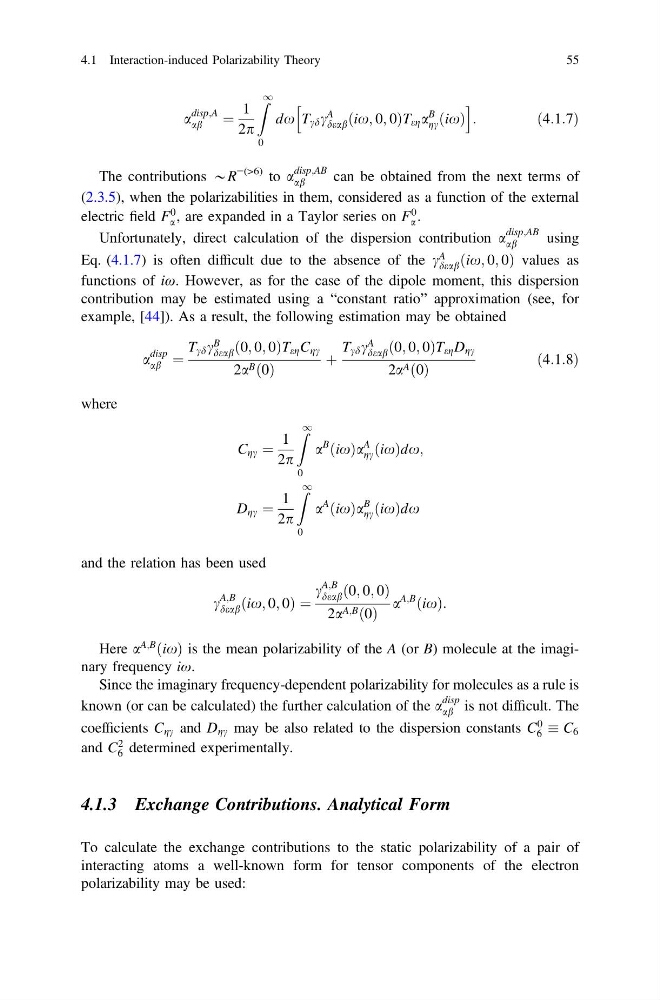
The contributions *R
−(>6) to a
disp;AB
ab
can be obtained from the next terms of
(2.3.5), when the polarizabilities in them, considered as a function of the external
electric field F
0
a , are expanded in a Taylor series on F
0
a .
Unfortunately, direct calculation of the dispersion contribution a
disp;AB
ab
using
Eq. (4.1.7) is often difficult due to the absence of the c
A
deab ðix; 0; 0Þ values as
functions of iω. However, as for the case of the dipole moment, this dispersion
contribution may be estimated using a “constant ratio” approximation (see, for
example, [44]). As a result, the following estimation may be obtained
a
disp
ab ¼
T cd c
B
deab ð0; 0; 0ÞT eg C gc
2a B ð0Þ
þ
T cd c
A
deab ð0; 0; 0ÞT eg D gc
2a A ð0Þ
ð4:1:8Þ
where
C gc ¼
1
2p
Z 1
0
a
B
ðixÞa
A
gc ðixÞdx;
D gc ¼
1
2p
Z 1
0
a
A
ðixÞa
B
gc ðixÞdx
and the relation has been used
c
A;B
deab ðix; 0; 0Þ ¼
c
A;B
deab ð0; 0; 0Þ
2a A;B ð0Þ
a
A;B
ðixÞ:
Here a
A;B
ðixÞ is the mean polarizability of the A (or B) molecule at the imaginary frequency iω.
Since the imaginary frequency-dependent polarizability for molecules as a rule is
known (or can be calculated) the further calculation of the a
disp
ab is not difficult. The
coefficients C gc and D gc may be also related to the dispersion constants C
0
6 C 6
and C
2
6 determined experimentally.
4.1.3 Exchange Contributions. Analytical Form
To calculate the exchange contributions to the static polarizability of a pair of
interacting atoms a well-known form for tensor components of the electron
polarizability may be used:
4.1 Interaction-induced Polarizability Theory
55
disp;A
ab
¼
1
2p
Z 1
0
dx T cd c
A
deab ðix; 0; 0ÞT eg a
B
gc ðixÞ
h
i
:
ð4:1:7Þ
The contributions *R
−(>6) to a
disp;AB
ab
can be obtained from the next terms of
(2.3.5), when the polarizabilities in them, considered as a function of the external
electric field F
0
a , are expanded in a Taylor series on F
0
a .
Unfortunately, direct calculation of the dispersion contribution a
disp;AB
ab
using
Eq. (4.1.7) is often difficult due to the absence of the c
A
deab ðix; 0; 0Þ values as
functions of iω. However, as for the case of the dipole moment, this dispersion
contribution may be estimated using a “constant ratio” approximation (see, for
example, [44]). As a result, the following estimation may be obtained
a
disp
ab ¼
T cd c
B
deab ð0; 0; 0ÞT eg C gc
2a B ð0Þ
þ
T cd c
A
deab ð0; 0; 0ÞT eg D gc
2a A ð0Þ
ð4:1:8Þ
where
C gc ¼
1
2p
Z 1
0
a
B
ðixÞa
A
gc ðixÞdx;
D gc ¼
1
2p
Z 1
0
a
A
ðixÞa
B
gc ðixÞdx
and the relation has been used
c
A;B
deab ðix; 0; 0Þ ¼
c
A;B
deab ð0; 0; 0Þ
2a A;B ð0Þ
a
A;B
ðixÞ:
Here a
A;B
ðixÞ is the mean polarizability of the A (or B) molecule at the imaginary frequency iω.
Since the imaginary frequency-dependent polarizability for molecules as a rule is
known (or can be calculated) the further calculation of the a
disp
ab is not difficult. The
coefficients C gc and D gc may be also related to the dispersion constants C
0
6 C 6
and C
2
6 determined experimentally.
4.1.3 Exchange Contributions. Analytical Form
To calculate the exchange contributions to the static polarizability of a pair of
interacting atoms a well-known form for tensor components of the electron
polarizability may be used:
4.1 Interaction-induced Polarizability Theory
55