

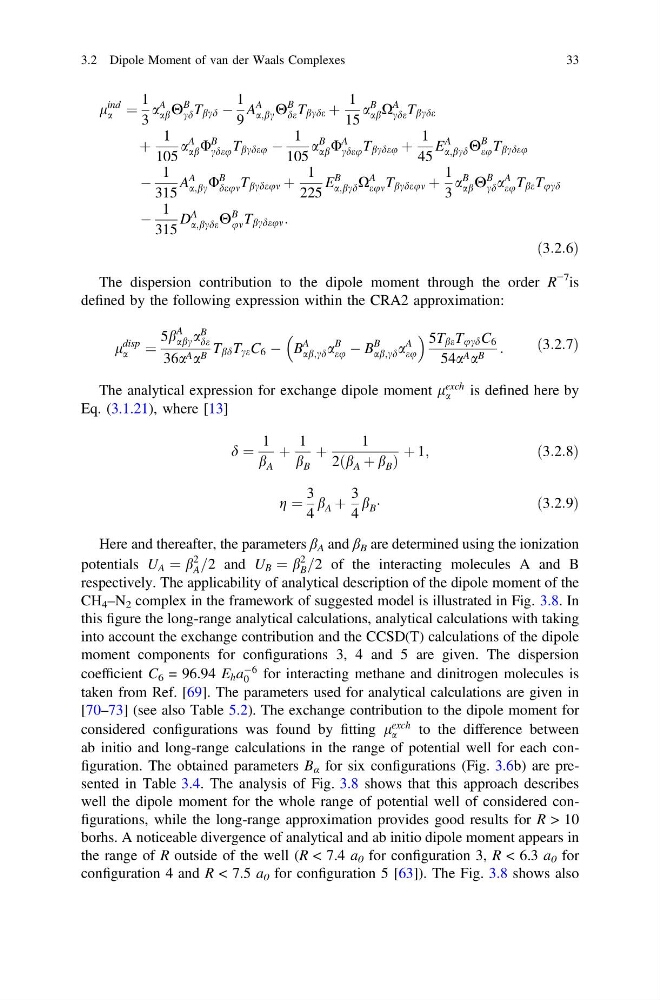
l
ind
a ¼
1
3
a
A
ab H
B
cd T bcd À
1
9
A
A
a;bc H
B
de T bcde þ
1
15
a
B
ab X
A
cde T bcde
þ
1
105
a
A
ab U
B
cdeu T bcdeu À
1
105
a
B
ab U
A
cdeu T bcdeu þ
1
45
E
A
a;bcd H
B
eu T bcdeu
À
1
315
A
A
a;bc U
B
deum T bcdeum þ
1
225
E
B
a;bcd X
A
eum T bcdeum þ
1
3
a
B
ab H
B
cd a
A
eu T be T ucd
À
1
315
D
A
a;bcde H
B
um T bcdeum :
ð3:2:6Þ
The dispersion contribution to the dipole moment through the order R
−7 is
defined by the following expression within the CRA2 approximation:
l
disp
a
¼
5b
A
abc a
B
de
36a A a B T bd T ce C 6 À B
A
ab;cd a
B
eu À B
B
ab;cd a
A
eu
5T be T ucd C 6
54a A a B :
ð3:2:7Þ
The analytical expression for exchange dipole moment l
exch
a
is defined here by
Eq. (3.1.21), where [13]
d ¼
1
b A
þ
1
b B
þ
1
2 b A þ b B
ð
Þ
þ 1;
ð3:2:8Þ
g ¼
3
4
b A þ
3
4
b B Á
ð 3:2:9Þ
Here and thereafter, the parameters β A and β B are determined using the ionization
potentials U A ¼ b
2
A =2 and U B ¼ b
2
B =2 of the interacting molecules A and B
respectively. The applicability of analytical description of the dipole moment of the
CH 4 –N 2 complex in the framework of suggested model is illustrated in Fig. 3.8. In
this figure the long-range analytical calculations, analytical calculations with taking
into account the exchange contribution and the CCSD(T) calculations of the dipole
moment components for configurations 3, 4 and 5 are given. The dispersion
coefficient C 6 = 96.94 E h a
À6
0 for interacting methane and dinitrogen molecules is
taken from Ref. [69]. The parameters used for analytical calculations are given in
[70–73] (see also Table 5.2). The exchange contribution to the dipole moment for
considered configurations was found by fitting l
exch
a
to the difference between
ab initio and long-range calculations in the range of potential well for each configuration. The obtained parameters B α for six configurations (Fig. 3.6b) are presented in Table 3.4. The analysis of Fig. 3.8 shows that this approach describes
well the dipole moment for the whole range of potential well of considered configurations, while the long-range approximation provides good results for R > 10
borhs. A noticeable divergence of analytical and ab initio dipole moment appears in
the range of R outside of the well (R < 7.4 a 0 for configuration 3, R < 6.3 a 0 for
configuration 4 and R < 7.5 a 0 for configuration 5 [63]). The Fig. 3.8 shows also
3.2 Dipole Moment of van der Waals Complexes
33
ind
a ¼
1
3
a
A
ab H
B
cd T bcd À
1
9
A
A
a;bc H
B
de T bcde þ
1
15
a
B
ab X
A
cde T bcde
þ
1
105
a
A
ab U
B
cdeu T bcdeu À
1
105
a
B
ab U
A
cdeu T bcdeu þ
1
45
E
A
a;bcd H
B
eu T bcdeu
À
1
315
A
A
a;bc U
B
deum T bcdeum þ
1
225
E
B
a;bcd X
A
eum T bcdeum þ
1
3
a
B
ab H
B
cd a
A
eu T be T ucd
À
1
315
D
A
a;bcde H
B
um T bcdeum :
ð3:2:6Þ
The dispersion contribution to the dipole moment through the order R
−7 is
defined by the following expression within the CRA2 approximation:
l
disp
a
¼
5b
A
abc a
B
de
36a A a B T bd T ce C 6 À B
A
ab;cd a
B
eu À B
B
ab;cd a
A
eu
5T be T ucd C 6
54a A a B :
ð3:2:7Þ
The analytical expression for exchange dipole moment l
exch
a
is defined here by
Eq. (3.1.21), where [13]
d ¼
1
b A
þ
1
b B
þ
1
2 b A þ b B
ð
Þ
þ 1;
ð3:2:8Þ
g ¼
3
4
b A þ
3
4
b B Á
ð 3:2:9Þ
Here and thereafter, the parameters β A and β B are determined using the ionization
potentials U A ¼ b
2
A =2 and U B ¼ b
2
B =2 of the interacting molecules A and B
respectively. The applicability of analytical description of the dipole moment of the
CH 4 –N 2 complex in the framework of suggested model is illustrated in Fig. 3.8. In
this figure the long-range analytical calculations, analytical calculations with taking
into account the exchange contribution and the CCSD(T) calculations of the dipole
moment components for configurations 3, 4 and 5 are given. The dispersion
coefficient C 6 = 96.94 E h a
À6
0 for interacting methane and dinitrogen molecules is
taken from Ref. [69]. The parameters used for analytical calculations are given in
[70–73] (see also Table 5.2). The exchange contribution to the dipole moment for
considered configurations was found by fitting l
exch
a
to the difference between
ab initio and long-range calculations in the range of potential well for each configuration. The obtained parameters B α for six configurations (Fig. 3.6b) are presented in Table 3.4. The analysis of Fig. 3.8 shows that this approach describes
well the dipole moment for the whole range of potential well of considered configurations, while the long-range approximation provides good results for R > 10
borhs. A noticeable divergence of analytical and ab initio dipole moment appears in
the range of R outside of the well (R < 7.4 a 0 for configuration 3, R < 6.3 a 0 for
configuration 4 and R < 7.5 a 0 for configuration 5 [63]). The Fig. 3.8 shows also
3.2 Dipole Moment of van der Waals Complexes
33