

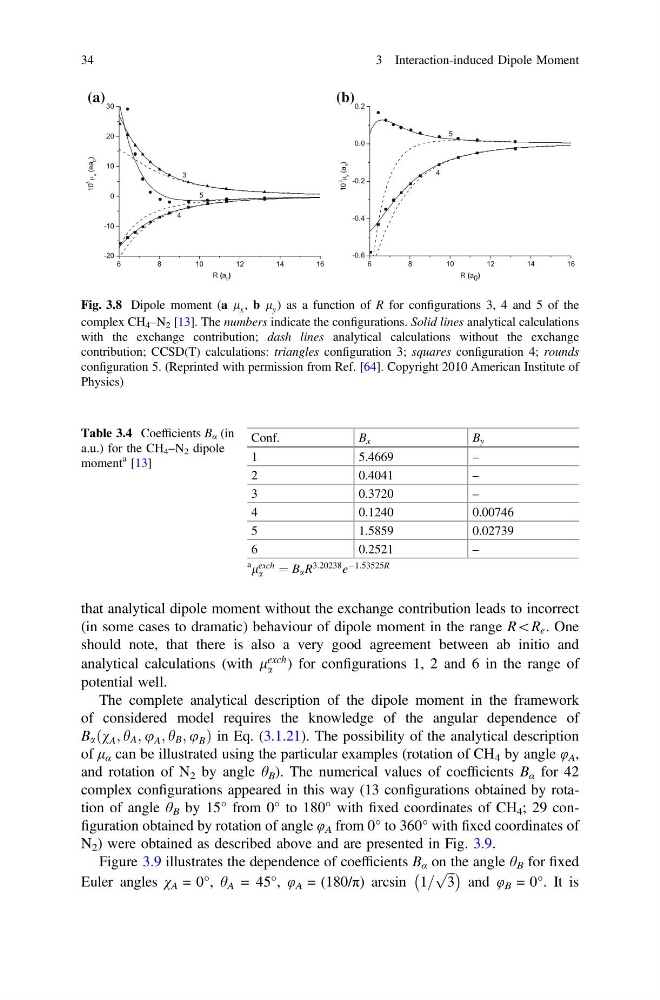
that analytical dipole moment without the exchange contribution leads to incorrect
(in some cases to dramatic) behaviour of dipole moment in the range R\R e . One
should note, that there is also a very good agreement between ab initio and
analytical calculations (with l
exch
a ) for configurations 1, 2 and 6 in the range of
potential well.
The complete analytical description of the dipole moment in the framework
of considered model requires the knowledge of the angular dependence of
B a v A ; h A ; u A ; h B ; u B
ð
Þ in Eq. (3.1.21). The possibility of the analytical description
of μ α can be illustrated using the particular examples (rotation of CH 4 by angle φ A ,
and rotation of N 2 by angle θ B ). The numerical values of coefficients B α for 42
complex configurations appeared in this way (13 configurations obtained by rotation of angle θ B by 15° from 0° to 180° with fixed coordinates of CH 4 ; 29 configuration obtained by rotation of angle φ A from 0° to 360° with fixed coordinates of
N 2 ) were obtained as described above and are presented in Fig. 3.9.
Figure 3.9 illustrates the dependence of coefficients B α on the angle θ B for fixed
Euler angles χ A = 0°, θ A = 45°, φ A = (180/π) arcsin 1=
ffiffi ffi
3
p
À
Á
and φ B = 0°. It is
6
8
1 0
1 2
1 4
1 6
-20
-10
0
10
20
30
10
3
x
(ea
0
)
R (a 0 )
4
5
3
6
8
1 0
1 2
1 4
1 6
-0.6
-0.4
-0.2
0.0
0.2
10
3
y
(a
0
)
R (a 0 )
4
5
° °
(b)
(a)
Fig. 3.8 Dipole moment (a l x , b l y ) as a function of R for configurations 3, 4 and 5 of the
complex CH 4 –N 2 [13]. The numbers indicate the configurations. Solid lines analytical calculations
with the exchange contribution; dash lines analytical calculations without the exchange
contribution; CCSD(T) calculations: triangles configuration 3; squares configuration 4; rounds
configuration 5. (Reprinted with permission from Ref. [64]. Copyright 2010 American Institute of
Physics)
Table 3.4 Coefficients B α (in
a.u.) for the CH 4 –N 2 dipole
moment
a [13]
Conf.
B x
B y
1
5.4669
–
2
0.4041
–
3
0.3720
–
4
0.1240
0.00746
5
1.5859
0.02739
6
0.2521
–
a l
exch
a
¼ B a R
3:20238 e
À1:53525R
34
3 Interaction-induced Dipole Moment
(in some cases to dramatic) behaviour of dipole moment in the range R\R e . One
should note, that there is also a very good agreement between ab initio and
analytical calculations (with l
exch
a ) for configurations 1, 2 and 6 in the range of
potential well.
The complete analytical description of the dipole moment in the framework
of considered model requires the knowledge of the angular dependence of
B a v A ; h A ; u A ; h B ; u B
ð
Þ in Eq. (3.1.21). The possibility of the analytical description
of μ α can be illustrated using the particular examples (rotation of CH 4 by angle φ A ,
and rotation of N 2 by angle θ B ). The numerical values of coefficients B α for 42
complex configurations appeared in this way (13 configurations obtained by rotation of angle θ B by 15° from 0° to 180° with fixed coordinates of CH 4 ; 29 configuration obtained by rotation of angle φ A from 0° to 360° with fixed coordinates of
N 2 ) were obtained as described above and are presented in Fig. 3.9.
Figure 3.9 illustrates the dependence of coefficients B α on the angle θ B for fixed
Euler angles χ A = 0°, θ A = 45°, φ A = (180/π) arcsin 1=
ffiffi ffi
3
p
À
Á
and φ B = 0°. It is
6
8
1 0
1 2
1 4
1 6
-20
-10
0
10
20
30
10
3
x
(ea
0
)
R (a 0 )
4
5
3
6
8
1 0
1 2
1 4
1 6
-0.6
-0.4
-0.2
0.0
0.2
10
3
y
(a
0
)
R (a 0 )
4
5
° °
(b)
(a)
Fig. 3.8 Dipole moment (a l x , b l y ) as a function of R for configurations 3, 4 and 5 of the
complex CH 4 –N 2 [13]. The numbers indicate the configurations. Solid lines analytical calculations
with the exchange contribution; dash lines analytical calculations without the exchange
contribution; CCSD(T) calculations: triangles configuration 3; squares configuration 4; rounds
configuration 5. (Reprinted with permission from Ref. [64]. Copyright 2010 American Institute of
Physics)
Table 3.4 Coefficients B α (in
a.u.) for the CH 4 –N 2 dipole
moment
a [13]
Conf.
B x
B y
1
5.4669
–
2
0.4041
–
3
0.3720
–
4
0.1240
0.00746
5
1.5859
0.02739
6
0.2521
–
a l
exch
a
¼ B a R
3:20238 e
À1:53525R
34
3 Interaction-induced Dipole Moment