

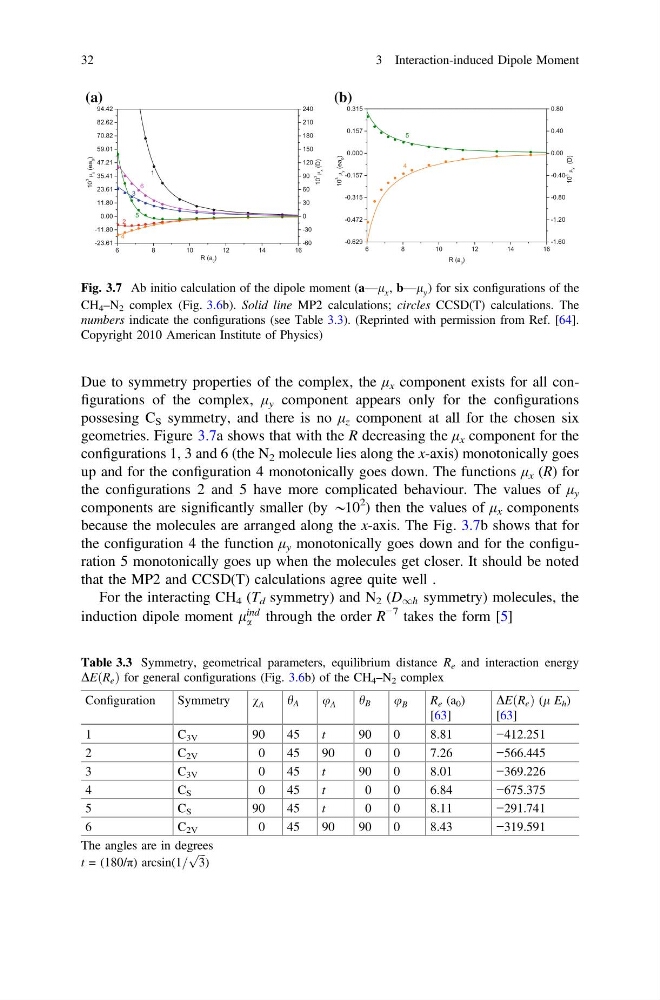
Due to symmetry properties of the complex, the μ x component exists for all configurations of the complex, μ y component appears only for the configurations
possesing C S symmetry, and there is no μ z component at all for the chosen six
geometries. Figure 3.7a shows that with the R decreasing the μ x component for the
configurations 1, 3 and 6 (the N 2 molecule lies along the x-axis) monotonically goes
up and for the configuration 4 monotonically goes down. The functions μ x (R) for
the configurations 2 and 5 have more complicated behaviour. The values of μ y
components are significantly smaller (by *10
2 ) then the values of μ x components
because the molecules are arranged along the x-axis. The Fig. 3.7b shows that for
the configuration 4 the function μ y monotonically goes down and for the configuration 5 monotonically goes up when the molecules get closer. It should be noted
that the MP2 and CCSD(T) calculations agree quite well .
For the interacting CH 4 (T d symmetry) and N 2 (D 1h symmetry) molecules, the
induction dipole moment l
ind
a through the order R
−7 takes the form [5]
6
8
10
12
14
16
-23.61
-11.80
0.00
11.80
23.61
35.41
47.21
59.01
70.82
82.62
94.42
-60
-30
0
30
60
90
120
150
180
210
240
10 3
x
(ea
0
)
10
3
x
(D)
R (a 0 )
1
6
3
5
2
4
6
8
10
12
14
16
-0.629
-0.472
-0.315
-0.157
0.000
0.157
0.315
-1.60
-1.20
-0.80
-0.40
0.00
0.40
0.80
10 3
y
(ea
0
)
10
3
y
(D)
R (a 0 )
5
4
(a)
(b)
Fig. 3.7 Ab initio calculation of the dipole moment (a—l x , b—l y ) for six configurations of the
CH 4 –N 2 complex (Fig. 3.6b). Solid line MP2 calculations; circles CCSD(T) calculations. The
numbers indicate the configurations (see Table 3.3). (Reprinted with permission from Ref. [64].
Copyright 2010 American Institute of Physics)
Table 3.3 Symmetry, geometrical parameters, equilibrium distance R e and interaction energy
DEðR e Þ for general configurations (Fig. 3.6b) of the CH 4 –N 2 complex
Configuration
Symmetry
v A
h A
u A
h B
u B
R e (a 0 )
[63]
DEðR e Þ (l E h )
[63]
1
C 3V
90
45
t
90
0
8.81
−412.251
2
C 2V
0
45
90
0
0
7.26
−566.445
3
C 3V
0
45
t
90
0
8.01
−369.226
4
C S
0
45
t
0
0
6.84
−675.375
5
C S
90
45
t
0
0
8.11
−291.741
6
C 2V
0
45
90
90
0
8.43
−319.591
The angles are in degrees
t = (180/π) arcsin(1=
ffiffi ffi
3
p
)
32
3 Interaction-induced Dipole Moment
possesing C S symmetry, and there is no μ z component at all for the chosen six
geometries. Figure 3.7a shows that with the R decreasing the μ x component for the
configurations 1, 3 and 6 (the N 2 molecule lies along the x-axis) monotonically goes
up and for the configuration 4 monotonically goes down. The functions μ x (R) for
the configurations 2 and 5 have more complicated behaviour. The values of μ y
components are significantly smaller (by *10
2 ) then the values of μ x components
because the molecules are arranged along the x-axis. The Fig. 3.7b shows that for
the configuration 4 the function μ y monotonically goes down and for the configuration 5 monotonically goes up when the molecules get closer. It should be noted
that the MP2 and CCSD(T) calculations agree quite well .
For the interacting CH 4 (T d symmetry) and N 2 (D 1h symmetry) molecules, the
induction dipole moment l
ind
a through the order R
−7 takes the form [5]
6
8
10
12
14
16
-23.61
-11.80
0.00
11.80
23.61
35.41
47.21
59.01
70.82
82.62
94.42
-60
-30
0
30
60
90
120
150
180
210
240
10 3
x
(ea
0
)
10
3
x
(D)
R (a 0 )
1
6
3
5
2
4
6
8
10
12
14
16
-0.629
-0.472
-0.315
-0.157
0.000
0.157
0.315
-1.60
-1.20
-0.80
-0.40
0.00
0.40
0.80
10 3
y
(ea
0
)
10
3
y
(D)
R (a 0 )
5
4
(a)
(b)
Fig. 3.7 Ab initio calculation of the dipole moment (a—l x , b—l y ) for six configurations of the
CH 4 –N 2 complex (Fig. 3.6b). Solid line MP2 calculations; circles CCSD(T) calculations. The
numbers indicate the configurations (see Table 3.3). (Reprinted with permission from Ref. [64].
Copyright 2010 American Institute of Physics)
Table 3.3 Symmetry, geometrical parameters, equilibrium distance R e and interaction energy
DEðR e Þ for general configurations (Fig. 3.6b) of the CH 4 –N 2 complex
Configuration
Symmetry
v A
h A
u A
h B
u B
R e (a 0 )
[63]
DEðR e Þ (l E h )
[63]
1
C 3V
90
45
t
90
0
8.81
−412.251
2
C 2V
0
45
90
0
0
7.26
−566.445
3
C 3V
0
45
t
90
0
8.01
−369.226
4
C S
0
45
t
0
0
6.84
−675.375
5
C S
90
45
t
0
0
8.11
−291.741
6
C 2V
0
45
90
90
0
8.43
−319.591
The angles are in degrees
t = (180/π) arcsin(1=
ffiffi ffi
3
p
)
32
3 Interaction-induced Dipole Moment