

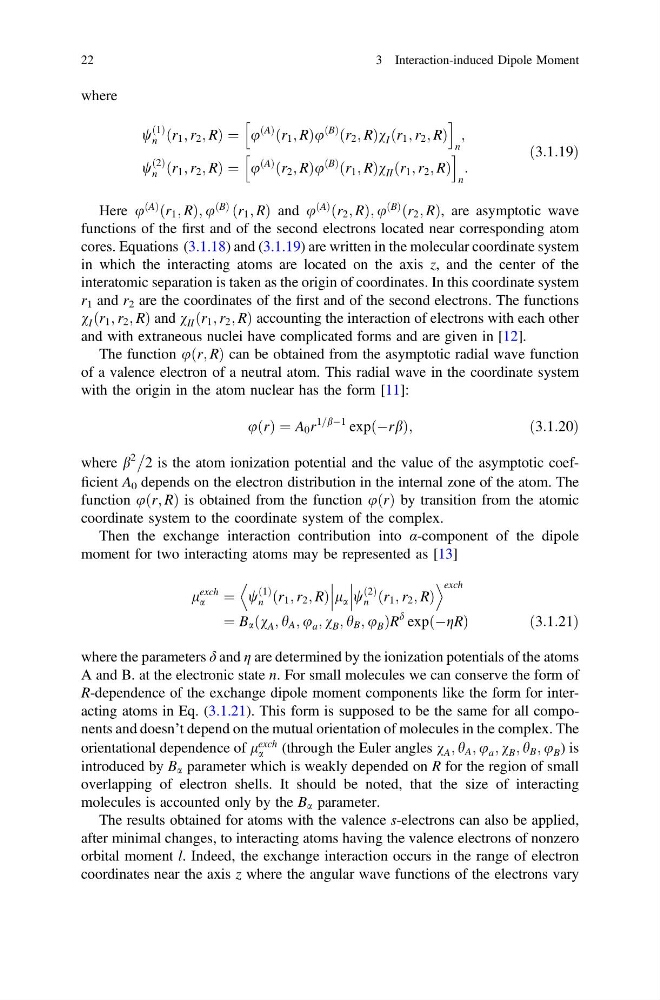
where
w
ð1Þ
n ðr 1 ; r 2 ; RÞ ¼ u
ðAÞ
ðr 1 ; RÞu
ðBÞ
ðr 2 ; RÞv I ðr 1 ; r 2 ; RÞ
h
i
n
;
w
ð2Þ
n ðr 1 ; r 2 ; RÞ ¼ u
ðAÞ
ðr 2 ; RÞu
ðBÞ
ðr 1 ; RÞv II ðr 1 ; r 2 ; RÞ
h
i
n
:
ð3:1:19Þ
Here u
ðAÞ
ðr 1 ; RÞ; u
ðBÞ
ðr 1 ; RÞ and u
ðAÞ
ðr 2 ; RÞ; u
ðBÞ
ðr 2 ; RÞ, are asymptotic wave
functions of the first and of the second electrons located near corresponding atom
cores. Equations (3.1.18) and (3.1.19) are written in the molecular coordinate system
in which the interacting atoms are located on the axis z, and the center of the
interatomic separation is taken as the origin of coordinates. In this coordinate system
r 1 and r 2 are the coordinates of the first and of the second electrons. The functions
v I ðr 1 ; r 2 ; RÞ and v II ðr 1 ; r 2 ; RÞ accounting the interaction of electrons with each other
and with extraneous nuclei have complicated forms and are given in [12].
The function uðr; RÞ can be obtained from the asymptotic radial wave function
of a valence electron of a neutral atom. This radial wave in the coordinate system
with the origin in the atom nuclear has the form [11]:
uðrÞ ¼ A 0 r
1=bÀ1 expðÀrbÞ;
ð3:1:20Þ
where b
2
2 is the atom ionization potential and the value of the asymptotic coefficient A 0 depends on the electron distribution in the internal zone of the atom. The
function uðr; RÞ is obtained from the function uðrÞ by transition from the atomic
coordinate system to the coordinate system of the complex.
Then the exchange interaction contribution into α-component of the dipole
moment for two interacting atoms may be represented as [13]
l
exch
a
¼ w
ð1Þ
n ðr 1 ; r 2 ; RÞ
D
l a w
ð2Þ
n ðr 1 ; r 2 ; RÞ
E exch
¼ B a ðv A ; h A ; u a ; v B ; h B ; u B ÞR
d expðÀgRÞ
ð 3:1:21Þ
where the parameters δ and η are determined by the ionization potentials of the atoms
A and B. at the electronic state n. For small molecules we can conserve the form of
R-dependence of the exchange dipole moment components like the form for interacting atoms in Eq. (3.1.21). This form is supposed to be the same for all components and doesn’t depend on the mutual orientation of molecules in the complex. The
orientational dependence of l
exch
a
(through the Euler angles v A ; h A ; u a ; v B ; h B ; u B ) is
introduced by B a parameter which is weakly depended on R for the region of small
overlapping of electron shells. It should be noted, that the size of interacting
molecules is accounted only by the B a parameter.
The results obtained for atoms with the valence s-electrons can also be applied,
after minimal changes, to interacting atoms having the valence electrons of nonzero
orbital moment l. Indeed, the exchange interaction occurs in the range of electron
coordinates near the axis z where the angular wave functions of the electrons vary
22
3 Interaction-induced Dipole Moment
w
ð1Þ
n ðr 1 ; r 2 ; RÞ ¼ u
ðAÞ
ðr 1 ; RÞu
ðBÞ
ðr 2 ; RÞv I ðr 1 ; r 2 ; RÞ
h
i
n
;
w
ð2Þ
n ðr 1 ; r 2 ; RÞ ¼ u
ðAÞ
ðr 2 ; RÞu
ðBÞ
ðr 1 ; RÞv II ðr 1 ; r 2 ; RÞ
h
i
n
:
ð3:1:19Þ
Here u
ðAÞ
ðr 1 ; RÞ; u
ðBÞ
ðr 1 ; RÞ and u
ðAÞ
ðr 2 ; RÞ; u
ðBÞ
ðr 2 ; RÞ, are asymptotic wave
functions of the first and of the second electrons located near corresponding atom
cores. Equations (3.1.18) and (3.1.19) are written in the molecular coordinate system
in which the interacting atoms are located on the axis z, and the center of the
interatomic separation is taken as the origin of coordinates. In this coordinate system
r 1 and r 2 are the coordinates of the first and of the second electrons. The functions
v I ðr 1 ; r 2 ; RÞ and v II ðr 1 ; r 2 ; RÞ accounting the interaction of electrons with each other
and with extraneous nuclei have complicated forms and are given in [12].
The function uðr; RÞ can be obtained from the asymptotic radial wave function
of a valence electron of a neutral atom. This radial wave in the coordinate system
with the origin in the atom nuclear has the form [11]:
uðrÞ ¼ A 0 r
1=bÀ1 expðÀrbÞ;
ð3:1:20Þ
where b
2
2 is the atom ionization potential and the value of the asymptotic coefficient A 0 depends on the electron distribution in the internal zone of the atom. The
function uðr; RÞ is obtained from the function uðrÞ by transition from the atomic
coordinate system to the coordinate system of the complex.
Then the exchange interaction contribution into α-component of the dipole
moment for two interacting atoms may be represented as [13]
l
exch
a
¼ w
ð1Þ
n ðr 1 ; r 2 ; RÞ
D
l a w
ð2Þ
n ðr 1 ; r 2 ; RÞ
E exch
¼ B a ðv A ; h A ; u a ; v B ; h B ; u B ÞR
d expðÀgRÞ
ð 3:1:21Þ
where the parameters δ and η are determined by the ionization potentials of the atoms
A and B. at the electronic state n. For small molecules we can conserve the form of
R-dependence of the exchange dipole moment components like the form for interacting atoms in Eq. (3.1.21). This form is supposed to be the same for all components and doesn’t depend on the mutual orientation of molecules in the complex. The
orientational dependence of l
exch
a
(through the Euler angles v A ; h A ; u a ; v B ; h B ; u B ) is
introduced by B a parameter which is weakly depended on R for the region of small
overlapping of electron shells. It should be noted, that the size of interacting
molecules is accounted only by the B a parameter.
The results obtained for atoms with the valence s-electrons can also be applied,
after minimal changes, to interacting atoms having the valence electrons of nonzero
orbital moment l. Indeed, the exchange interaction occurs in the range of electron
coordinates near the axis z where the angular wave functions of the electrons vary
22
3 Interaction-induced Dipole Moment