

I
A;B
ba
I aa
ffi
b
A;B
abc 0; 0; 0
ð
Þa
B;A
de 0
ð Þ
a A 0
ð Þa B 0
ð Þ
1 þ
2
3 D 1;2
1 þ D 1;2
!
;
ð3:1:16Þ
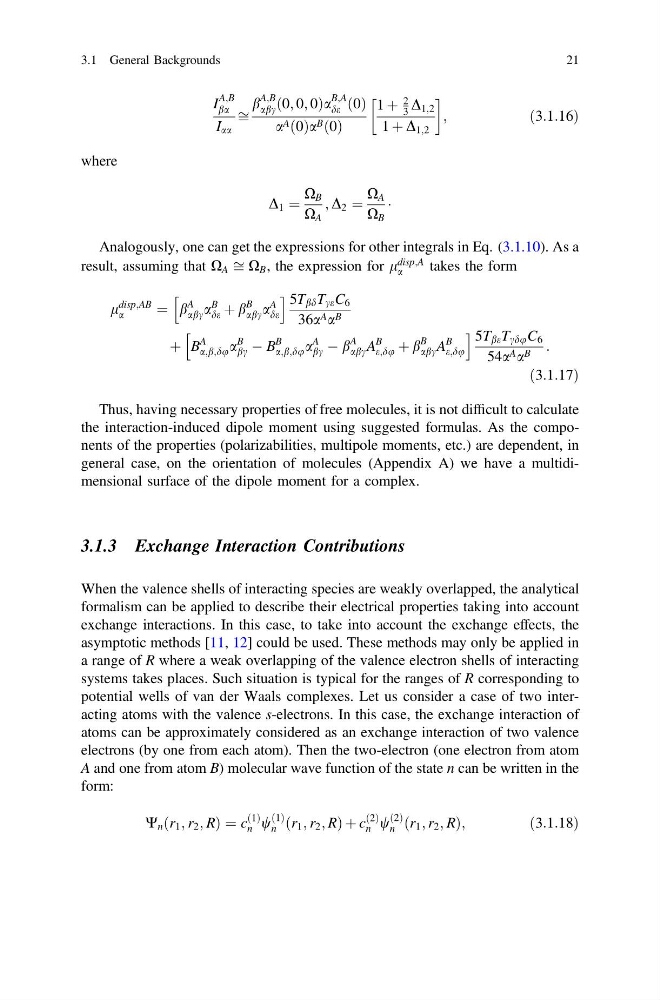
where
D 1 ¼
X B
X A
; D 2 ¼
X A
X B
Á
Analogously, one can get the expressions for other integrals in Eq. (3.1.10). As a
result, assuming that X A ffi X B , the expression for l
disp;A
a
takes the form
l
disp;AB
a
¼ b
A
abc a
B
de þ b
B
abc a
A
de
h
i 5T bd T ce C 6
36a A a B
þ B
A
a;b;du a
B
bc À B
B
a;b;du a
A
bc À b
A
abc A
B
e;du þ b
B
abc A
B
e;du
h
i 5T be T cdu C 6
54a A a B :
ð3:1:17Þ
Thus, having necessary properties of free molecules, it is not difficult to calculate
the interaction-induced dipole moment using suggested formulas. As the components of the properties (polarizabilities, multipole moments, etc.) are dependent, in
general case, on the orientation of molecules (Appendix A) we have a multidimensional surface of the dipole moment for a complex.
3.1.3 Exchange Interaction Contributions
When the valence shells of interacting species are weakly overlapped, the analytical
formalism can be applied to describe their electrical properties taking into account
exchange interactions. In this case, to take into account the exchange effects, the
asymptotic methods [11, 12] could be used. These methods may only be applied in
a range of R where a weak overlapping of the valence electron shells of interacting
systems takes places. Such situation is typical for the ranges of R corresponding to
potential wells of van der Waals complexes. Let us consider a case of two interacting atoms with the valence s-electrons. In this case, the exchange interaction of
atoms can be approximately considered as an exchange interaction of two valence
electrons (by one from each atom). Then the two-electron (one electron from atom
A and one from atom B) molecular wave function of the state n can be written in the
form:
W n ðr 1 ; r 2 ; RÞ ¼ c
ð1Þ
n w
ð1Þ
n ðr 1 ; r 2 ; RÞ þ c
ð2Þ
n w
ð2Þ
n ðr 1 ; r 2 ; RÞ;
ð3:1:18Þ
3.1 General Backgrounds
21
A;B
ba
I aa
ffi
b
A;B
abc 0; 0; 0
ð
Þa
B;A
de 0
ð Þ
a A 0
ð Þa B 0
ð Þ
1 þ
2
3 D 1;2
1 þ D 1;2
!
;
ð3:1:16Þ
where
D 1 ¼
X B
X A
; D 2 ¼
X A
X B
Á
Analogously, one can get the expressions for other integrals in Eq. (3.1.10). As a
result, assuming that X A ffi X B , the expression for l
disp;A
a
takes the form
l
disp;AB
a
¼ b
A
abc a
B
de þ b
B
abc a
A
de
h
i 5T bd T ce C 6
36a A a B
þ B
A
a;b;du a
B
bc À B
B
a;b;du a
A
bc À b
A
abc A
B
e;du þ b
B
abc A
B
e;du
h
i 5T be T cdu C 6
54a A a B :
ð3:1:17Þ
Thus, having necessary properties of free molecules, it is not difficult to calculate
the interaction-induced dipole moment using suggested formulas. As the components of the properties (polarizabilities, multipole moments, etc.) are dependent, in
general case, on the orientation of molecules (Appendix A) we have a multidimensional surface of the dipole moment for a complex.
3.1.3 Exchange Interaction Contributions
When the valence shells of interacting species are weakly overlapped, the analytical
formalism can be applied to describe their electrical properties taking into account
exchange interactions. In this case, to take into account the exchange effects, the
asymptotic methods [11, 12] could be used. These methods may only be applied in
a range of R where a weak overlapping of the valence electron shells of interacting
systems takes places. Such situation is typical for the ranges of R corresponding to
potential wells of van der Waals complexes. Let us consider a case of two interacting atoms with the valence s-electrons. In this case, the exchange interaction of
atoms can be approximately considered as an exchange interaction of two valence
electrons (by one from each atom). Then the two-electron (one electron from atom
A and one from atom B) molecular wave function of the state n can be written in the
form:
W n ðr 1 ; r 2 ; RÞ ¼ c
ð1Þ
n w
ð1Þ
n ðr 1 ; r 2 ; RÞ þ c
ð2Þ
n w
ð2Þ
n ðr 1 ; r 2 ; RÞ;
ð3:1:18Þ
3.1 General Backgrounds
21