

slightly and so may be substituted by their values on the z axis. Therefore, for this
case taking into account the exchange interaction is reduced to the problem considered above with the only difference that for the case of electrons with nonzero
orbital momentum the coefficient A 0 in Eq. (3.1.20) should be multiplied by
ffiffiffiffiffiffiffiffiffiffiffi ffi
2l þ 1
p
[12].
3.2 Dipole Moment of van der Waals Complexes
For ab initio calculations of all properties of van der Waals complexes like interaction energies, dipole moments, polarizabilities, etc. one should use the basis set
augmented with diffuse function, because they allow to describe better the interactions of molecules that are far from each other (distances are larger than those of
covalent bonds within molecules). Moreover, the use of a method accounting for
the electron correlation (post HF) should be employed.
In case if we consider systems that have single reference character, at least the
MP2 level of theory should be used, and the gold standard is the CCSD(T) level of
theory. For multireference systems one could use the methods like CASPT2 or
CASPT3 (but be sure there is a convergence of the perturbation theory), or MRCI.
5
6
7
8
9
1 0
1 1
1 2
-0.004
-0.003
-0.002
-0.001
0.000
0.001
0.002
0.003
μ z
μ x
Dipole moment (ea
0
)
R (a 0 )
μ y
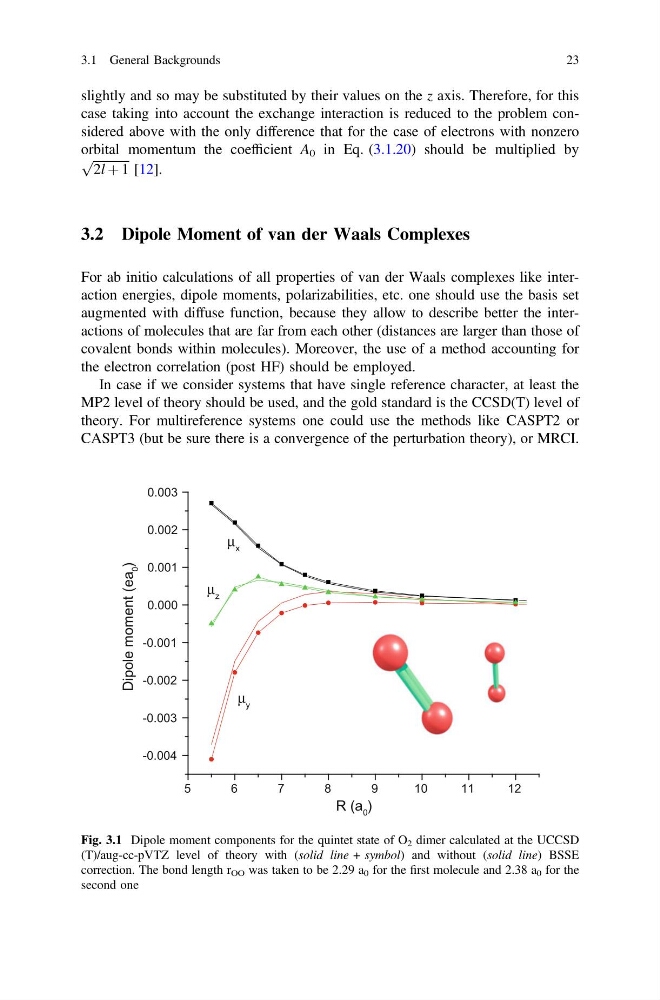
Fig. 3.1 Dipole moment components for the quintet state of O 2 dimer calculated at the UCCSD
(T)/aug-cc-pVTZ level of theory with (solid line + symbol) and without (solid line) BSSE
correction. The bond length r OO was taken to be 2.29 a 0 for the first molecule and 2.38 a 0 for the
second one
3.1 General Backgrounds
23
case taking into account the exchange interaction is reduced to the problem considered above with the only difference that for the case of electrons with nonzero
orbital momentum the coefficient A 0 in Eq. (3.1.20) should be multiplied by
ffiffiffiffiffiffiffiffiffiffiffi ffi
2l þ 1
p
[12].
3.2 Dipole Moment of van der Waals Complexes
For ab initio calculations of all properties of van der Waals complexes like interaction energies, dipole moments, polarizabilities, etc. one should use the basis set
augmented with diffuse function, because they allow to describe better the interactions of molecules that are far from each other (distances are larger than those of
covalent bonds within molecules). Moreover, the use of a method accounting for
the electron correlation (post HF) should be employed.
In case if we consider systems that have single reference character, at least the
MP2 level of theory should be used, and the gold standard is the CCSD(T) level of
theory. For multireference systems one could use the methods like CASPT2 or
CASPT3 (but be sure there is a convergence of the perturbation theory), or MRCI.
5
6
7
8
9
1 0
1 1
1 2
-0.004
-0.003
-0.002
-0.001
0.000
0.001
0.002
0.003
μ z
μ x
Dipole moment (ea
0
)
R (a 0 )
μ y
Fig. 3.1 Dipole moment components for the quintet state of O 2 dimer calculated at the UCCSD
(T)/aug-cc-pVTZ level of theory with (solid line + symbol) and without (solid line) BSSE
correction. The bond length r OO was taken to be 2.29 a 0 for the first molecule and 2.38 a 0 for the
second one
3.1 General Backgrounds
23