

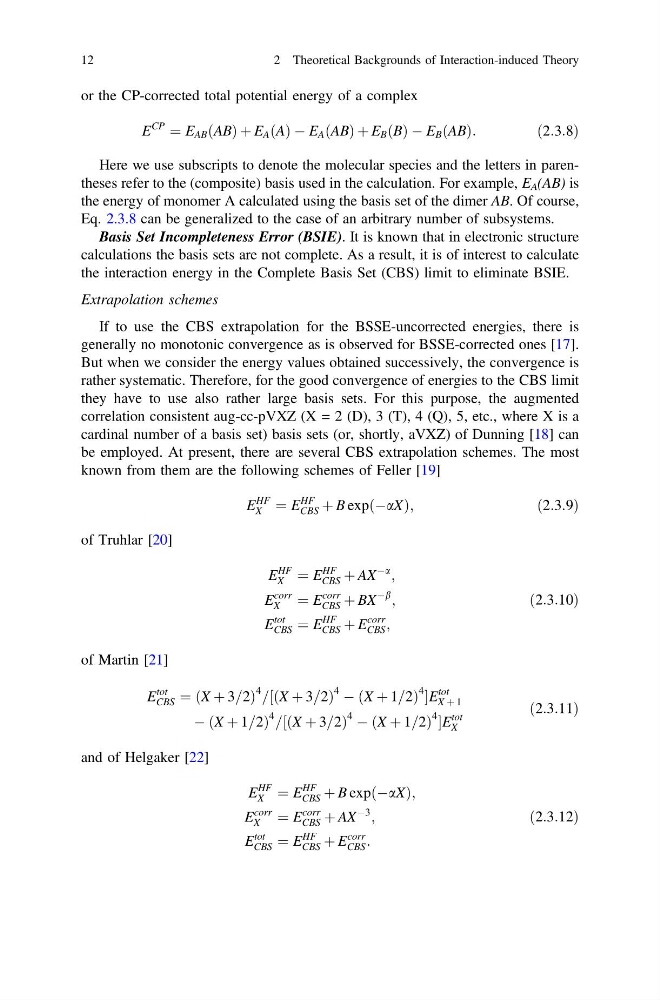
or the CP-corrected total potential energy of a complex
E
CP
¼ E AB ðABÞ þ E A ðAÞ À E A ðABÞ þ E B ðBÞ À E B ðABÞ:
ð2:3:8Þ
Here we use subscripts to denote the molecular species and the letters in parentheses refer to the (composite) basis used in the calculation. For example, E A (AB) is
the energy of monomer A calculated using the basis set of the dimer AB. Of course,
Eq. 2.3.8 can be generalized to the case of an arbitrary number of subsystems.
Basis Set Incompleteness Error (BSIE). It is known that in electronic structure
calculations the basis sets are not complete. As a result, it is of interest to calculate
the interaction energy in the Complete Basis Set (CBS) limit to eliminate BSIE.
Extrapolation schemes
If to use the CBS extrapolation for the BSSE-uncorrected energies, there is
generally no monotonic convergence as is observed for BSSE-corrected ones [17].
But when we consider the energy values obtained successively, the convergence is
rather systematic. Therefore, for the good convergence of energies to the CBS limit
they have to use also rather large basis sets. For this purpose, the augmented
correlation consistent aug-cc-pVXZ (X = 2 (D), 3 (T), 4 (Q), 5, etc., where X is a
cardinal number of a basis set) basis sets (or, shortly, aVXZ) of Dunning [18] can
be employed. At present, there are several CBS extrapolation schemes. The most
known from them are the following schemes of Feller [19]
E
HF
X ¼ E
HF
CBS þ B expðÀaXÞ;
ð2:3:9Þ
of Truhlar [20]
E
HF
X ¼ E
HF
CBS þ AX
Àa
;
E
corr
X
¼ E
corr
CBS þ BX
Àb
;
E
tot
CBS ¼ E
HF
CBS þ E
corr
CBS ;
ð2:3:10Þ
of Martin [21]
E
tot
CBS ¼ ðX þ 3=2Þ
4 =½ðX þ 3=2Þ
4 À ðX þ 1=2Þ
4 E
tot
X þ 1
À ðX þ 1=2Þ
4 =½ðX þ 3=2Þ
4 À ðX þ 1=2Þ
4 E
tot
X
ð2:3:11Þ
and of Helgaker [22]
E
HF
X ¼ E
HF
CBS þ B expðÀaXÞ;
E
corr
X
¼ E
corr
CBS þ AX
À3
;
E
tot
CBS ¼ E
HF
CBS þ E
corr
CBS :
ð2:3:12Þ
12
2 Theoretical Backgrounds of Interaction-induced Theory
E
CP
¼ E AB ðABÞ þ E A ðAÞ À E A ðABÞ þ E B ðBÞ À E B ðABÞ:
ð2:3:8Þ
Here we use subscripts to denote the molecular species and the letters in parentheses refer to the (composite) basis used in the calculation. For example, E A (AB) is
the energy of monomer A calculated using the basis set of the dimer AB. Of course,
Eq. 2.3.8 can be generalized to the case of an arbitrary number of subsystems.
Basis Set Incompleteness Error (BSIE). It is known that in electronic structure
calculations the basis sets are not complete. As a result, it is of interest to calculate
the interaction energy in the Complete Basis Set (CBS) limit to eliminate BSIE.
Extrapolation schemes
If to use the CBS extrapolation for the BSSE-uncorrected energies, there is
generally no monotonic convergence as is observed for BSSE-corrected ones [17].
But when we consider the energy values obtained successively, the convergence is
rather systematic. Therefore, for the good convergence of energies to the CBS limit
they have to use also rather large basis sets. For this purpose, the augmented
correlation consistent aug-cc-pVXZ (X = 2 (D), 3 (T), 4 (Q), 5, etc., where X is a
cardinal number of a basis set) basis sets (or, shortly, aVXZ) of Dunning [18] can
be employed. At present, there are several CBS extrapolation schemes. The most
known from them are the following schemes of Feller [19]
E
HF
X ¼ E
HF
CBS þ B expðÀaXÞ;
ð2:3:9Þ
of Truhlar [20]
E
HF
X ¼ E
HF
CBS þ AX
Àa
;
E
corr
X
¼ E
corr
CBS þ BX
Àb
;
E
tot
CBS ¼ E
HF
CBS þ E
corr
CBS ;
ð2:3:10Þ
of Martin [21]
E
tot
CBS ¼ ðX þ 3=2Þ
4 =½ðX þ 3=2Þ
4 À ðX þ 1=2Þ
4 E
tot
X þ 1
À ðX þ 1=2Þ
4 =½ðX þ 3=2Þ
4 À ðX þ 1=2Þ
4 E
tot
X
ð2:3:11Þ
and of Helgaker [22]
E
HF
X ¼ E
HF
CBS þ B expðÀaXÞ;
E
corr
X
¼ E
corr
CBS þ AX
À3
;
E
tot
CBS ¼ E
HF
CBS þ E
corr
CBS :
ð2:3:12Þ
12
2 Theoretical Backgrounds of Interaction-induced Theory