

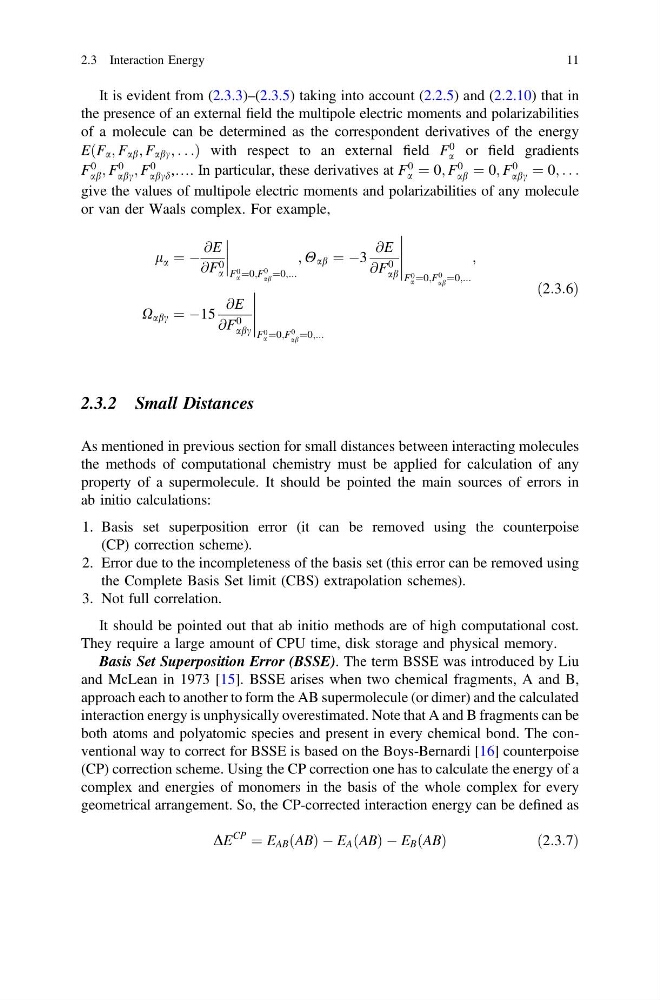
It is evident from (2.3.3)–(2.3.5) taking into account (2.2.5) and (2.2.10) that in
the presence of an external field the multipole electric moments and polarizabilities
of a molecule can be determined as the correspondent derivatives of the energy
EðF a ; F ab ; F abc ; . . .Þ with respect to an external field F
0
a or field gradients
F
0
ab ; F
0
abc ; F
0
abcd ,…. In particular, these derivatives at F
0
a ¼ 0; F
0
ab ¼ 0; F
0
abc ¼ 0; . . .
give the values of multipole electric moments and polarizabilities of any molecule
or van der Waals complex. For example,
l a ¼ À
@E
@F 0
a
F 0
a ¼0;F
0
ab
¼0;...
; H ab ¼ À3
@E
@F
0
ab
F 0
a ¼0;F 0
ab
¼0;...
;
X abc ¼ À15
@E
@F
0
abc
F 0
a ¼0;F 0
ab
¼0;...
ð2:3:6Þ
2.3.2 Small Distances
As mentioned in previous section for small distances between interacting molecules
the methods of computational chemistry must be applied for calculation of any
property of a supermolecule. It should be pointed the main sources of errors in
ab initio calculations:
1. Basis set superposition error (it can be removed using the counterpoise
(CP) correction scheme).
2. Error due to the incompleteness of the basis set (this error can be removed using
the Complete Basis Set limit (CBS) extrapolation schemes).
3. Not full correlation.
It should be pointed out that ab initio methods are of high computational cost.
They require a large amount of CPU time, disk storage and physical memory.
Basis Set Superposition Error (BSSE). The term BSSE was introduced by Liu
and McLean in 1973 [15]. BSSE arises when two chemical fragments, A and B,
approach each to another to form the AB supermolecule (or dimer) and the calculated
interaction energy is unphysically overestimated. Note that A and B fragments can be
both atoms and polyatomic species and present in every chemical bond. The conventional way to correct for BSSE is based on the Boys-Bernardi [16] counterpoise
(CP) correction scheme. Using the CP correction one has to calculate the energy of a
complex and energies of monomers in the basis of the whole complex for every
geometrical arrangement. So, the CP-corrected interaction energy can be defined as
DE
CP
¼ E AB ðABÞ À E A ðABÞ À E B ðABÞ
ð 2:3:7Þ
2.3 Interaction Energy
11
the presence of an external field the multipole electric moments and polarizabilities
of a molecule can be determined as the correspondent derivatives of the energy
EðF a ; F ab ; F abc ; . . .Þ with respect to an external field F
0
a or field gradients
F
0
ab ; F
0
abc ; F
0
abcd ,…. In particular, these derivatives at F
0
a ¼ 0; F
0
ab ¼ 0; F
0
abc ¼ 0; . . .
give the values of multipole electric moments and polarizabilities of any molecule
or van der Waals complex. For example,
l a ¼ À
@E
@F 0
a
F 0
a ¼0;F
0
ab
¼0;...
; H ab ¼ À3
@E
@F
0
ab
F 0
a ¼0;F 0
ab
¼0;...
;
X abc ¼ À15
@E
@F
0
abc
F 0
a ¼0;F 0
ab
¼0;...
ð2:3:6Þ
2.3.2 Small Distances
As mentioned in previous section for small distances between interacting molecules
the methods of computational chemistry must be applied for calculation of any
property of a supermolecule. It should be pointed the main sources of errors in
ab initio calculations:
1. Basis set superposition error (it can be removed using the counterpoise
(CP) correction scheme).
2. Error due to the incompleteness of the basis set (this error can be removed using
the Complete Basis Set limit (CBS) extrapolation schemes).
3. Not full correlation.
It should be pointed out that ab initio methods are of high computational cost.
They require a large amount of CPU time, disk storage and physical memory.
Basis Set Superposition Error (BSSE). The term BSSE was introduced by Liu
and McLean in 1973 [15]. BSSE arises when two chemical fragments, A and B,
approach each to another to form the AB supermolecule (or dimer) and the calculated
interaction energy is unphysically overestimated. Note that A and B fragments can be
both atoms and polyatomic species and present in every chemical bond. The conventional way to correct for BSSE is based on the Boys-Bernardi [16] counterpoise
(CP) correction scheme. Using the CP correction one has to calculate the energy of a
complex and energies of monomers in the basis of the whole complex for every
geometrical arrangement. So, the CP-corrected interaction energy can be defined as
DE
CP
¼ E AB ðABÞ À E A ðABÞ À E B ðABÞ
ð 2:3:7Þ
2.3 Interaction Energy
11