

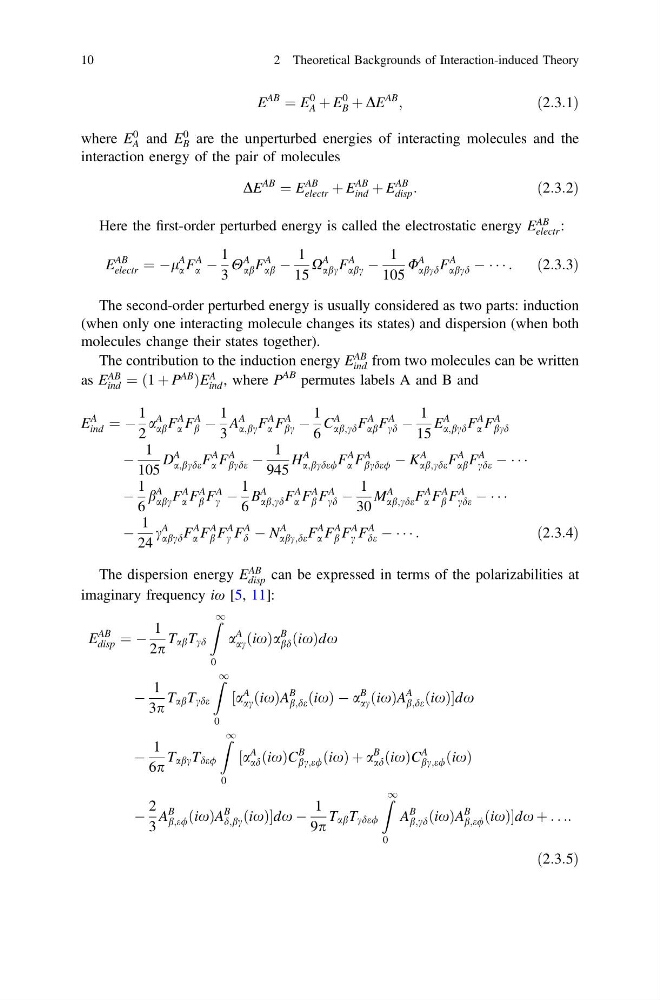
E
AB
¼ E
0
A þ E
0
B þ DE
AB
;
ð2:3:1Þ
where E
0
A and E
0
B are the unperturbed energies of interacting molecules and the
interaction energy of the pair of molecules
DE
AB
¼ E
AB
electr þ E
AB
ind þ E
AB
disp :
ð2:3:2Þ
Here the first-order perturbed energy is called the electrostatic energy E
AB
electr :
E
AB
electr ¼ Àl
A
a F
A
a À
1
3
H
A
ab F
A
ab À
1
15
X
A
abc F
A
abc À
1
105
U
A
abcd F
A
abcd À Á Á Á :
ð2:3:3Þ
The second-order perturbed energy is usually considered as two parts: induction
(when only one interacting molecule changes its states) and dispersion (when both
molecules change their states together).
The contribution to the induction energy E
AB
ind from two molecules can be written
as E
AB
ind ¼ ð1 þ P
AB
ÞE
A
ind , where P
AB permutes labels A and B and
E
A
ind ¼ À
1
2
a
A
ab F
A
a F
A
b À
1
3
A
A
a;bc F
A
a F
A
bc À
1
6
C
A
ab;cd F
A
ab F
A
cd À
1
15
E
A
a;bcd F
A
a F
A
bcd
À
1
105
D
A
a;bcde F
A
a F
A
bcde À
1
945
H
A
a;bcde/ F
A
a F
A
bcde/ À K
A
ab;cde F
A
ab F
A
cde À Á Á Á
À
1
6
b
A
abc F
A
a F
A
b F
A
c À
1
6
B
A
ab;cd F
A
a F
A
b F
A
cd À
1
30
M
A
ab;cde F
A
a F
A
b F
A
cde À Á Á Á
À
1
24
c
A
abcd F
A
a F
A
b F
A
c F
A
d À N
A
abc;de F
A
a F
A
b F
A
c F
A
de À Á Á Á :
ð2:3:4Þ
The dispersion energy E
AB
disp can be expressed in terms of the polarizabilities at
imaginary frequency iω [5, 11]:
E
AB
disp ¼ À
1
2p
T ab T cd
Z 1
0
a
A
ac ðixÞa
B
bd ðixÞdx
À
1
3p
T ab T cde
Z 1
0
½a
A
ac ðixÞA
B
b;de ðixÞ À a
B
ac ðixÞA
A
b;de ðixÞdx
À
1
6p
T abc T de/
Z 1
0
½a
A
ad ðixÞC
B
bc;e/ ðixÞ þ a
B
ad ðixÞC
A
bc;e/ ðixÞ
À
2
3
A
B
b;e/ ðixÞA
B
d;bc ðixÞdx À
1
9p
T ab T cde/
Z 1
0
A
B
b;cd ðixÞA
B
b;e/ ðixÞdx þ . . .:
ð2:3:5Þ
10
2 Theoretical Backgrounds of Interaction-induced Theory
AB
¼ E
0
A þ E
0
B þ DE
AB
;
ð2:3:1Þ
where E
0
A and E
0
B are the unperturbed energies of interacting molecules and the
interaction energy of the pair of molecules
DE
AB
¼ E
AB
electr þ E
AB
ind þ E
AB
disp :
ð2:3:2Þ
Here the first-order perturbed energy is called the electrostatic energy E
AB
electr :
E
AB
electr ¼ Àl
A
a F
A
a À
1
3
H
A
ab F
A
ab À
1
15
X
A
abc F
A
abc À
1
105
U
A
abcd F
A
abcd À Á Á Á :
ð2:3:3Þ
The second-order perturbed energy is usually considered as two parts: induction
(when only one interacting molecule changes its states) and dispersion (when both
molecules change their states together).
The contribution to the induction energy E
AB
ind from two molecules can be written
as E
AB
ind ¼ ð1 þ P
AB
ÞE
A
ind , where P
AB permutes labels A and B and
E
A
ind ¼ À
1
2
a
A
ab F
A
a F
A
b À
1
3
A
A
a;bc F
A
a F
A
bc À
1
6
C
A
ab;cd F
A
ab F
A
cd À
1
15
E
A
a;bcd F
A
a F
A
bcd
À
1
105
D
A
a;bcde F
A
a F
A
bcde À
1
945
H
A
a;bcde/ F
A
a F
A
bcde/ À K
A
ab;cde F
A
ab F
A
cde À Á Á Á
À
1
6
b
A
abc F
A
a F
A
b F
A
c À
1
6
B
A
ab;cd F
A
a F
A
b F
A
cd À
1
30
M
A
ab;cde F
A
a F
A
b F
A
cde À Á Á Á
À
1
24
c
A
abcd F
A
a F
A
b F
A
c F
A
d À N
A
abc;de F
A
a F
A
b F
A
c F
A
de À Á Á Á :
ð2:3:4Þ
The dispersion energy E
AB
disp can be expressed in terms of the polarizabilities at
imaginary frequency iω [5, 11]:
E
AB
disp ¼ À
1
2p
T ab T cd
Z 1
0
a
A
ac ðixÞa
B
bd ðixÞdx
À
1
3p
T ab T cde
Z 1
0
½a
A
ac ðixÞA
B
b;de ðixÞ À a
B
ac ðixÞA
A
b;de ðixÞdx
À
1
6p
T abc T de/
Z 1
0
½a
A
ad ðixÞC
B
bc;e/ ðixÞ þ a
B
ad ðixÞC
A
bc;e/ ðixÞ
À
2
3
A
B
b;e/ ðixÞA
B
d;bc ðixÞdx À
1
9p
T ab T cde/
Z 1
0
A
B
b;cd ðixÞA
B
b;e/ ðixÞdx þ . . .:
ð2:3:5Þ
10
2 Theoretical Backgrounds of Interaction-induced Theory