

2.1.4 Dependence on the Origin of the Coordinate System
In general case the multipole moments depend on the origin of the coordinate
system (except for the charge q of a molecule). It follows from the definition (2.1.1)
if the vector r is shifted on any vector a. For uncharged molecules the origin
dependence appears only for the multipole moments of the rank n ! 2. As a result,
because in the book only the uncharged molecules and complexes are considered,
their dipole moments and connected with them polarizabilities and first hyperpolarizabilities do not depend on the origin of the coordinate system.
2.2 Interaction Hamiltonian
2.2.1 Large Separations
Let us consider briefly, following the works [1–6], how the Hamiltonian of two
interacting molecules, which are far from each other, may be written to apply
afterwards to the van der Waals complexes. It can be expected that for the far
intermolecular distances the interaction energy of molecules is weak relative to the
interaction energy within a molecule. As a result, the perturbation theory can be
effectively used to describe the energy and other values of interacting molecules.
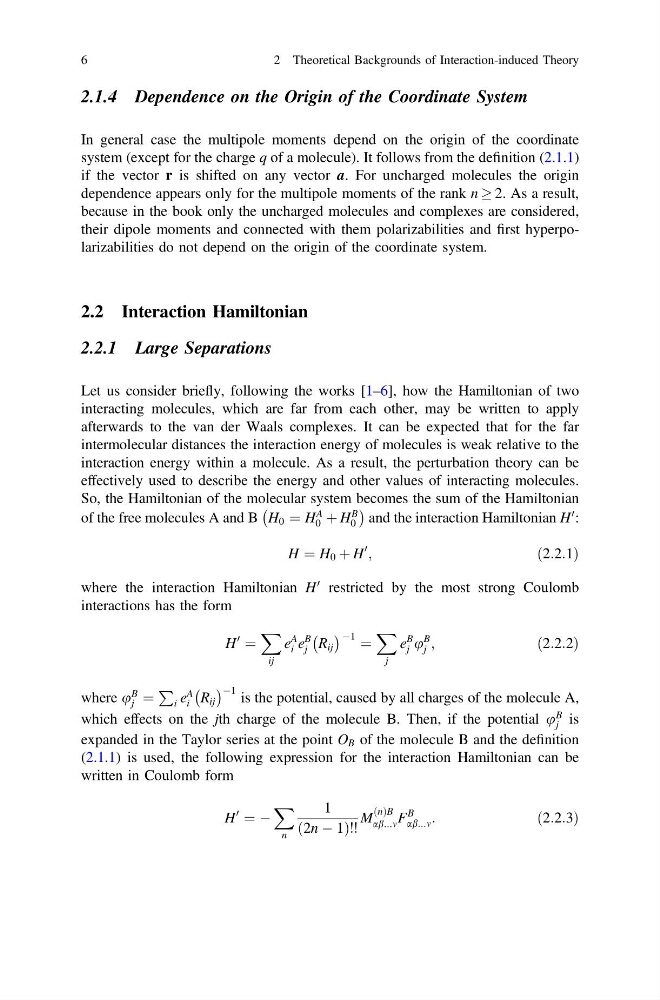
So, the Hamiltonian of the molecular system becomes the sum of the Hamiltonian
of the free molecules A and B H 0 ¼ H
A
0 þ H
B
0
À
Á
and the interaction Hamiltonian H
0 :
H ¼ H 0 þ H
0
;
ð2:2:1Þ
where the interaction Hamiltonian H
0 restricted by the most strong Coulomb
interactions has the form
H
0
¼
X
ij
e
A
i e
B
j R ij
À Á À1 ¼
X
j
e
B
j u
B
j ;
ð2:2:2Þ
where u
B
j ¼
P
i e
A
i R ij
À Á À1 is the potential, caused by all charges of the molecule A,
which effects on the jth charge of the molecule B. Then, if the potential u
B
j is
expanded in the Taylor series at the point O B of the molecule B and the definition
(2.1.1) is used, the following expression for the interaction Hamiltonian can be
written in Coulomb form
H
0
¼ À
X
n
1
ð2n À 1Þ!!
M
ðnÞB
ab...m F
B
ab...m :
ð2:2:3Þ
6
2 Theoretical Backgrounds of Interaction-induced Theory
In general case the multipole moments depend on the origin of the coordinate
system (except for the charge q of a molecule). It follows from the definition (2.1.1)
if the vector r is shifted on any vector a. For uncharged molecules the origin
dependence appears only for the multipole moments of the rank n ! 2. As a result,
because in the book only the uncharged molecules and complexes are considered,
their dipole moments and connected with them polarizabilities and first hyperpolarizabilities do not depend on the origin of the coordinate system.
2.2 Interaction Hamiltonian
2.2.1 Large Separations
Let us consider briefly, following the works [1–6], how the Hamiltonian of two
interacting molecules, which are far from each other, may be written to apply
afterwards to the van der Waals complexes. It can be expected that for the far
intermolecular distances the interaction energy of molecules is weak relative to the
interaction energy within a molecule. As a result, the perturbation theory can be
effectively used to describe the energy and other values of interacting molecules.
So, the Hamiltonian of the molecular system becomes the sum of the Hamiltonian
of the free molecules A and B H 0 ¼ H
A
0 þ H
B
0
À
Á
and the interaction Hamiltonian H
0 :
H ¼ H 0 þ H
0
;
ð2:2:1Þ
where the interaction Hamiltonian H
0 restricted by the most strong Coulomb
interactions has the form
H
0
¼
X
ij
e
A
i e
B
j R ij
À Á À1 ¼
X
j
e
B
j u
B
j ;
ð2:2:2Þ
where u
B
j ¼
P
i e
A
i R ij
À Á À1 is the potential, caused by all charges of the molecule A,
which effects on the jth charge of the molecule B. Then, if the potential u
B
j is
expanded in the Taylor series at the point O B of the molecule B and the definition
(2.1.1) is used, the following expression for the interaction Hamiltonian can be
written in Coulomb form
H
0
¼ À
X
n
1
ð2n À 1Þ!!
M
ðnÞB
ab...m F
B
ab...m :
ð2:2:3Þ
6
2 Theoretical Backgrounds of Interaction-induced Theory