

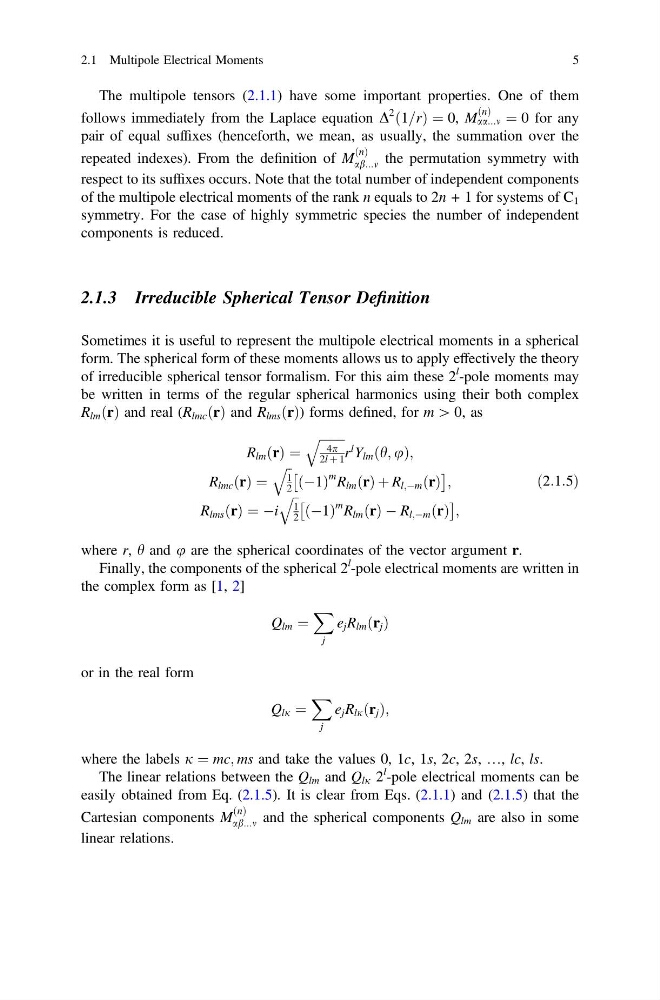
The multipole tensors (2.1.1) have some important properties. One of them
follows immediately from the Laplace equation D
2 1=r
ð Þ ¼ 0, M
ðnÞ
aa...m ¼ 0 for any
pair of equal suffixes (henceforth, we mean, as usually, the summation over the
repeated indexes). From the definition of M
ðnÞ
ab...m the permutation symmetry with
respect to its suffixes occurs. Note that the total number of independent components
of the multipole electrical moments of the rank n equals to 2n + 1 for systems of C 1
symmetry. For the case of highly symmetric species the number of independent
components is reduced.
2.1.3 Irreducible Spherical Tensor Definition
Sometimes it is useful to represent the multipole electrical moments in a spherical
form. The spherical form of these moments allows us to apply effectively the theory
of irreducible spherical tensor formalism. For this aim these 2
l -pole moments may
be written in terms of the regular spherical harmonics using their both complex
R lm ðrÞ and real (R lmc ðrÞ and R lms ðrÞ) forms defined, for m [ 0, as
R lm ðrÞ ¼
ffiffiffiffiffiffiffiffi
4p
2l þ 1
q
r
l Y lm ðh; uÞ;
R lmc ðrÞ ¼
ffiffi
1
2
q
À1
ð Þ
m R lm ðrÞ þ R l;Àm ðrÞ
Â
à ;
R lms ðrÞ ¼ Ài
ffiffi
1
2
q
À1
ð Þ
m R lm ðrÞ À R l;Àm ðrÞ
Â
à ;
ð2:1:5Þ
where r, h and u are the spherical coordinates of the vector argument r.
Finally, the components of the spherical 2
l
-pole electrical moments are written in
the complex form as [1, 2]
Q lm ¼
X
j
e j R lm ðr j Þ
or in the real form
Q lj ¼
X
j
e j R lj ðr j Þ;
where the labels j ¼ mc; ms and take the values 0, 1c, 1s, 2c, 2s, …, lc, ls.
The linear relations between the Q lm and Q lj 2
l -pole electrical moments can be
easily obtained from Eq. (2.1.5). It is clear from Eqs. (2.1.1) and (2.1.5) that the
Cartesian components M
ðnÞ
ab...m and the spherical components Q lm are also in some
linear relations.
2.1 Multipole Electrical Moments
5
follows immediately from the Laplace equation D
2 1=r
ð Þ ¼ 0, M
ðnÞ
aa...m ¼ 0 for any
pair of equal suffixes (henceforth, we mean, as usually, the summation over the
repeated indexes). From the definition of M
ðnÞ
ab...m the permutation symmetry with
respect to its suffixes occurs. Note that the total number of independent components
of the multipole electrical moments of the rank n equals to 2n + 1 for systems of C 1
symmetry. For the case of highly symmetric species the number of independent
components is reduced.
2.1.3 Irreducible Spherical Tensor Definition
Sometimes it is useful to represent the multipole electrical moments in a spherical
form. The spherical form of these moments allows us to apply effectively the theory
of irreducible spherical tensor formalism. For this aim these 2
l -pole moments may
be written in terms of the regular spherical harmonics using their both complex
R lm ðrÞ and real (R lmc ðrÞ and R lms ðrÞ) forms defined, for m [ 0, as
R lm ðrÞ ¼
ffiffiffiffiffiffiffiffi
4p
2l þ 1
q
r
l Y lm ðh; uÞ;
R lmc ðrÞ ¼
ffiffi
1
2
q
À1
ð Þ
m R lm ðrÞ þ R l;Àm ðrÞ
Â
à ;
R lms ðrÞ ¼ Ài
ffiffi
1
2
q
À1
ð Þ
m R lm ðrÞ À R l;Àm ðrÞ
Â
à ;
ð2:1:5Þ
where r, h and u are the spherical coordinates of the vector argument r.
Finally, the components of the spherical 2
l
-pole electrical moments are written in
the complex form as [1, 2]
Q lm ¼
X
j
e j R lm ðr j Þ
or in the real form
Q lj ¼
X
j
e j R lj ðr j Þ;
where the labels j ¼ mc; ms and take the values 0, 1c, 1s, 2c, 2s, …, lc, ls.
The linear relations between the Q lm and Q lj 2
l -pole electrical moments can be
easily obtained from Eq. (2.1.5). It is clear from Eqs. (2.1.1) and (2.1.5) that the
Cartesian components M
ðnÞ
ab...m and the spherical components Q lm are also in some
linear relations.
2.1 Multipole Electrical Moments
5