

2.1.2 Cartesian Definition
In this case the multipole electrical moments of the rank n for any molecule B can
be defined in the form (see, for example, [1–6])
M
ðnÞðBÞ
ab...m ¼
ðÀ1Þ
n
n!
X
j
e
ðBÞ
j r
2n þ 1
j
@
@r ja
@
@r jb
Á Á Á
@
@r jm
1
r j
;
ð2:1:1Þ
where the Greek indexes a; b; . . .; m take the values X, Y, Z (the number of Greek
indexes equals to n), e
B
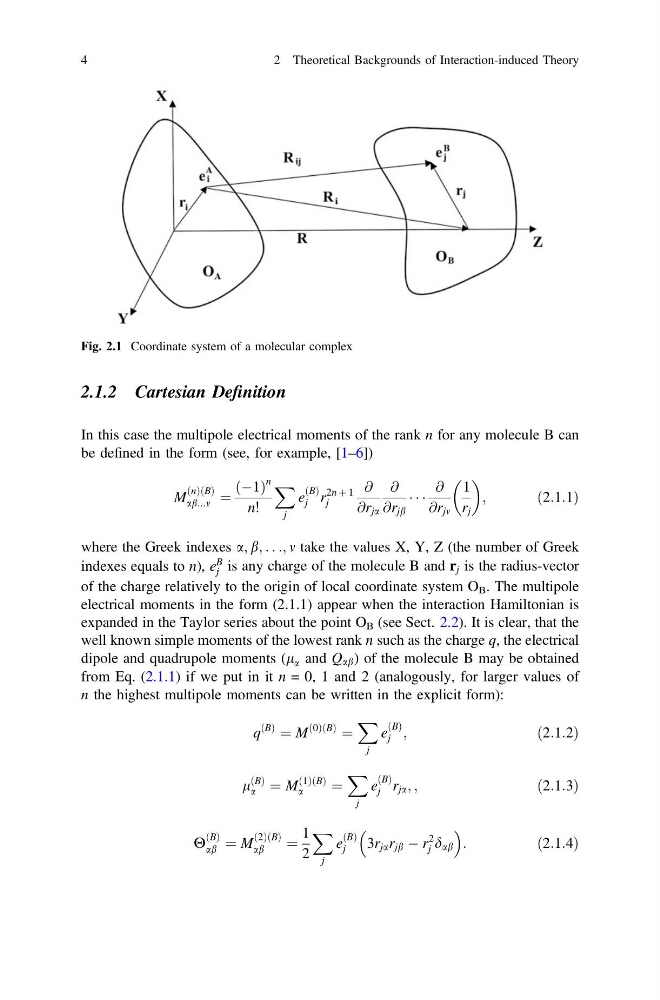
j is any charge of the molecule B and r j is the radius-vector
of the charge relatively to the origin of local coordinate system O B . The multipole
electrical moments in the form (2.1.1) appear when the interaction Hamiltonian is
expanded in the Taylor series about the point O B (see Sect. 2.2). It is clear, that the
well known simple moments of the lowest rank n such as the charge q, the electrical
dipole and quadrupole moments (l a and Q ab ) of the molecule B may be obtained
from Eq. (2.1.1) if we put in it n = 0, 1 and 2 (analogously, for larger values of
n the highest multipole moments can be written in the explicit form):
q
ðBÞ
¼ M
ð0ÞðBÞ
¼
X
j
e
ðBÞ
j ;
ð2:1:2Þ
l
ðBÞ
a ¼ M
ð1ÞðBÞ
a
¼
X
j
e
ðBÞ
j r ja ; ;
ð2:1:3Þ
H
ðBÞ
ab ¼ M
ð2ÞðBÞ
ab
¼
1
2
X
j
e
ðBÞ
j
3r ja r jb À r
2
j d ab
:
ð2:1:4Þ
Fig. 2.1 Coordinate system of a molecular complex
4
2 Theoretical Backgrounds of Interaction-induced Theory
In this case the multipole electrical moments of the rank n for any molecule B can
be defined in the form (see, for example, [1–6])
M
ðnÞðBÞ
ab...m ¼
ðÀ1Þ
n
n!
X
j
e
ðBÞ
j r
2n þ 1
j
@
@r ja
@
@r jb
Á Á Á
@
@r jm
1
r j
;
ð2:1:1Þ
where the Greek indexes a; b; . . .; m take the values X, Y, Z (the number of Greek
indexes equals to n), e
B
j is any charge of the molecule B and r j is the radius-vector
of the charge relatively to the origin of local coordinate system O B . The multipole
electrical moments in the form (2.1.1) appear when the interaction Hamiltonian is
expanded in the Taylor series about the point O B (see Sect. 2.2). It is clear, that the
well known simple moments of the lowest rank n such as the charge q, the electrical
dipole and quadrupole moments (l a and Q ab ) of the molecule B may be obtained
from Eq. (2.1.1) if we put in it n = 0, 1 and 2 (analogously, for larger values of
n the highest multipole moments can be written in the explicit form):
q
ðBÞ
¼ M
ð0ÞðBÞ
¼
X
j
e
ðBÞ
j ;
ð2:1:2Þ
l
ðBÞ
a ¼ M
ð1ÞðBÞ
a
¼
X
j
e
ðBÞ
j r ja ; ;
ð2:1:3Þ
H
ðBÞ
ab ¼ M
ð2ÞðBÞ
ab
¼
1
2
X
j
e
ðBÞ
j
3r ja r jb À r
2
j d ab
:
ð2:1:4Þ
Fig. 2.1 Coordinate system of a molecular complex
4
2 Theoretical Backgrounds of Interaction-induced Theory