

82
Chapter 6 Pauling “3-Electron Bonds”, 5-Electron 3-Centre Bonding …
between
,
and
. We may write
2
2
1
1
2
3
( ) ( ) ( )
as 1 1 2 2 3
, in which α and β are the spin wave-functions
for electrons with z
s spin quantum numbers of +½ and -½, and the odd-electron is
assumed to have s z = +½. By substituting the linear combinations of atomic
orbitals of Eqn. (6-1) into this configuration, and then expanding the configuration
as a linear combination of atomic orbital configurations, we obtain Eqn. (6-2)
1
2
1 1 2 2 3
1
const x[ 2 (y y b b a )
{(y y a a b ) (y a a b b )}]
k
(2)
To obtain this expression, we have omitted all atomic orbital configurations for
which two or more electrons occupy the same atomic orbital with the same z
s
spin quantum numbers. Such configurations are forbidden by the Pauli exclusion
principle. A derivation of the above linear combination that takes proper account
of electron indistinguishability is provided in Refs. 9a, b.
For the 19 valence-electron systems 3
O
,
2
SO
,
2
ClO and other isoelectronic
species, the pπ-atomic orbitals that are associated with the odd electron are
displayed in Figure 6-1. The molecular orbitals that may be constructed from these
orbitals are also given by Eqn. (1) (with y, a and b ≡ pπ), and the π-electron
configuration for the 5-electron 3-centre bonding is
2
2
1
1
2
3
( ) ( ) ( )
.
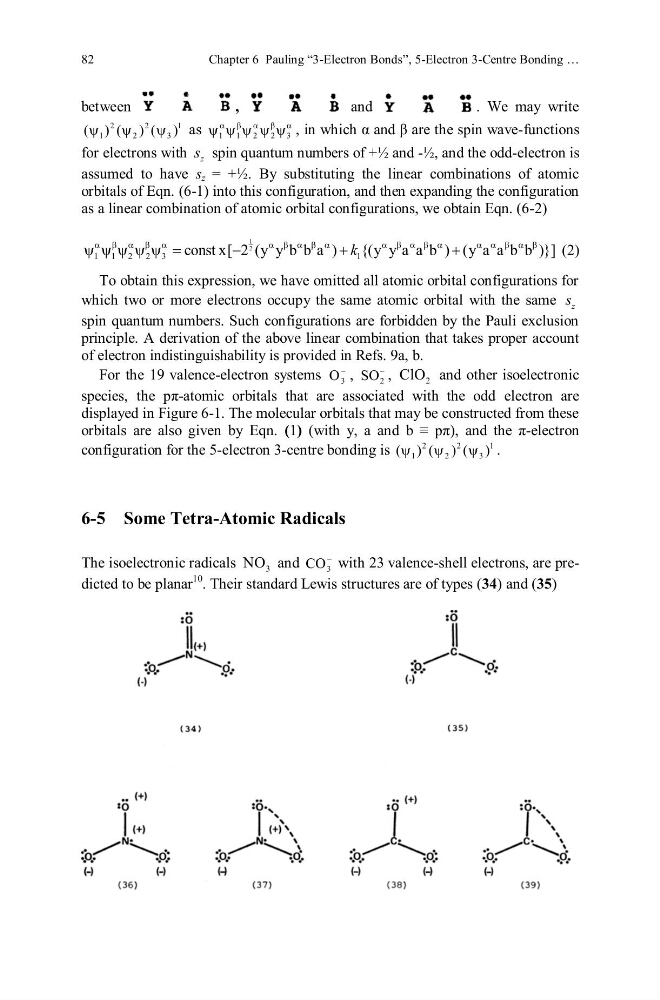
6-5 Some Tetra-Atomic Radicals
The isoelectronic radicals
3
NO and
3
CO
with 23 valence-shell electrons, are predicted to be planar
10
. Their standard Lewis structures are of types (34) and (35)
Chapter 6 Pauling “3-Electron Bonds”, 5-Electron 3-Centre Bonding …
between
,
and
. We may write
2
2
1
1
2
3
( ) ( ) ( )
as 1 1 2 2 3
, in which α and β are the spin wave-functions
for electrons with z
s spin quantum numbers of +½ and -½, and the odd-electron is
assumed to have s z = +½. By substituting the linear combinations of atomic
orbitals of Eqn. (6-1) into this configuration, and then expanding the configuration
as a linear combination of atomic orbital configurations, we obtain Eqn. (6-2)
1
2
1 1 2 2 3
1
const x[ 2 (y y b b a )
{(y y a a b ) (y a a b b )}]
k
(2)
To obtain this expression, we have omitted all atomic orbital configurations for
which two or more electrons occupy the same atomic orbital with the same z
s
spin quantum numbers. Such configurations are forbidden by the Pauli exclusion
principle. A derivation of the above linear combination that takes proper account
of electron indistinguishability is provided in Refs. 9a, b.
For the 19 valence-electron systems 3
O
,
2
SO
,
2
ClO and other isoelectronic
species, the pπ-atomic orbitals that are associated with the odd electron are
displayed in Figure 6-1. The molecular orbitals that may be constructed from these
orbitals are also given by Eqn. (1) (with y, a and b ≡ pπ), and the π-electron
configuration for the 5-electron 3-centre bonding is
2
2
1
1
2
3
( ) ( ) ( )
.
6-5 Some Tetra-Atomic Radicals
The isoelectronic radicals
3
NO and
3
CO
with 23 valence-shell electrons, are predicted to be planar
10
. Their standard Lewis structures are of types (34) and (35)