

6-4 3-Centre Molecular Orbitals and Pauling “3-Electron Bonds”
81
bond” structures. In the Chapter 6 Addendum (and also Figure 11-6) are used to
reduce the formal charge separations of (30) and (31). The electron spin resonance
measurements (Table 6-1) indicate that the odd-electron of ClO 2 is delocalized
over the three atomic centres, with a chlorine odd-electron charge of 0.59, and
therefore Pauling “3-electron bonds” are appropriate for any valence-bond
structure for this radical.
6-4 3-Centre Molecular Orbitals and Pauling “3-Electron Bonds”
If we designate the three NO 2 atomic orbitals of Figure 6-1 as y, a and b, then we
may construct the delocalized molecular orbitals of Eqn (1)
1
2
1
1
(y b) / 2
a
k ,
1
2
2
(y b) / 2
,
1
2
3
3 (y b) / 2 a
k
,
(1)
from them, for which 1
k and 3
k are constants, both > 0 and related through the
requirement that 1
and 3
must be orthogonal. (These molecular orbitals are
formally identical with those of Section 2-3.) With respect to each pair of nitrogen
and oxygen atoms, molecular orbitals 1
, 2
and 3
are respectively bonding,
non-bonding and antibonding. Five electrons are associated with the y, a and b
atomic orbitals of Figure 6-1 in each of the Pauling “3-electron bond” structures
(7) and (8). Therefore, for the lowest-energy delocalized molecular orbital
description of these electrons, orbitals 1
and 2
are doubly-occupied, and 3
is
singly-occupied. The molecular orbital configuration for the 5-electron 3-centre
bonding unit is then
2
2
1
1
2
3
( ) ( ) ( )
. We shall now deduce that use of this
configuration is equivalent to invoking resonance between the Pauling “3-electron
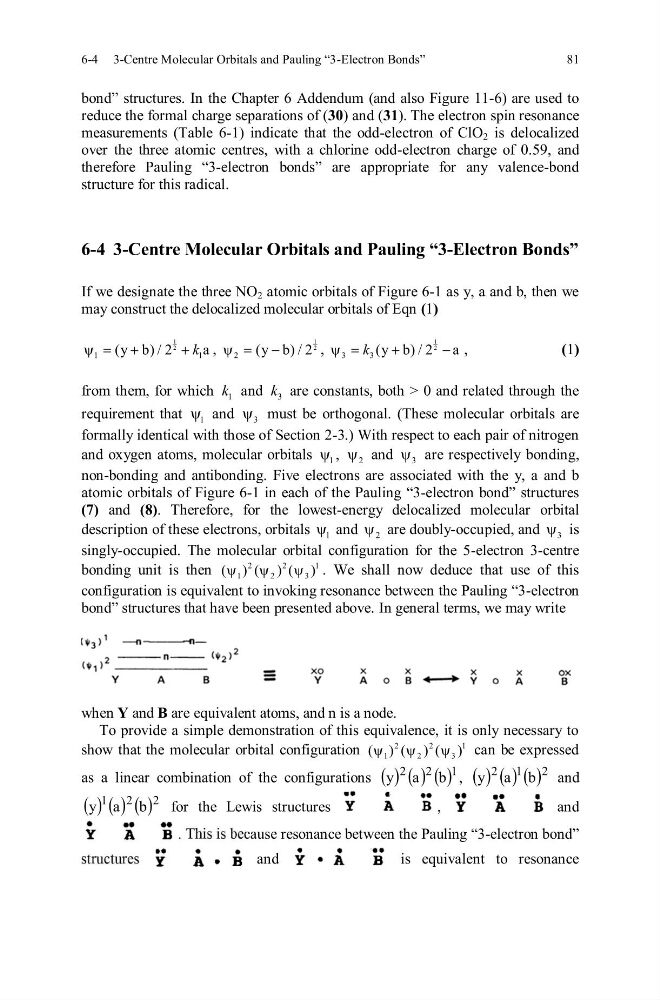
bond” structures that have been presented above. In general terms, we may write
when Y and B are equivalent atoms, and n is a node.
To provide a simple demonstration of this equivalence, it is only necessary to
show that the molecular orbital configuration
2
2
1
1
2
3
( ) ( ) ( )
can be expressed
as a linear combination of the configurations
1
2
2
b
a
y
,
2
1
2
b
a
y
and
2
2
1
b
a
y
for the Lewis structures
,
and
. This is because resonance between the Pauling “3-electron bond”
structures
and
is equivalent to resonance
81
bond” structures. In the Chapter 6 Addendum (and also Figure 11-6) are used to
reduce the formal charge separations of (30) and (31). The electron spin resonance
measurements (Table 6-1) indicate that the odd-electron of ClO 2 is delocalized
over the three atomic centres, with a chlorine odd-electron charge of 0.59, and
therefore Pauling “3-electron bonds” are appropriate for any valence-bond
structure for this radical.
6-4 3-Centre Molecular Orbitals and Pauling “3-Electron Bonds”
If we designate the three NO 2 atomic orbitals of Figure 6-1 as y, a and b, then we
may construct the delocalized molecular orbitals of Eqn (1)
1
2
1
1
(y b) / 2
a
k ,
1
2
2
(y b) / 2
,
1
2
3
3 (y b) / 2 a
k
,
(1)
from them, for which 1
k and 3
k are constants, both > 0 and related through the
requirement that 1
and 3
must be orthogonal. (These molecular orbitals are
formally identical with those of Section 2-3.) With respect to each pair of nitrogen
and oxygen atoms, molecular orbitals 1
, 2
and 3
are respectively bonding,
non-bonding and antibonding. Five electrons are associated with the y, a and b
atomic orbitals of Figure 6-1 in each of the Pauling “3-electron bond” structures
(7) and (8). Therefore, for the lowest-energy delocalized molecular orbital
description of these electrons, orbitals 1
and 2
are doubly-occupied, and 3
is
singly-occupied. The molecular orbital configuration for the 5-electron 3-centre
bonding unit is then
2
2
1
1
2
3
( ) ( ) ( )
. We shall now deduce that use of this
configuration is equivalent to invoking resonance between the Pauling “3-electron
bond” structures that have been presented above. In general terms, we may write
when Y and B are equivalent atoms, and n is a node.
To provide a simple demonstration of this equivalence, it is only necessary to
show that the molecular orbital configuration
2
2
1
1
2
3
( ) ( ) ( )
can be expressed
as a linear combination of the configurations
1
2
2
b
a
y
,
2
1
2
b
a
y
and
2
2
1
b
a
y
for the Lewis structures
,
and
. This is because resonance between the Pauling “3-electron bond”
structures
and
is equivalent to resonance