

80
Chapter 6 Pauling “3-Electron Bonds”, 5-Electron 3-Centre Bonding …
The latter three structures locate the odd-electron on one of each of the three
atoms. Electron spin resonance measurements (Table 6-1) indicate that the odd
electron is delocalized over all three atoms, and that it occupies the 2pπ-type
atomic orbitals of Figure 6-1.
A similar valence-bond representation pertains for the anion
2
SO
, with a sulfur
atom replacing the central oxygen atom. It is also appropriate for the anion
2
2
NO
when
1
2
( )
N
replaces
1
2
( )
O
in structures (22) and (23), and N and
( )
N
replace the
O
and (central) O atom of structures (24), (25) and (26). Formal charge considerations suggest that the odd-electron should be more located on the terminal
oxygen atoms of 3
O
and
2
SO
than it is for
2
2
NO
and the electron spin resonance estimates of the odd-electron charge on the central atom (Table 6-1) are in
accord with this expectation. For
2
NF and 2
PF , the three Lewis structures that are
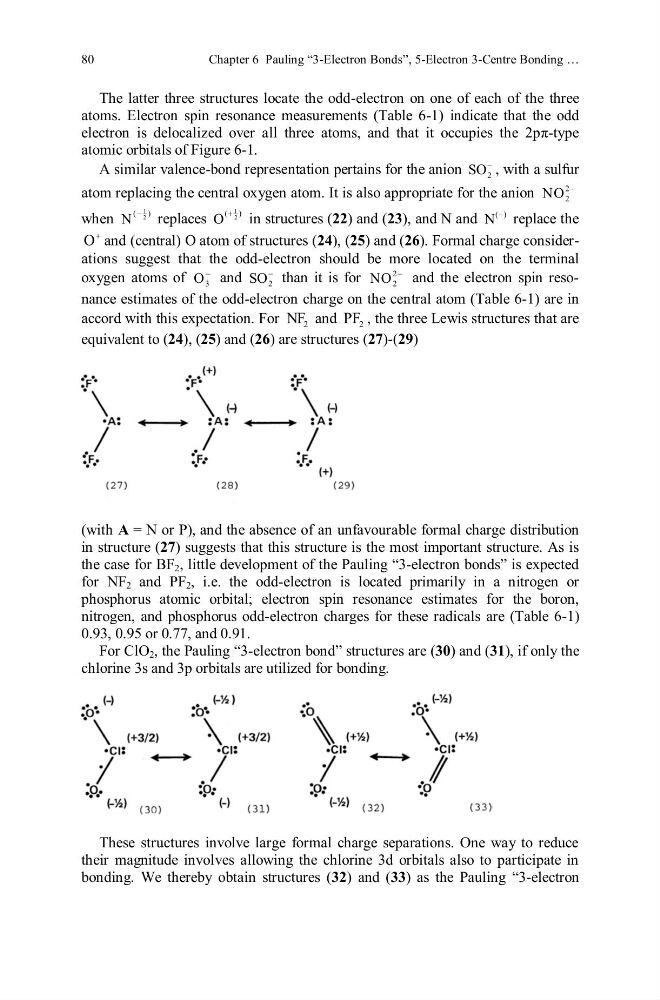
equivalent to (24), (25) and (26) are structures (27)-(29)
(with A = N or P), and the absence of an unfavourable formal charge distribution
in structure (27) suggests that this structure is the most important structure. As is
the case for BF 2 , little development of the Pauling “3-electron bonds” is expected
for NF 2 and PF 2 , i.e. the odd-electron is located primarily in a nitrogen or
phosphorus atomic orbital; electron spin resonance estimates for the boron,
nitrogen, and phosphorus odd-electron charges for these radicals are (Table 6-1)
0.93, 0.95 or 0.77, and 0.91.
For ClO 2 , the Pauling “3-electron bond” structures are (30) and (31), if only the
chlorine 3s and 3p orbitals are utilized for bonding.
These structures involve large formal charge separations. One way to reduce
their magnitude involves allowing the chlorine 3d orbitals also to participate in
bonding. We thereby obtain structures (32) and (33) as the Pauling “3-electron
Chapter 6 Pauling “3-Electron Bonds”, 5-Electron 3-Centre Bonding …
The latter three structures locate the odd-electron on one of each of the three
atoms. Electron spin resonance measurements (Table 6-1) indicate that the odd
electron is delocalized over all three atoms, and that it occupies the 2pπ-type
atomic orbitals of Figure 6-1.
A similar valence-bond representation pertains for the anion
2
SO
, with a sulfur
atom replacing the central oxygen atom. It is also appropriate for the anion
2
2
NO
when
1
2
( )
N
replaces
1
2
( )
O
in structures (22) and (23), and N and
( )
N
replace the
O
and (central) O atom of structures (24), (25) and (26). Formal charge considerations suggest that the odd-electron should be more located on the terminal
oxygen atoms of 3
O
and
2
SO
than it is for
2
2
NO
and the electron spin resonance estimates of the odd-electron charge on the central atom (Table 6-1) are in
accord with this expectation. For
2
NF and 2
PF , the three Lewis structures that are
equivalent to (24), (25) and (26) are structures (27)-(29)
(with A = N or P), and the absence of an unfavourable formal charge distribution
in structure (27) suggests that this structure is the most important structure. As is
the case for BF 2 , little development of the Pauling “3-electron bonds” is expected
for NF 2 and PF 2 , i.e. the odd-electron is located primarily in a nitrogen or
phosphorus atomic orbital; electron spin resonance estimates for the boron,
nitrogen, and phosphorus odd-electron charges for these radicals are (Table 6-1)
0.93, 0.95 or 0.77, and 0.91.
For ClO 2 , the Pauling “3-electron bond” structures are (30) and (31), if only the
chlorine 3s and 3p orbitals are utilized for bonding.
These structures involve large formal charge separations. One way to reduce
their magnitude involves allowing the chlorine 3d orbitals also to participate in
bonding. We thereby obtain structures (32) and (33) as the Pauling “3-electron