

6-3 Triatomic Radicals with 19 Valence-Shell Electrons: O3
– , SO2
– , NF2 and ClO2
79
weights for (13) and (14) should be rather larger than are those for (15) and (16).
Resonance between (13)-(16), with weights of 0.325, 0.325, 0.175 and 0.175 for
these structures, will generate the carbon and oxygen odd-electron charges of 0.65
and 0.175. The resulting formal charges for the Pauling “3-electron bond”
structures are those of structures (17) and (18).
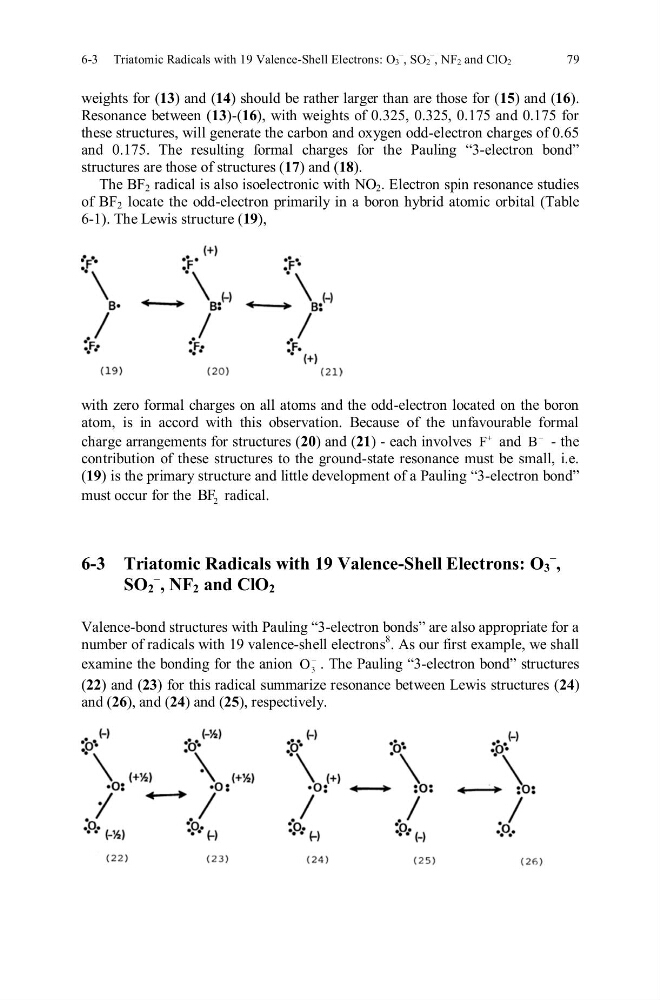
The BF 2 radical is also isoelectronic with NO 2 . Electron spin resonance studies
of BF 2 locate the odd-electron primarily in a boron hybrid atomic orbital (Table
6-1). The Lewis structure (19),
with zero formal charges on all atoms and the odd-electron located on the boron
atom, is in accord with this observation. Because of the unfavourable formal
charge arrangements for structures (20) and (21) - each involves F
and B
- the
contribution of these structures to the ground-state resonance must be small, i.e.
(19) is the primary structure and little development of a Pauling “3-electron bond”
must occur for the 2
BF radical.
6-3 Triatomic Radicals with 19 Valence-Shell Electrons: O 3
–
,
SO 2
–
, NF 2 and ClO 2
Valence-bond structures with Pauling “3-electron bonds” are also appropriate for a
number of radicals with 19 valence-shell electrons
8 . As our first example, we shall
examine the bonding for the anion 3
O
. The Pauling “3-electron bond” structures
(22) and (23) for this radical summarize resonance between Lewis structures (24)
and (26), and (24) and (25), respectively.
– , SO2
– , NF2 and ClO2
79
weights for (13) and (14) should be rather larger than are those for (15) and (16).
Resonance between (13)-(16), with weights of 0.325, 0.325, 0.175 and 0.175 for
these structures, will generate the carbon and oxygen odd-electron charges of 0.65
and 0.175. The resulting formal charges for the Pauling “3-electron bond”
structures are those of structures (17) and (18).
The BF 2 radical is also isoelectronic with NO 2 . Electron spin resonance studies
of BF 2 locate the odd-electron primarily in a boron hybrid atomic orbital (Table
6-1). The Lewis structure (19),
with zero formal charges on all atoms and the odd-electron located on the boron
atom, is in accord with this observation. Because of the unfavourable formal
charge arrangements for structures (20) and (21) - each involves F
and B
- the
contribution of these structures to the ground-state resonance must be small, i.e.
(19) is the primary structure and little development of a Pauling “3-electron bond”
must occur for the 2
BF radical.
6-3 Triatomic Radicals with 19 Valence-Shell Electrons: O 3
–
,
SO 2
–
, NF 2 and ClO 2
Valence-bond structures with Pauling “3-electron bonds” are also appropriate for a
number of radicals with 19 valence-shell electrons
8 . As our first example, we shall
examine the bonding for the anion 3
O
. The Pauling “3-electron bond” structures
(22) and (23) for this radical summarize resonance between Lewis structures (24)
and (26), and (24) and (25), respectively.