

78
Chapter 6 Pauling “3-Electron Bonds”, 5-Electron 3-Centre Bonding …
Resonance between the Pauling “3-electron bond” structures (7) and (8) (or (9)
and (10)) do not account for one
2
NO bond-property. The N-O bond-lengths of
1.19 Å are similar to Pauling’s estimate of 1.20 Å for an N-O double bond (cf.
1.214 Å for
3
CH N O
)
6 . However, resonance between structures (7) and (8),
each of which has seven bonding electrons, would imply that the N-O bonds for
NO 2 should be longer than double bonds. To obtain an additional bonding electron
in each structure, it is necessary to utilize the “increased-valence” procedures
i that
we shall describe in Chapters 11 and 12.
6-2
2
CO
and
2
BF
The anion
2
CO
is isoelectronic with
2
NO . Electron spin resonance
measurements (Table 6-1) indicate that the odd-electron of
2
CO
is more located
on the carbon atom than is the odd-electron of
2
NO located on the nitrogen atom.
Estimates of the carbon and oxygen odd-electron charges are 0.65 and 0.175,
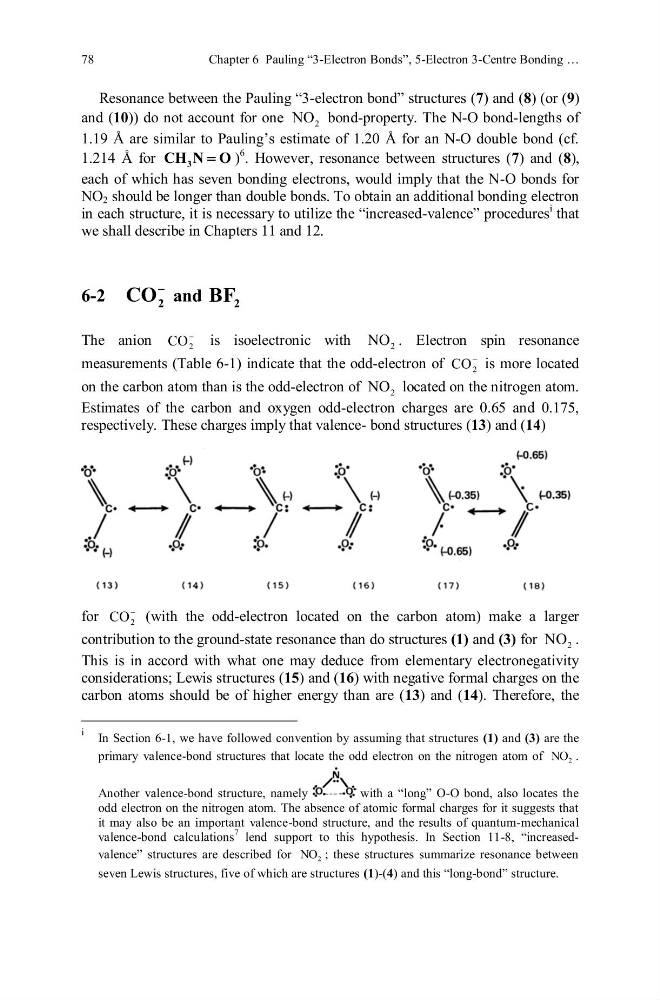
respectively. These charges imply that valence- bond structures (13) and (14)
for
2
CO
(with the odd-electron located on the carbon atom) make a larger
contribution to the ground-state resonance than do structures (1) and (3) for
2
NO .
This is in accord with what one may deduce from elementary electronegativity
considerations; Lewis structures (15) and (16) with negative formal charges on the
carbon atoms should be of higher energy than are (13) and (14). Therefore, the
i In Section 6-1, we have followed convention by assuming that structures (1) and (3) are the
primary valence-bond structures that locate the odd electron on the nitrogen atom of
2
NO .
Another valence-bond structure, namely
with a “long” O-O bond, also locates the
odd electron on the nitrogen atom. The absence of atomic formal charges for it suggests that
it may also be an important valence-bond structure, and the results of quantum-mechanical
valence-bond calculations
7 lend support to this hypothesis. In Section 11-8, “increasedvalence” structures are described for
2
NO ; these structures summarize resonance between
seven Lewis structures, five of which are structures (1)-(4) and this “long-bond” structure.
Chapter 6 Pauling “3-Electron Bonds”, 5-Electron 3-Centre Bonding …
Resonance between the Pauling “3-electron bond” structures (7) and (8) (or (9)
and (10)) do not account for one
2
NO bond-property. The N-O bond-lengths of
1.19 Å are similar to Pauling’s estimate of 1.20 Å for an N-O double bond (cf.
1.214 Å for
3
CH N O
)
6 . However, resonance between structures (7) and (8),
each of which has seven bonding electrons, would imply that the N-O bonds for
NO 2 should be longer than double bonds. To obtain an additional bonding electron
in each structure, it is necessary to utilize the “increased-valence” procedures
i that
we shall describe in Chapters 11 and 12.
6-2
2
CO
and
2
BF
The anion
2
CO
is isoelectronic with
2
NO . Electron spin resonance
measurements (Table 6-1) indicate that the odd-electron of
2
CO
is more located
on the carbon atom than is the odd-electron of
2
NO located on the nitrogen atom.
Estimates of the carbon and oxygen odd-electron charges are 0.65 and 0.175,
respectively. These charges imply that valence- bond structures (13) and (14)
for
2
CO
(with the odd-electron located on the carbon atom) make a larger
contribution to the ground-state resonance than do structures (1) and (3) for
2
NO .
This is in accord with what one may deduce from elementary electronegativity
considerations; Lewis structures (15) and (16) with negative formal charges on the
carbon atoms should be of higher energy than are (13) and (14). Therefore, the
i In Section 6-1, we have followed convention by assuming that structures (1) and (3) are the
primary valence-bond structures that locate the odd electron on the nitrogen atom of
2
NO .
Another valence-bond structure, namely
with a “long” O-O bond, also locates the
odd electron on the nitrogen atom. The absence of atomic formal charges for it suggests that
it may also be an important valence-bond structure, and the results of quantum-mechanical
valence-bond calculations
7 lend support to this hypothesis. In Section 11-8, “increasedvalence” structures are described for
2
NO ; these structures summarize resonance between
seven Lewis structures, five of which are structures (1)-(4) and this “long-bond” structure.