

6-1 NO2
77
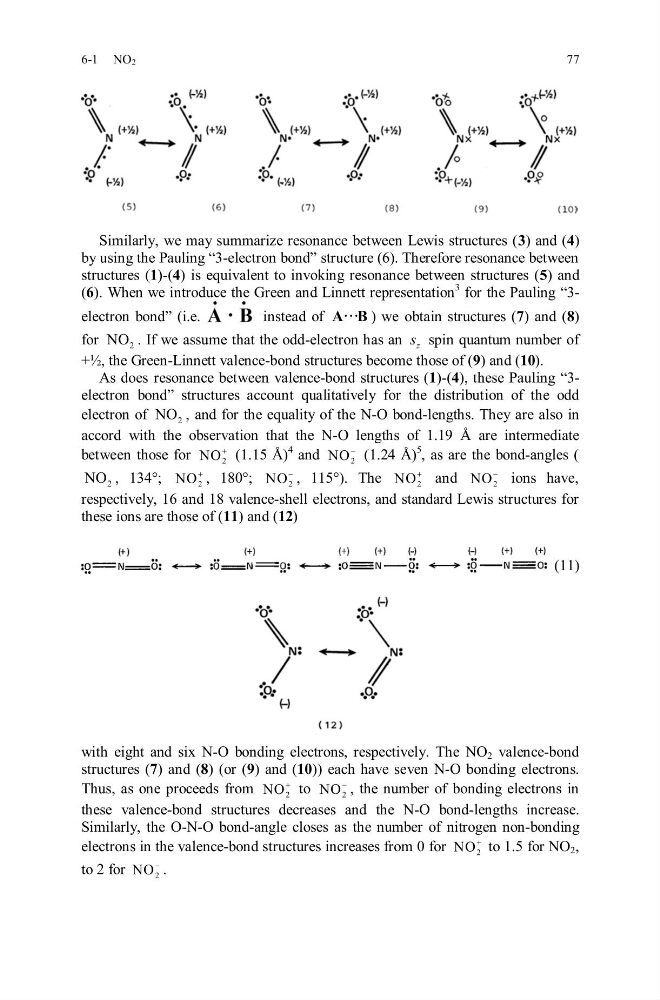
Similarly, we may summarize resonance between Lewis structures (3) and (4)
by using the Pauling “3-electron bond” structure (6). Therefore resonance between
structures (1)-(4) is equivalent to invoking resonance between structures (5) and
(6). When we introduce the Green and Linnett representation
3 for the Pauling “3electron bond” (i.e.
instead of A···B ) we obtain structures (7) and (8)
for
2
NO . If we assume that the odd-electron has an z
s spin quantum number of
+½, the Green-Linnett valence-bond structures become those of (9) and (10).
As does resonance between valence-bond structures (1)-(4), these Pauling “3electron bond” structures account qualitatively for the distribution of the odd
electron of
2
NO , and for the equality of the N-O bond-lengths. They are also in
accord with the observation that the N-O lengths of 1.19 Å are intermediate
between those for
2
NO
(1.15 Å)
4 and
2
NO
(1.24 Å)
5
, as are the bond-angles (
2
NO , 134°;
2
NO
, 180°;
2
NO
, 115°). The
2
NO
and
2
NO
ions have,
respectively, 16 and 18 valence-shell electrons, and standard Lewis structures for
these ions are those of (11) and (12)
(11)
with eight and six N-O bonding electrons, respectively. The NO 2 valence-bond
structures (7) and (8) (or (9) and (10)) each have seven N-O bonding electrons.
Thus, as one proceeds from
2
NO
to
2
NO
, the number of bonding electrons in
these valence-bond structures decreases and the N-O bond-lengths increase.
Similarly, the O-N-O bond-angle closes as the number of nitrogen non-bonding
electrons in the valence-bond structures increases from 0 for
2
NO
to 1.5 for NO 2 ,
to 2 for
2
NO
.
77
Similarly, we may summarize resonance between Lewis structures (3) and (4)
by using the Pauling “3-electron bond” structure (6). Therefore resonance between
structures (1)-(4) is equivalent to invoking resonance between structures (5) and
(6). When we introduce the Green and Linnett representation
3 for the Pauling “3electron bond” (i.e.
instead of A···B ) we obtain structures (7) and (8)
for
2
NO . If we assume that the odd-electron has an z
s spin quantum number of
+½, the Green-Linnett valence-bond structures become those of (9) and (10).
As does resonance between valence-bond structures (1)-(4), these Pauling “3electron bond” structures account qualitatively for the distribution of the odd
electron of
2
NO , and for the equality of the N-O bond-lengths. They are also in
accord with the observation that the N-O lengths of 1.19 Å are intermediate
between those for
2
NO
(1.15 Å)
4 and
2
NO
(1.24 Å)
5
, as are the bond-angles (
2
NO , 134°;
2
NO
, 180°;
2
NO
, 115°). The
2
NO
and
2
NO
ions have,
respectively, 16 and 18 valence-shell electrons, and standard Lewis structures for
these ions are those of (11) and (12)
(11)
with eight and six N-O bonding electrons, respectively. The NO 2 valence-bond
structures (7) and (8) (or (9) and (10)) each have seven N-O bonding electrons.
Thus, as one proceeds from
2
NO
to
2
NO
, the number of bonding electrons in
these valence-bond structures decreases and the N-O bond-lengths increase.
Similarly, the O-N-O bond-angle closes as the number of nitrogen non-bonding
electrons in the valence-bond structures increases from 0 for
2
NO
to 1.5 for NO 2 ,
to 2 for
2
NO
.