

76
Chapter 6 Pauling “3-Electron Bonds”, 5-Electron 3-Centre Bonding …
Table 6-1 Electron spin resonance estimates of Α-atom odd-electron charges ( A
) for AY2
radicals, (a) H.J. Bower, M.C.R. Symons and D.J.A. Tinling, in Radical Ions (E.T. Kaiser and L.
Kevan, eds., Interscience, New York, 1968) Chapter 10; (b) M.C.R. Symons, Chem. Soc.
Specialist Reports., Electron Spin Resonance 3, 140 (1974); (c) W. Nelson and W. Gordy,
J. Chem. Phys., 51, 4710 (1969); (d) M.S. Wei, J.H. Current and J. Gendell, J. Chem. Phys. 57,
2431 (1972). For reasons that are discussed in Ref. (d), the experimental estimates of the spin
densities (which we have equated to the odd-electron charges) rarely add exactly to unity.
However we shall make the simplifying assumption that they do, i.e. that A
Y
2
1
with the
A
given in this table.
2
NO
(σ)
(a)
0.52
2
2
NO
(π)
(b)
0.80
2
CO
(σ)
(b)
0.65
2
ClO
(π)
(a)
0.59
2
BF
(σ)
(c)
0.93
2
NF
(π)
(a)
0.95 ,
(d)
0.77
3
O
(σ)
(b)
0.58
2
PF
(π)
(d )
0.91
2
SO
(π)
(b)
0.74
2
PCl
(π)
(d )
0.81
is needed to account for the location of the odd-electron on all three atoms and for
the equality of the N-O bond-lengths. If it is assumed that each of the structures
(1)-(4) makes the same contribution to the resonance, then the nitrogen and
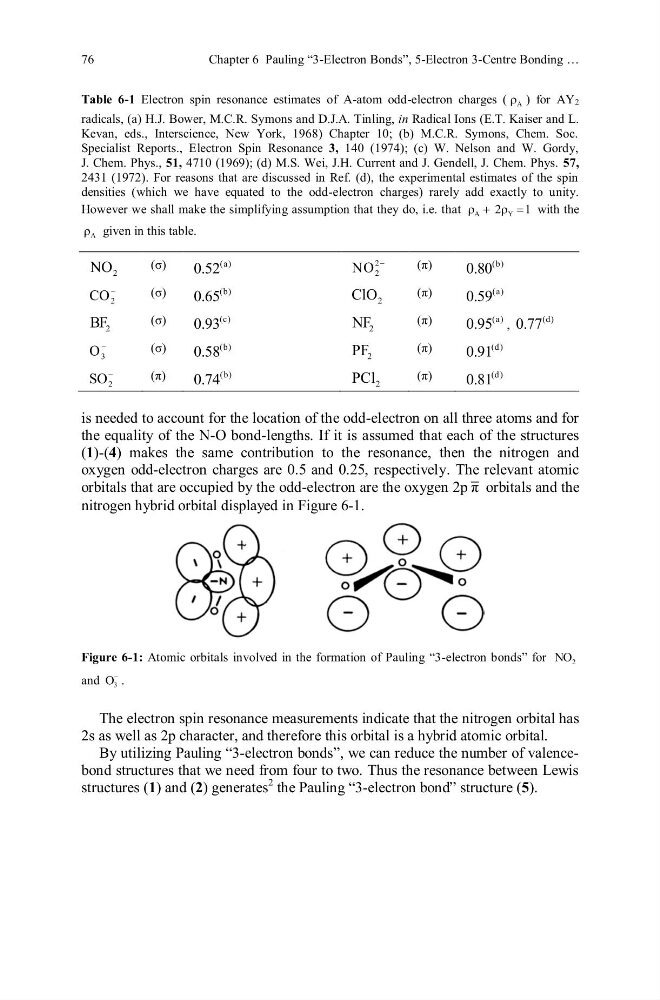
oxygen odd-electron charges are 0.5 and 0.25, respectively. The relevant atomic
orbitals that are occupied by the odd-electron are the oxygen 2p π orbitals and the
nitrogen hybrid orbital displayed in Figure 6-1.
Figure 6-1: Atomic orbitals involved in the formation of Pauling “3-electron bonds” for
2
NO
and 3
O
.
The electron spin resonance measurements indicate that the nitrogen orbital has
2s as well as 2p character, and therefore this orbital is a hybrid atomic orbital.
By utilizing Pauling “3-electron bonds”, we can reduce the number of valencebond structures that we need from four to two. Thus the resonance between Lewis
structures (1) and (2) generates
2 the Pauling “3-electron bond” structure (5).
Chapter 6 Pauling “3-Electron Bonds”, 5-Electron 3-Centre Bonding …
Table 6-1 Electron spin resonance estimates of Α-atom odd-electron charges ( A
) for AY2
radicals, (a) H.J. Bower, M.C.R. Symons and D.J.A. Tinling, in Radical Ions (E.T. Kaiser and L.
Kevan, eds., Interscience, New York, 1968) Chapter 10; (b) M.C.R. Symons, Chem. Soc.
Specialist Reports., Electron Spin Resonance 3, 140 (1974); (c) W. Nelson and W. Gordy,
J. Chem. Phys., 51, 4710 (1969); (d) M.S. Wei, J.H. Current and J. Gendell, J. Chem. Phys. 57,
2431 (1972). For reasons that are discussed in Ref. (d), the experimental estimates of the spin
densities (which we have equated to the odd-electron charges) rarely add exactly to unity.
However we shall make the simplifying assumption that they do, i.e. that A
Y
2
1
with the
A
given in this table.
2
NO
(σ)
(a)
0.52
2
2
NO
(π)
(b)
0.80
2
CO
(σ)
(b)
0.65
2
ClO
(π)
(a)
0.59
2
BF
(σ)
(c)
0.93
2
NF
(π)
(a)
0.95 ,
(d)
0.77
3
O
(σ)
(b)
0.58
2
PF
(π)
(d )
0.91
2
SO
(π)
(b)
0.74
2
PCl
(π)
(d )
0.81
is needed to account for the location of the odd-electron on all three atoms and for
the equality of the N-O bond-lengths. If it is assumed that each of the structures
(1)-(4) makes the same contribution to the resonance, then the nitrogen and
oxygen odd-electron charges are 0.5 and 0.25, respectively. The relevant atomic
orbitals that are occupied by the odd-electron are the oxygen 2p π orbitals and the
nitrogen hybrid orbital displayed in Figure 6-1.
Figure 6-1: Atomic orbitals involved in the formation of Pauling “3-electron bonds” for
2
NO
and 3
O
.
The electron spin resonance measurements indicate that the nitrogen orbital has
2s as well as 2p character, and therefore this orbital is a hybrid atomic orbital.
By utilizing Pauling “3-electron bonds”, we can reduce the number of valencebond structures that we need from four to two. Thus the resonance between Lewis
structures (1) and (2) generates
2 the Pauling “3-electron bond” structure (5).