

6-5 Some Tetra-Atomic Radicals
83
(together with two other equivalent structures). For each of these structures, the
odd-electron occupies an oxygen atomic orbital. To locate the odd-electron in a
carbon or nitrogen atomic orbital, it is necessary to reduce the number of C-O and
N-O covalent bonds, as occurs in structures (36)-(39), for example. These latter
structures do not have a more favourable distribution of atomic formal charges
than do structures (34) and (35). This fact, taken together with the smaller number
of C-O or N-O covalent bonds, suggests that structures (36)-(39) should be
unimportant valence-bond structures for the ground-states of these radicals. This
expectation is in accord with the electron spin resonance observations that the
odd-electron for either
3
NO or
3
CO
occupies primarily atomic orbitals that are
located on the oxygen atoms. Therefore, no appreciable development of a Pauling
“3-electron bond” may occur for these systems.
In contrast, the radicals
2
3
NO
,
2
3
PO
,
3
SO
and
3
ClO with 25 valence shell
electrons, have been found to have their odd electron delocalized over all atomic
centres
10
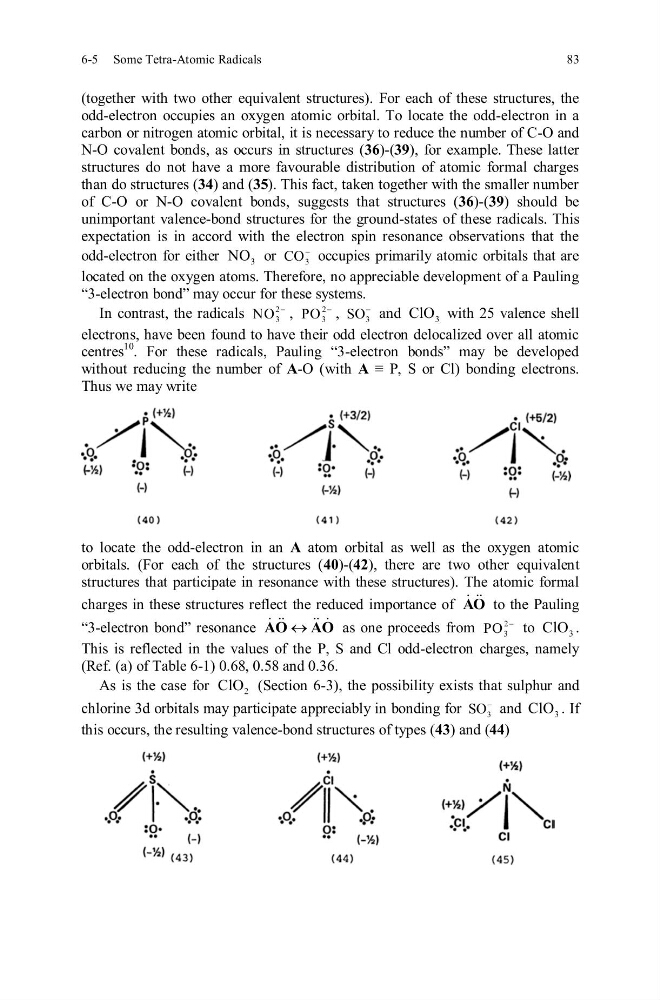
. For these radicals, Pauling “3-electron bonds” may be developed
without reducing the number of A-O (with A ≡ P, S or Cl) bonding electrons.
Thus we may write
to locate the odd-electron in an A atom orbital as well as the oxygen atomic
orbitals. (For each of the structures (40)-(42), there are two other equivalent
structures that participate in resonance with these structures). The atomic formal
charges in these structures reflect the reduced importance of O
A
to the Pauling
“3-electron bond” resonance
O
A
O
A
as one proceeds from
2
3
PO
to
3
ClO .
This is reflected in the values of the P, S and Cl odd-electron charges, namely
(Ref. (a) of Table 6-1) 0.68, 0.58 and 0.36.
As is the case for
2
ClO (Section 6-3), the possibility exists that sulphur and
chlorine 3d orbitals may participate appreciably in bonding for
3
SO
and
3
ClO . If
this occurs, the resulting valence-bond structures of types (43) and (44)
83
(together with two other equivalent structures). For each of these structures, the
odd-electron occupies an oxygen atomic orbital. To locate the odd-electron in a
carbon or nitrogen atomic orbital, it is necessary to reduce the number of C-O and
N-O covalent bonds, as occurs in structures (36)-(39), for example. These latter
structures do not have a more favourable distribution of atomic formal charges
than do structures (34) and (35). This fact, taken together with the smaller number
of C-O or N-O covalent bonds, suggests that structures (36)-(39) should be
unimportant valence-bond structures for the ground-states of these radicals. This
expectation is in accord with the electron spin resonance observations that the
odd-electron for either
3
NO or
3
CO
occupies primarily atomic orbitals that are
located on the oxygen atoms. Therefore, no appreciable development of a Pauling
“3-electron bond” may occur for these systems.
In contrast, the radicals
2
3
NO
,
2
3
PO
,
3
SO
and
3
ClO with 25 valence shell
electrons, have been found to have their odd electron delocalized over all atomic
centres
10
. For these radicals, Pauling “3-electron bonds” may be developed
without reducing the number of A-O (with A ≡ P, S or Cl) bonding electrons.
Thus we may write
to locate the odd-electron in an A atom orbital as well as the oxygen atomic
orbitals. (For each of the structures (40)-(42), there are two other equivalent
structures that participate in resonance with these structures). The atomic formal
charges in these structures reflect the reduced importance of O
A
to the Pauling
“3-electron bond” resonance
O
A
O
A
as one proceeds from
2
3
PO
to
3
ClO .
This is reflected in the values of the P, S and Cl odd-electron charges, namely
(Ref. (a) of Table 6-1) 0.68, 0.58 and 0.36.
As is the case for
2
ClO (Section 6-3), the possibility exists that sulphur and
chlorine 3d orbitals may participate appreciably in bonding for
3
SO
and
3
ClO . If
this occurs, the resulting valence-bond structures of types (43) and (44)