

72
Chapter 5 Pauling “3-Electron Bonds” and Hypoligated Transition Metal Complexes
positive charges greater than unity. Thus, to satisfy this requirement, we have
indicated only two π-bonds in valence-bond structure (8), although on overlap
considerations, three are possible. The average Fe-O bond-order for (8) is unity,
but because part of the contribution arises from the π-bonding, it is not surprising
that the Fe-O bond-lengths for
3
2
6
[Fe(H O) ]
are longer than the estimate
9 of 1.92
Å for the length of an Fe-O σ-single bond. For the Co(II) and Co(III) complexes,
the
3
NH ligands have no lone-pair electrons available for Co-N π-bonding.
5-4 Interconversion Between Hypoligated and Hyperligated
Electronic States
The Pauling “3-electron bond” theory of hypoligation has wide applicability. All
4
9
d – d transition-metal complexes of the type ML N will involve one or more
Pauling “3-electron bonds” in their valence-bond structures, if the metal-ion has
insufficient vacant inner d and valence-shell s and p orbitals available to form N
electron-pair M-L σ-bonds with the N ligands.
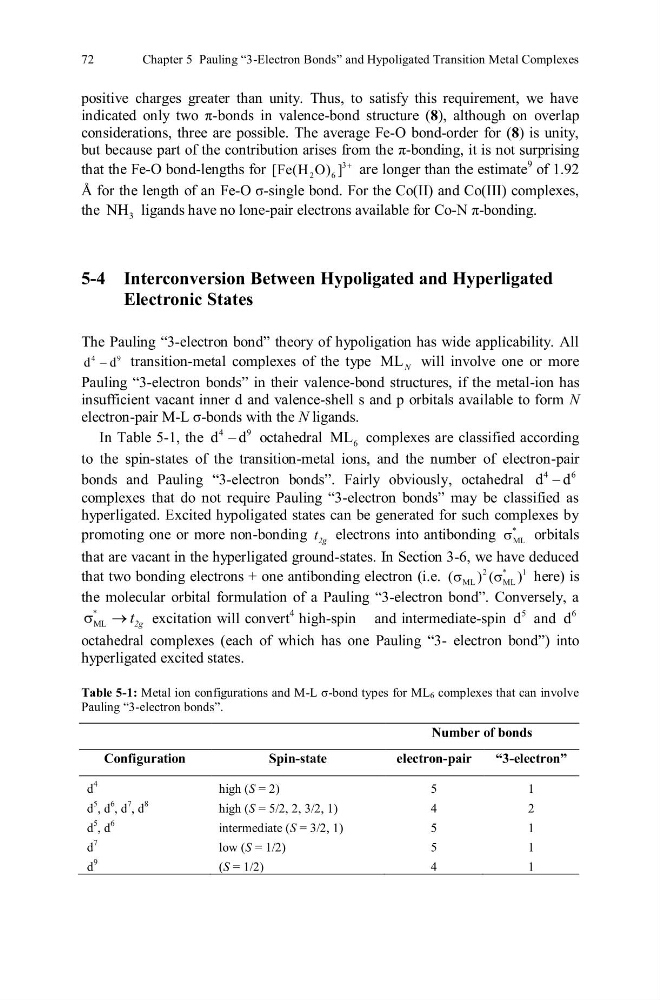
In Table 5-1, the
4
9
d – d octahedral
6
ML complexes are classified according
to the spin-states of the transition-metal ions, and the number of electron-pair
bonds and Pauling “3-electron bonds”. Fairly obviously, octahedral
4
6
d d
complexes that do not require Pauling “3-electron bonds” may be classified as
hyperligated. Excited hypoligated states can be generated for such complexes by
promoting one or more non-bonding 2g
t electrons into antibonding
*
ML
orbitals
that are vacant in the hyperligated ground-states. In Section 3-6, we have deduced
that two bonding electrons + one antibonding electron (i.e.
2
*
1
ML
ML
(
) (
)
here) is
the molecular orbital formulation of a Pauling “3-electron bond”. Conversely, a
*
ML
2g
t
excitation will convert
4 high-spin and intermediate-spin
5
d and
6
d
octahedral complexes (each of which has one Pauling “3- electron bond”) into
hyperligated excited states.
Table 5-1: Metal ion configurations and M-L σ-bond types for ML6 complexes that can involve
Pauling “3-electron bonds”.
Number of bonds
Configuration
Spin-state
electron-pair
“3-electron”
d
4
high (S = 2)
5
1
d
5
, d
6
, d
7
, d
8
high (S = 5/2, 2, 3/2, 1)
4
2
d
5
, d
6
intermediate (S = 3/2, 1)
5
1
d
7
low (S = 1/2)
5
1
d
9
(S = 1/2)
4
1
Chapter 5 Pauling “3-Electron Bonds” and Hypoligated Transition Metal Complexes
positive charges greater than unity. Thus, to satisfy this requirement, we have
indicated only two π-bonds in valence-bond structure (8), although on overlap
considerations, three are possible. The average Fe-O bond-order for (8) is unity,
but because part of the contribution arises from the π-bonding, it is not surprising
that the Fe-O bond-lengths for
3
2
6
[Fe(H O) ]
are longer than the estimate
9 of 1.92
Å for the length of an Fe-O σ-single bond. For the Co(II) and Co(III) complexes,
the
3
NH ligands have no lone-pair electrons available for Co-N π-bonding.
5-4 Interconversion Between Hypoligated and Hyperligated
Electronic States
The Pauling “3-electron bond” theory of hypoligation has wide applicability. All
4
9
d – d transition-metal complexes of the type ML N will involve one or more
Pauling “3-electron bonds” in their valence-bond structures, if the metal-ion has
insufficient vacant inner d and valence-shell s and p orbitals available to form N
electron-pair M-L σ-bonds with the N ligands.
In Table 5-1, the
4
9
d – d octahedral
6
ML complexes are classified according
to the spin-states of the transition-metal ions, and the number of electron-pair
bonds and Pauling “3-electron bonds”. Fairly obviously, octahedral
4
6
d d
complexes that do not require Pauling “3-electron bonds” may be classified as
hyperligated. Excited hypoligated states can be generated for such complexes by
promoting one or more non-bonding 2g
t electrons into antibonding
*
ML
orbitals
that are vacant in the hyperligated ground-states. In Section 3-6, we have deduced
that two bonding electrons + one antibonding electron (i.e.
2
*
1
ML
ML
(
) (
)
here) is
the molecular orbital formulation of a Pauling “3-electron bond”. Conversely, a
*
ML
2g
t
excitation will convert
4 high-spin and intermediate-spin
5
d and
6
d
octahedral complexes (each of which has one Pauling “3- electron bond”) into
hyperligated excited states.
Table 5-1: Metal ion configurations and M-L σ-bond types for ML6 complexes that can involve
Pauling “3-electron bonds”.
Number of bonds
Configuration
Spin-state
electron-pair
“3-electron”
d
4
high (S = 2)
5
1
d
5
, d
6
, d
7
, d
8
high (S = 5/2, 2, 3/2, 1)
4
2
d
5
, d
6
intermediate (S = 3/2, 1)
5
1
d
7
low (S = 1/2)
5
1
d
9
(S = 1/2)
4
1