

5-5 Metal-Ligand -Bonding and Pauling “3-Electron Bonds”
73
5-5 Metal-Ligand -Bonding and Pauling “3-Electron Bonds”
A number of paramagnetic transition metal complexes must involve Pauling “3electron bonds” for the π-electrons only. We shall consider one example here,
namely the Fe(VI) tetrahedral anion
2
4
FeO
. This anion may be considered to
involve
6
2
Fe (3d)
bonded to four
2
O
ligands. In a tetrahedral environment, the
lowest- energy 3d orbitals are xy
d and yz
d , which are degenerate. Consequently,
the
2
(3d) configuration of lowest energy is an S = 1 spin state, with parallel spins
for the two electrons that occupy these orbitals. Magnetic susceptibility
measurements
10 support this assignment of an S = 1 spin state for
2
4
FeO
.
The remaining seven valence-shell orbitals of Fe
2+ are vacant, and they are
available for coordination with the O
2– ligands. Tetrahedral hybridization of the 4s
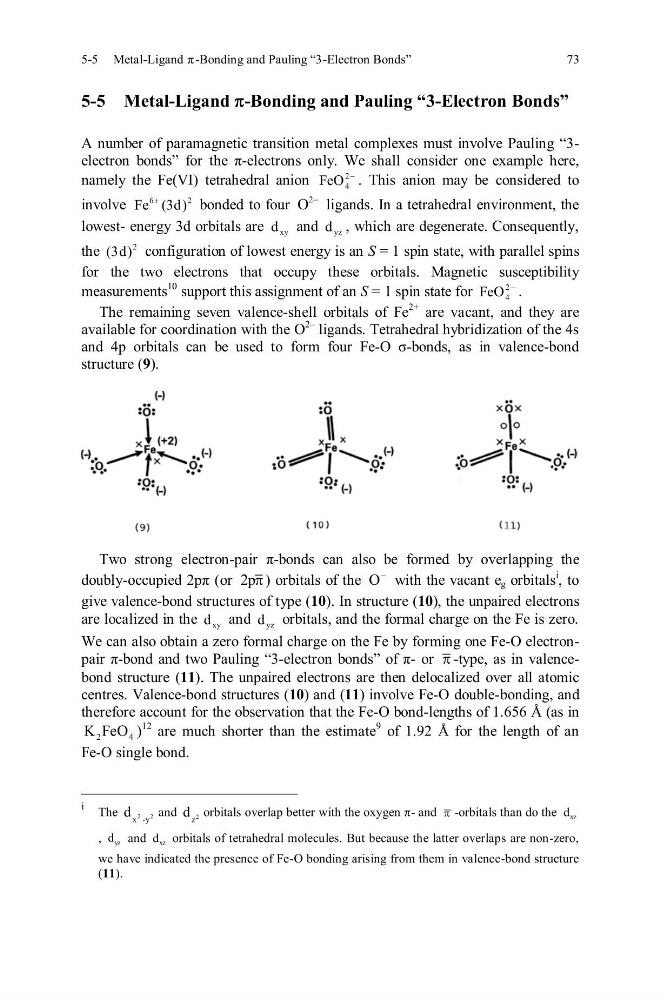
and 4p orbitals can be used to form four Fe-O σ-bonds, as in valence-bond
structure (9).
Two strong electron-pair π-bonds can also be formed by overlapping the
doubly-occupied 2pπ (or 2p ) orbitals of the O
with the vacant e g orbitals
i
, to
give valence-bond structures of type (10). In structure (10), the unpaired electrons
are localized in the xy
d and yz
d orbitals, and the formal charge on the Fe is zero.
We can also obtain a zero formal charge on the Fe by forming one Fe-O electronpair π-bond and two Pauling “3-electron bonds” of π- or -type, as in valencebond structure (11). The unpaired electrons are then delocalized over all atomic
centres. Valence-bond structures (10) and (11) involve Fe-O double-bonding, and
therefore account for the observation that the Fe-O bond-lengths of 1.656 Å (as in
2
4
K FeO )
12 are much shorter than the estimate
9 of 1.92 Å for the length of an
Fe-O single bond.
i The
2
2
x -y
d
and
2
z
d orbitals overlap better with the oxygen π- and -orbitals than do the xz
d
, yz
d and xz
d orbitals of tetrahedral molecules. But because the latter overlaps are non-zero,
we have indicated the presence of Fe-O bonding arising from them in valence-bond structure
(11).
π
73
5-5 Metal-Ligand -Bonding and Pauling “3-Electron Bonds”
A number of paramagnetic transition metal complexes must involve Pauling “3electron bonds” for the π-electrons only. We shall consider one example here,
namely the Fe(VI) tetrahedral anion
2
4
FeO
. This anion may be considered to
involve
6
2
Fe (3d)
bonded to four
2
O
ligands. In a tetrahedral environment, the
lowest- energy 3d orbitals are xy
d and yz
d , which are degenerate. Consequently,
the
2
(3d) configuration of lowest energy is an S = 1 spin state, with parallel spins
for the two electrons that occupy these orbitals. Magnetic susceptibility
measurements
10 support this assignment of an S = 1 spin state for
2
4
FeO
.
The remaining seven valence-shell orbitals of Fe
2+ are vacant, and they are
available for coordination with the O
2– ligands. Tetrahedral hybridization of the 4s
and 4p orbitals can be used to form four Fe-O σ-bonds, as in valence-bond
structure (9).
Two strong electron-pair π-bonds can also be formed by overlapping the
doubly-occupied 2pπ (or 2p ) orbitals of the O
with the vacant e g orbitals
i
, to
give valence-bond structures of type (10). In structure (10), the unpaired electrons
are localized in the xy
d and yz
d orbitals, and the formal charge on the Fe is zero.
We can also obtain a zero formal charge on the Fe by forming one Fe-O electronpair π-bond and two Pauling “3-electron bonds” of π- or -type, as in valencebond structure (11). The unpaired electrons are then delocalized over all atomic
centres. Valence-bond structures (10) and (11) involve Fe-O double-bonding, and
therefore account for the observation that the Fe-O bond-lengths of 1.656 Å (as in
2
4
K FeO )
12 are much shorter than the estimate
9 of 1.92 Å for the length of an
Fe-O single bond.
i The
2
2
x -y
d
and
2
z
d orbitals overlap better with the oxygen π- and -orbitals than do the xz
d
, yz
d and xz
d orbitals of tetrahedral molecules. But because the latter overlaps are non-zero,
we have indicated the presence of Fe-O bonding arising from them in valence-bond structure
(11).
π