

5-3 Metal-Ion Spin-State and Metal-Ligand Bond-Lengths
71
5-3 Metal-Ion Spin-State and Metal-Ligand Bond-Lengths
The nature of the spin-state of the metal ion may be reflected in the metal-ligand
bond-lengths of the ML N complex. This is well-exemplified for the hyperligated
and hypoligated complexes
3
3 6
[Co(NH ) ]
, and
2
3 6
[Co(NH ) ]
, which have
respectively low-spin
6
(3d) and high-spin
7
(3d) configurations for the Co
3+ and
Co
2+ ions. The Co-N bond-lengths for these complexes are 1.94 Å and 2.11 Å,
respectively
5, 6 . In Section 5-1, we have shown that the valence-bond description
for the Co(III) complex permits the formation of six electron-pair Co-N σ-bonds,
as in structure (1).
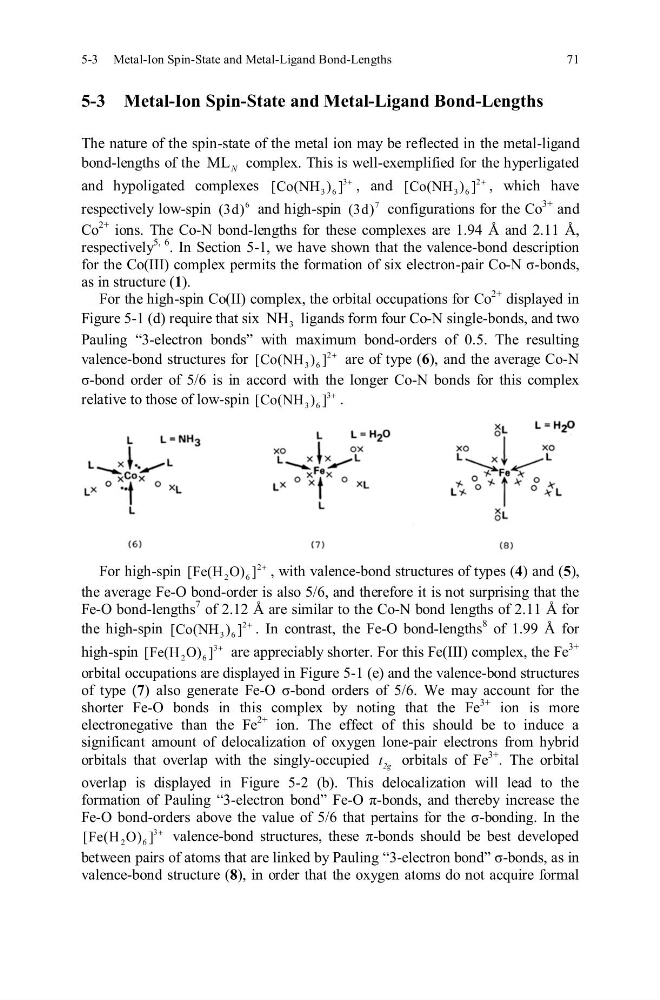
For the high-spin Co(II) complex, the orbital occupations for Co
2+ displayed in
Figure 5-1 (d) require that six
3
NH ligands form four Co-N single-bonds, and two
Pauling “3-electron bonds” with maximum bond-orders of 0.5. The resulting
valence-bond structures for
2
3 6
[Co(NH ) ]
are of type (6), and the average Co-N
σ-bond order of 5/6 is in accord with the longer Co-N bonds for this complex
relative to those of low-spin
3
3 6
[Co(NH ) ]
.
For high-spin
2
2
6
[Fe(H O) ]
, with valence-bond structures of types (4) and (5),
the average Fe-O bond-order is also 5/6, and therefore it is not surprising that the
Fe-O bond-lengths
7 of 2.12 Å are similar to the Co-N bond lengths of 2.11 Å for
the high-spin
2
3 6
[Co(NH ) ]
. In contrast, the Fe-O bond-lengths
8 of 1.99 Å for
high-spin
3
2
6
[Fe(H O) ]
are appreciably shorter. For this Fe(III) complex, the Fe
3+
orbital occupations are displayed in Figure 5-1 (e) and the valence-bond structures
of type (7) also generate Fe-O σ-bond orders of 5/6. We may account for the
shorter Fe-O bonds in this complex by noting that the Fe
3+ ion is more
electronegative than the Fe
2+ ion. The effect of this should be to induce a
significant amount of delocalization of oxygen lone-pair electrons from hybrid
orbitals that overlap with the singly-occupied 2g
t orbitals of Fe
3+
. The orbital
overlap is displayed in Figure 5-2 (b). This delocalization will lead to the
formation of Pauling “3-electron bond” Fe-O π-bonds, and thereby increase the
Fe-O bond-orders above the value of 5/6 that pertains for the σ-bonding. In the
3
2
6
[Fe(H O) ]
valence-bond structures, these π-bonds should be best developed
between pairs of atoms that are linked by Pauling “3-electron bond” σ-bonds, as in
valence-bond structure (8), in order that the oxygen atoms do not acquire formal
71
5-3 Metal-Ion Spin-State and Metal-Ligand Bond-Lengths
The nature of the spin-state of the metal ion may be reflected in the metal-ligand
bond-lengths of the ML N complex. This is well-exemplified for the hyperligated
and hypoligated complexes
3
3 6
[Co(NH ) ]
, and
2
3 6
[Co(NH ) ]
, which have
respectively low-spin
6
(3d) and high-spin
7
(3d) configurations for the Co
3+ and
Co
2+ ions. The Co-N bond-lengths for these complexes are 1.94 Å and 2.11 Å,
respectively
5, 6 . In Section 5-1, we have shown that the valence-bond description
for the Co(III) complex permits the formation of six electron-pair Co-N σ-bonds,
as in structure (1).
For the high-spin Co(II) complex, the orbital occupations for Co
2+ displayed in
Figure 5-1 (d) require that six
3
NH ligands form four Co-N single-bonds, and two
Pauling “3-electron bonds” with maximum bond-orders of 0.5. The resulting
valence-bond structures for
2
3 6
[Co(NH ) ]
are of type (6), and the average Co-N
σ-bond order of 5/6 is in accord with the longer Co-N bonds for this complex
relative to those of low-spin
3
3 6
[Co(NH ) ]
.
For high-spin
2
2
6
[Fe(H O) ]
, with valence-bond structures of types (4) and (5),
the average Fe-O bond-order is also 5/6, and therefore it is not surprising that the
Fe-O bond-lengths
7 of 2.12 Å are similar to the Co-N bond lengths of 2.11 Å for
the high-spin
2
3 6
[Co(NH ) ]
. In contrast, the Fe-O bond-lengths
8 of 1.99 Å for
high-spin
3
2
6
[Fe(H O) ]
are appreciably shorter. For this Fe(III) complex, the Fe
3+
orbital occupations are displayed in Figure 5-1 (e) and the valence-bond structures
of type (7) also generate Fe-O σ-bond orders of 5/6. We may account for the
shorter Fe-O bonds in this complex by noting that the Fe
3+ ion is more
electronegative than the Fe
2+ ion. The effect of this should be to induce a
significant amount of delocalization of oxygen lone-pair electrons from hybrid
orbitals that overlap with the singly-occupied 2g
t orbitals of Fe
3+
. The orbital
overlap is displayed in Figure 5-2 (b). This delocalization will lead to the
formation of Pauling “3-electron bond” Fe-O π-bonds, and thereby increase the
Fe-O bond-orders above the value of 5/6 that pertains for the σ-bonding. In the
3
2
6
[Fe(H O) ]
valence-bond structures, these π-bonds should be best developed
between pairs of atoms that are linked by Pauling “3-electron bond” σ-bonds, as in
valence-bond structure (8), in order that the oxygen atoms do not acquire formal