

70
Chapter 5 Pauling “3-Electron Bonds” and Hypoligated Transition Metal Complexes
5-2 Pauling “3-Electron Bonds” and the Electronic Structure
of [Fe(H 2 O) 6 ]
2+
For the purpose of bonding to the
3
NH ligands of
3
3 6
[Co(NH ) ]
, the Co
3+ is
assumed to form six
2
3
d sp hybrid orbitals from the
2
2
x y
3d ,
2
z
3d , 4s and three 4p
orbitals. For
2
2
6
[Fe(H O) ]
, we allow the Fe
2+ to form a similar set of hybrid
orbitals. However, in contrast to what is the case for the Co
3+ in
3
3 6
[Co(NH ) ]
,
two of these Fe
2+ orbitals are singly-occupied, and four are vacant, as is shown in
Figure 5-1(c). The latter four orbitals are available to form four electron-pair σbonds between the Fe
2+ and four 2
H O ligands. The two singly-occupied
2
3
d sp
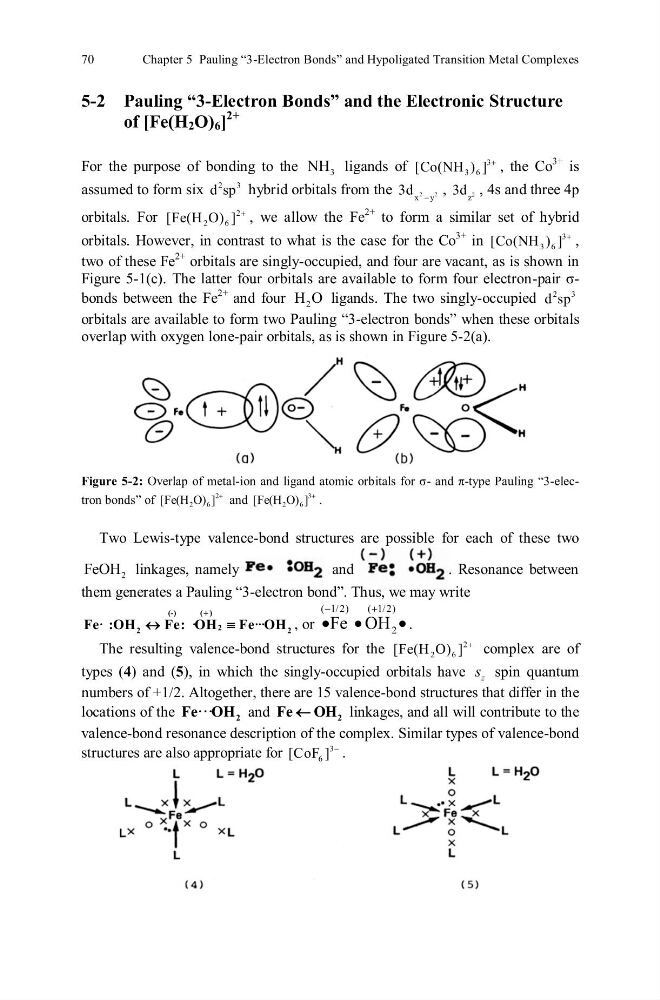
orbitals are available to form two Pauling “3-electron bonds” when these orbitals
overlap with oxygen lone-pair orbitals, as is shown in Figure 5-2(a).
Figure 5-2: Overlap of metal-ion and ligand atomic orbitals for σ- and π-type Pauling “3-electron bonds” of
2
2
6
[Fe(H O) ]
and
3
2
6
[Fe(H O) ]
.
Two Lewis-type valence-bond structures are possible for each of these two
2
FeOH linkages, namely
and
. Resonance between
them generates a Pauling “3-electron bond”. Thus, we may write
(-)
( )
2
2
2
Fe· :OH
Fe: ·OH
Fe···OH
, or
( 1/ 2)
( 1/ 2)
2
Fe OH
.
The resulting valence-bond structures for the
2
2
6
[Fe(H O) ]
complex are of
types (4) and (5), in which the singly-occupied orbitals have z
s spin quantum
numbers of +1/2. Altogether, there are 15 valence-bond structures that differ in the
locations of the
2
Fe···OH and
2
Fe OH
linkages, and all will contribute to the
valence-bond resonance description of the complex. Similar types of valence-bond
structures are also appropriate for
3
6
[CoF ]
.
Chapter 5 Pauling “3-Electron Bonds” and Hypoligated Transition Metal Complexes
5-2 Pauling “3-Electron Bonds” and the Electronic Structure
of [Fe(H 2 O) 6 ]
2+
For the purpose of bonding to the
3
NH ligands of
3
3 6
[Co(NH ) ]
, the Co
3+ is
assumed to form six
2
3
d sp hybrid orbitals from the
2
2
x y
3d ,
2
z
3d , 4s and three 4p
orbitals. For
2
2
6
[Fe(H O) ]
, we allow the Fe
2+ to form a similar set of hybrid
orbitals. However, in contrast to what is the case for the Co
3+ in
3
3 6
[Co(NH ) ]
,
two of these Fe
2+ orbitals are singly-occupied, and four are vacant, as is shown in
Figure 5-1(c). The latter four orbitals are available to form four electron-pair σbonds between the Fe
2+ and four 2
H O ligands. The two singly-occupied
2
3
d sp
orbitals are available to form two Pauling “3-electron bonds” when these orbitals
overlap with oxygen lone-pair orbitals, as is shown in Figure 5-2(a).
Figure 5-2: Overlap of metal-ion and ligand atomic orbitals for σ- and π-type Pauling “3-electron bonds” of
2
2
6
[Fe(H O) ]
and
3
2
6
[Fe(H O) ]
.
Two Lewis-type valence-bond structures are possible for each of these two
2
FeOH linkages, namely
and
. Resonance between
them generates a Pauling “3-electron bond”. Thus, we may write
(-)
( )
2
2
2
Fe· :OH
Fe: ·OH
Fe···OH
, or
( 1/ 2)
( 1/ 2)
2
Fe OH
.
The resulting valence-bond structures for the
2
2
6
[Fe(H O) ]
complex are of
types (4) and (5), in which the singly-occupied orbitals have z
s spin quantum
numbers of +1/2. Altogether, there are 15 valence-bond structures that differ in the
locations of the
2
Fe···OH and
2
Fe OH
linkages, and all will contribute to the
valence-bond resonance description of the complex. Similar types of valence-bond
structures are also appropriate for
3
6
[CoF ]
.