

4-9 N-H Bond-Strengths of NH3, N2H4, N2H2, and HN2 H + N2
61
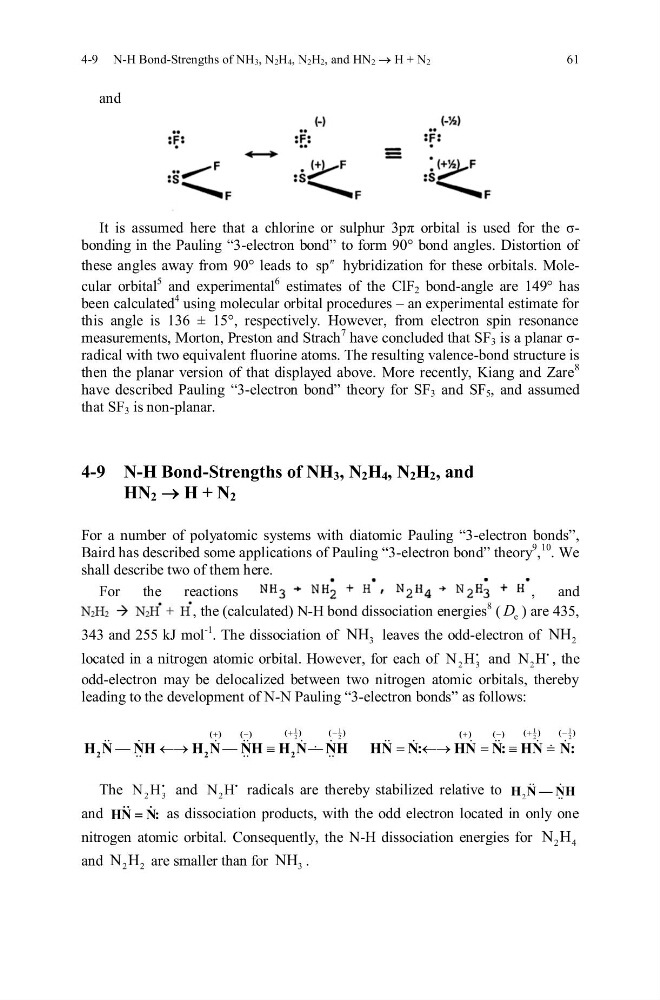
and
It is assumed here that a chlorine or sulphur 3pπ orbital is used for the σbonding in the Pauling “3-electron bond” to form 90° bond angles. Distortion of
these angles away from 90° leads to sp
n hybridization for these orbitals. Molecular orbital
5 and experimental
6 estimates of the ClF 2 bond-angle are 149° has
been calculated
4 using molecular orbital procedures – an experimental estimate for
this angle is 136 ± 15°, respectively. However, from electron spin resonance
measurements, Morton, Preston and Strach
7 have concluded that SF 3 is a planar σradical with two equivalent fluorine atoms. The resulting valence-bond structure is
then the planar version of that displayed above. More recently, Kiang and Zare
8
have described Pauling “3-electron bond” theory for SF 3 and SF 5 , and assumed
that SF 3 is non-planar.
4-9 N-H Bond-Strengths of NH 3 , N 2 H 4 , N 2 H 2 , and
HN 2 H + N 2
For a number of polyatomic systems with diatomic Pauling “3-electron bonds”,
Baird has described some applications of Pauling “3-electron bond” theory
9 ,
10
. We
shall describe two of them here.
For
the reactions
,
and
, the (calculated) N-H bond dissociation energies
8 ( e
D ) are 435,
343 and 255 kJ mol
-1
. The dissociation of
3
NH leaves the odd-electron of
2
NH
located in a nitrogen atomic orbital. However, for each of 2 3
N H
and 2
N H
, the
odd-electron may be delocalized between two nitrogen atomic orbitals, thereby
leading to the development of N-N Pauling “3-electron bonds” as follows:
1
1
1
1
2
2
2
2
( )
( )
( )
( )
( )
( )
( )
( )
2
2
2
H N — NH
H N — NH H N— NH HN N:
HN N: HN N:
The 2 3
N H
and 2
N H
radicals are thereby stabilized relative to 2
H N — NH
and HN N:
as dissociation products, with the odd electron located in only one
nitrogen atomic orbital. Consequently, the N-H dissociation energies for 2 4
N H
and 2 2
N H are smaller than for
3
NH .
61
and
It is assumed here that a chlorine or sulphur 3pπ orbital is used for the σbonding in the Pauling “3-electron bond” to form 90° bond angles. Distortion of
these angles away from 90° leads to sp
n hybridization for these orbitals. Molecular orbital
5 and experimental
6 estimates of the ClF 2 bond-angle are 149° has
been calculated
4 using molecular orbital procedures – an experimental estimate for
this angle is 136 ± 15°, respectively. However, from electron spin resonance
measurements, Morton, Preston and Strach
7 have concluded that SF 3 is a planar σradical with two equivalent fluorine atoms. The resulting valence-bond structure is
then the planar version of that displayed above. More recently, Kiang and Zare
8
have described Pauling “3-electron bond” theory for SF 3 and SF 5 , and assumed
that SF 3 is non-planar.
4-9 N-H Bond-Strengths of NH 3 , N 2 H 4 , N 2 H 2 , and
HN 2 H + N 2
For a number of polyatomic systems with diatomic Pauling “3-electron bonds”,
Baird has described some applications of Pauling “3-electron bond” theory
9 ,
10
. We
shall describe two of them here.
For
the reactions
,
and
, the (calculated) N-H bond dissociation energies
8 ( e
D ) are 435,
343 and 255 kJ mol
-1
. The dissociation of
3
NH leaves the odd-electron of
2
NH
located in a nitrogen atomic orbital. However, for each of 2 3
N H
and 2
N H
, the
odd-electron may be delocalized between two nitrogen atomic orbitals, thereby
leading to the development of N-N Pauling “3-electron bonds” as follows:
1
1
1
1
2
2
2
2
( )
( )
( )
( )
( )
( )
( )
( )
2
2
2
H N — NH
H N — NH H N— NH HN N:
HN N: HN N:
The 2 3
N H
and 2
N H
radicals are thereby stabilized relative to 2
H N — NH
and HN N:
as dissociation products, with the odd electron located in only one
nitrogen atomic orbital. Consequently, the N-H dissociation energies for 2 4
N H
and 2 2
N H are smaller than for
3
NH .