

60
Chapter 4 Valence-Bond Structures for some Diatomic and related Molecules
For NO
, the estimate of 1.268 Å for its bond-length is longer than the 1.21 Å
for the N-O double-bond of
3
CH N O
; the reason for this appreciable bondlength difference is not apparent.
4-7 ClO and FO
The molecular orbital configuration for the 13 valence-shell electrons of the ClO
ground-state is
x
2
2
2
2
2
* 2
* 1
x
y
y
( s) ( * s) ( p) ( ) ( ) ( ) ( )
, from which the valencebond structure
1
1
2
2
( )
( )
X O X
:Cl — O: may be generated with three bonding electrons. The ClO
bond-length of 1.55 Å is appreciably shorter than the Cl-O single-bond length of
1.70 Å for
2
Cl O , thereby reflecting the significant development of a Pauling “3electron bond” for one set of π-electrons for ClO. Dimers of ClO are known
(Section 11-7), one of which involves an O-O bond with a length
3 of 1.426 Å. For
FO, the valence-bond structure
may be similarly generated from its
molecular orbital configuration. However, in contrast to what occurs for
2 2
Cl O ,
the dimer 2 2
F O has a strong O-O bond whose length of 1.217 Å is almost identical with that of the double bond for 2
O (Section 2-3(b)). Presumably, the very
electronegative fluorine atom is not able to stabilize the Pauling “3-electron bond”
of FO, and the valence-bond structure
:F — O: with the odd-electron located in an
oxygen atomic orbital provides a better representation of the electronic structure.
This is equivalent to saying that the electronegativity of fluorine prevents it from
acquiring a formal positive charge of appreciable magnitude in a neutral molecule.
The results of calculations by Baird and Taylor
4 show that as the difference in
electronegativity between A and B in the Pauling “3-electron bond” structure
A · B
increases, the stability of the bond decreases.
4-8 ClF 2 and SF 3
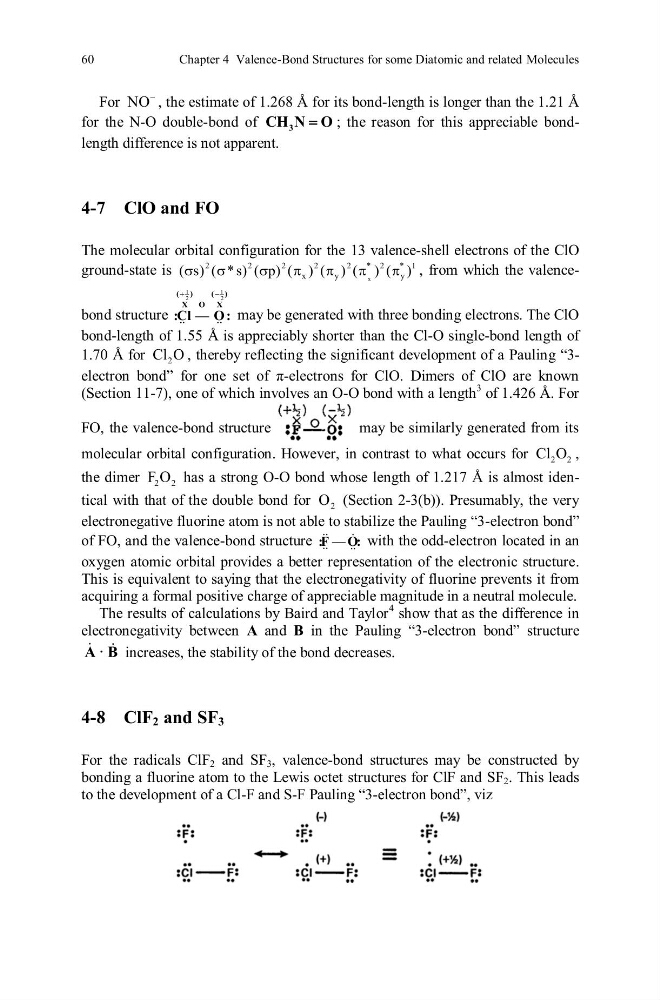
For the radicals ClF 2 and SF 3 , valence-bond structures may be constructed by
bonding a fluorine atom to the Lewis octet structures for ClF and SF 2 . This leads
to the development of a Cl-F and S-F Pauling “3-electron bond”, viz
Chapter 4 Valence-Bond Structures for some Diatomic and related Molecules
For NO
, the estimate of 1.268 Å for its bond-length is longer than the 1.21 Å
for the N-O double-bond of
3
CH N O
; the reason for this appreciable bondlength difference is not apparent.
4-7 ClO and FO
The molecular orbital configuration for the 13 valence-shell electrons of the ClO
ground-state is
x
2
2
2
2
2
* 2
* 1
x
y
y
( s) ( * s) ( p) ( ) ( ) ( ) ( )
, from which the valencebond structure
1
1
2
2
( )
( )
X O X
:Cl — O: may be generated with three bonding electrons. The ClO
bond-length of 1.55 Å is appreciably shorter than the Cl-O single-bond length of
1.70 Å for
2
Cl O , thereby reflecting the significant development of a Pauling “3electron bond” for one set of π-electrons for ClO. Dimers of ClO are known
(Section 11-7), one of which involves an O-O bond with a length
3 of 1.426 Å. For
FO, the valence-bond structure
may be similarly generated from its
molecular orbital configuration. However, in contrast to what occurs for
2 2
Cl O ,
the dimer 2 2
F O has a strong O-O bond whose length of 1.217 Å is almost identical with that of the double bond for 2
O (Section 2-3(b)). Presumably, the very
electronegative fluorine atom is not able to stabilize the Pauling “3-electron bond”
of FO, and the valence-bond structure
:F — O: with the odd-electron located in an
oxygen atomic orbital provides a better representation of the electronic structure.
This is equivalent to saying that the electronegativity of fluorine prevents it from
acquiring a formal positive charge of appreciable magnitude in a neutral molecule.
The results of calculations by Baird and Taylor
4 show that as the difference in
electronegativity between A and B in the Pauling “3-electron bond” structure
A · B
increases, the stability of the bond decreases.
4-8 ClF 2 and SF 3
For the radicals ClF 2 and SF 3 , valence-bond structures may be constructed by
bonding a fluorine atom to the Lewis octet structures for ClF and SF 2 . This leads
to the development of a Cl-F and S-F Pauling “3-electron bond”, viz