

62
Chapter 4 Valence-Bond Structures for some Diatomic and related Molecules
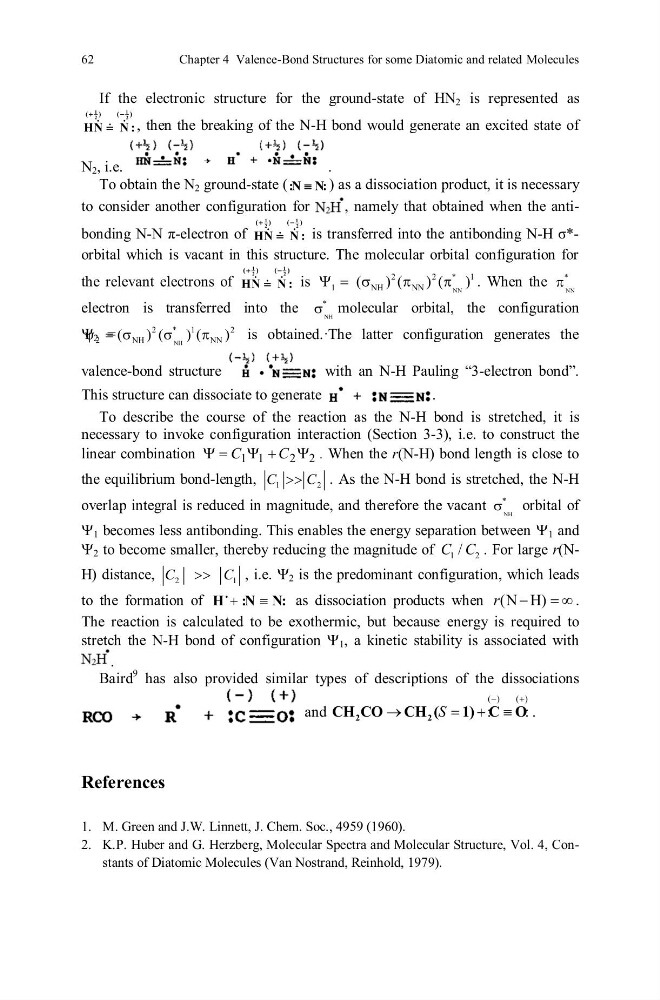
If the electronic structure for the ground-state of HN 2 is represented as
1
1
2
2
( )
( )
HN N :
, then the breaking of the N-H bond would generate an excited state of
N 2 , i.e.
.
To obtain the N 2 ground-state (:N N:
) as a dissociation product, it is necessary
to consider another configuration for
, namely that obtained when the antibonding N-N π-electron of
1
1
2
2
( )
( )
HN N :
is transferred into the antibonding N-H σ*orbital which is vacant in this structure. The molecular orbital configuration for
the relevant electrons of
1
1
2
2
( )
( )
HN N :
is
NN
2
2
*
1
1
NH
NN
(
) (
) ( )
. When the
*
electron is transferred into the
NH
*
molecular orbital, the configuration
2 =
NH
2
*
1
2
2
NH
NN
(
) (
) (
)
is obtained.·The latter configuration generates the
valence-bond structure
with an N-H Pauling “3-electron bond”.
This structure can dissociate to generate
.
To describe the course of the reaction as the N-H bond is stretched, it is
necessary to invoke configuration interaction (Section 3-3), i.e. to construct the
linear combination
2
2
1
1
C
C
. When the r(N-H) bond length is close to
the equilibrium bond-length, 1
2
C
C
. As the N-H bond is stretched, the N-H
overlap integral is reduced in magnitude, and therefore the vacant
NH
*
orbital of
1 becomes less antibonding. This enables the energy separation between 1 and
2 to become smaller, thereby reducing the magnitude of 1 2
/
C C . For large r(NH) distance, 2
1
C
C
, i.e. 2 is the predominant configuration, which leads
to the formation of
H :N N: as dissociation products when (N H)
r
.
The reaction is calculated to be exothermic, but because energy is required to
stretch the N-H bond of configuration 1 , a kinetic stability is associated with
.
Baird
9 has also provided similar types of descriptions of the dissociations
and
( )
( )
:
:
2
2
CH CO CH (
1) C O
S
.
References
1. M. Green and J.W. Linnett, J. Chem. Soc., 4959 (1960).
2. K.P. Huber and G. Herzberg, Molecular Spectra and Molecular Structure, Vol. 4, Constants of Diatomic Molecules (Van Nostrand, Reinhold, 1979).
Chapter 4 Valence-Bond Structures for some Diatomic and related Molecules
If the electronic structure for the ground-state of HN 2 is represented as
1
1
2
2
( )
( )
HN N :
, then the breaking of the N-H bond would generate an excited state of
N 2 , i.e.
.
To obtain the N 2 ground-state (:N N:
) as a dissociation product, it is necessary
to consider another configuration for
, namely that obtained when the antibonding N-N π-electron of
1
1
2
2
( )
( )
HN N :
is transferred into the antibonding N-H σ*orbital which is vacant in this structure. The molecular orbital configuration for
the relevant electrons of
1
1
2
2
( )
( )
HN N :
is
NN
2
2
*
1
1
NH
NN
(
) (
) ( )
. When the
*
electron is transferred into the
NH
*
molecular orbital, the configuration
2 =
NH
2
*
1
2
2
NH
NN
(
) (
) (
)
is obtained.·The latter configuration generates the
valence-bond structure
with an N-H Pauling “3-electron bond”.
This structure can dissociate to generate
.
To describe the course of the reaction as the N-H bond is stretched, it is
necessary to invoke configuration interaction (Section 3-3), i.e. to construct the
linear combination
2
2
1
1
C
C
. When the r(N-H) bond length is close to
the equilibrium bond-length, 1
2
C
C
. As the N-H bond is stretched, the N-H
overlap integral is reduced in magnitude, and therefore the vacant
NH
*
orbital of
1 becomes less antibonding. This enables the energy separation between 1 and
2 to become smaller, thereby reducing the magnitude of 1 2
/
C C . For large r(NH) distance, 2
1
C
C
, i.e. 2 is the predominant configuration, which leads
to the formation of
H :N N: as dissociation products when (N H)
r
.
The reaction is calculated to be exothermic, but because energy is required to
stretch the N-H bond of configuration 1 , a kinetic stability is associated with
.
Baird
9 has also provided similar types of descriptions of the dissociations
and
( )
( )
:
:
2
2
CH CO CH (
1) C O
S
.
References
1. M. Green and J.W. Linnett, J. Chem. Soc., 4959 (1960).
2. K.P. Huber and G. Herzberg, Molecular Spectra and Molecular Structure, Vol. 4, Constants of Diatomic Molecules (Van Nostrand, Reinhold, 1979).