

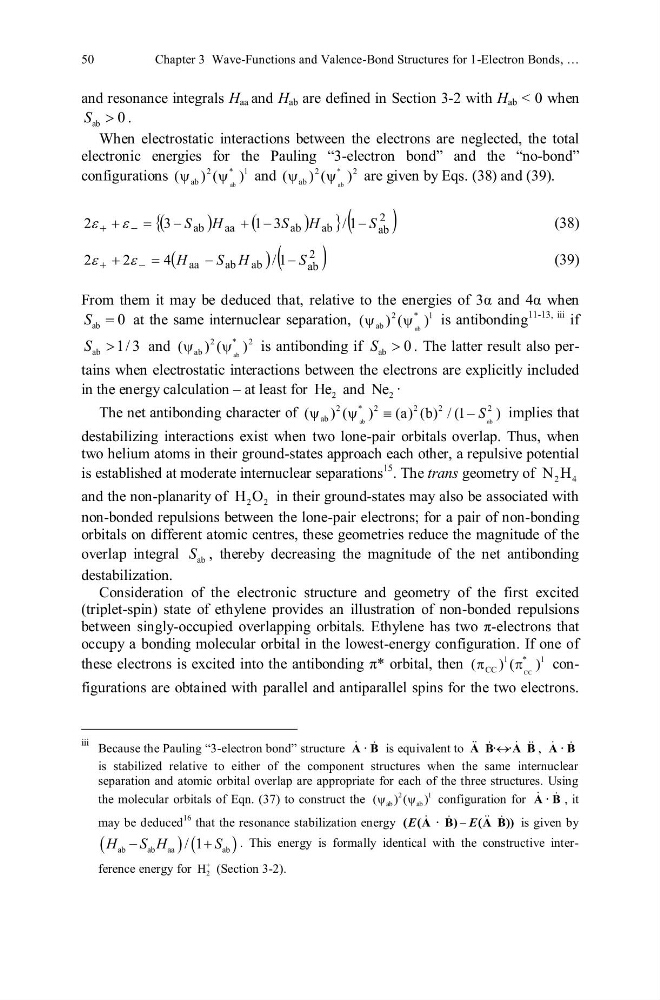
50
Chapter 3 Wave-Functions and Valence-Bond Structures for 1-Electron Bonds, …
and resonance integrals H aa and H ab are defined in Section 3-2 with H ab < 0 when
ab
0
S .
When electrostatic interactions between the electrons are neglected, the total
electronic energies for the Pauling “3-electron bond” and the “no-bond”
configurations
ab
2
* 1
ab
( ) ( )
and
ab
2
* 2
ab
( ) ( )
are given by Eqs. (38) and (39).
2
ab
ab
ab
aa
ab
1
/
3
1
3
2
S
H
S
H
S
(38)
2
ab
ab
ab
aa
1
/
4
2
2
S
H
S
H
(39)
From them it may be deduced that, relative to the energies of 3α and 4α when
ab
0
S at the same internuclear separation,
ab
2
* 1
ab
( ) ( )
is antibonding
11-13, iii if
ab
1/ 3
S
and
ab
2
* 2
ab
( ) ( )
is antibonding if ab 0
S . The latter result also pertains when electrostatic interactions between the electrons are explicitly included
in the energy calculation – at least for
2
He and
2
Ne ·
The net antibonding character of
ab
ab
2
* 2
2
2
2
ab
( ) ( )
(a) (b) / (1 – )
S
implies that
destabilizing interactions exist when two lone-pair orbitals overlap. Thus, when
two helium atoms in their ground-states approach each other, a repulsive potential
is established at moderate internuclear separations
15 . The trans geometry of 2 4
N H
and the non-planarity of 2 2
H O in their ground-states may also be associated with
non-bonded repulsions between the lone-pair electrons; for a pair of non-bonding
orbitals on different atomic centres, these geometries reduce the magnitude of the
overlap integral ab
S , thereby decreasing the magnitude of the net antibonding
destabilization.
Consideration of the electronic structure and geometry of the first excited
(triplet-spin) state of ethylene provides an illustration of non-bonded repulsions
between singly-occupied overlapping orbitals. Ethylene has two π-electrons that
occupy a bonding molecular orbital in the lowest-energy configuration. If one of
these electrons is excited into the antibonding π* orbital, then
CC
1
*
1
CC
(
) ( )
configurations are obtained with parallel and antiparallel spins for the two electrons.
iii Because the Pauling “3-electron bond” structure A · B
is equivalent to A B· ·A B
, A · B
is stabilized relative to either of the component structures when the same internuclear
separation and atomic orbital overlap are appropriate for each of the three structures. Using
the molecular orbitals of Eqn. (37) to construct the
2
1
ab
ab
( ) ( )
configuration for A · B
, it
may be deduced
16 that the resonance stabilization energy ( (A · B) – (A B))
E
E
is given by
ab
ab aa
ab
/ 1
H
S H
S . This energy is formally identical with the constructive interference energy for 2
H
(Section 3-2).
Chapter 3 Wave-Functions and Valence-Bond Structures for 1-Electron Bonds, …
and resonance integrals H aa and H ab are defined in Section 3-2 with H ab < 0 when
ab
0
S .
When electrostatic interactions between the electrons are neglected, the total
electronic energies for the Pauling “3-electron bond” and the “no-bond”
configurations
ab
2
* 1
ab
( ) ( )
and
ab
2
* 2
ab
( ) ( )
are given by Eqs. (38) and (39).
2
ab
ab
ab
aa
ab
1
/
3
1
3
2
S
H
S
H
S
(38)
2
ab
ab
ab
aa
1
/
4
2
2
S
H
S
H
(39)
From them it may be deduced that, relative to the energies of 3α and 4α when
ab
0
S at the same internuclear separation,
ab
2
* 1
ab
( ) ( )
is antibonding
11-13, iii if
ab
1/ 3
S
and
ab
2
* 2
ab
( ) ( )
is antibonding if ab 0
S . The latter result also pertains when electrostatic interactions between the electrons are explicitly included
in the energy calculation – at least for
2
He and
2
Ne ·
The net antibonding character of
ab
ab
2
* 2
2
2
2
ab
( ) ( )
(a) (b) / (1 – )
S
implies that
destabilizing interactions exist when two lone-pair orbitals overlap. Thus, when
two helium atoms in their ground-states approach each other, a repulsive potential
is established at moderate internuclear separations
15 . The trans geometry of 2 4
N H
and the non-planarity of 2 2
H O in their ground-states may also be associated with
non-bonded repulsions between the lone-pair electrons; for a pair of non-bonding
orbitals on different atomic centres, these geometries reduce the magnitude of the
overlap integral ab
S , thereby decreasing the magnitude of the net antibonding
destabilization.
Consideration of the electronic structure and geometry of the first excited
(triplet-spin) state of ethylene provides an illustration of non-bonded repulsions
between singly-occupied overlapping orbitals. Ethylene has two π-electrons that
occupy a bonding molecular orbital in the lowest-energy configuration. If one of
these electrons is excited into the antibonding π* orbital, then
CC
1
*
1
CC
(
) ( )
configurations are obtained with parallel and antiparallel spins for the two electrons.
iii Because the Pauling “3-electron bond” structure A · B
is equivalent to A B· ·A B
, A · B
is stabilized relative to either of the component structures when the same internuclear
separation and atomic orbital overlap are appropriate for each of the three structures. Using
the molecular orbitals of Eqn. (37) to construct the
2
1
ab
ab
( ) ( )
configuration for A · B
, it
may be deduced
16 that the resonance stabilization energy ( (A · B) – (A B))
E
E
is given by
ab
ab aa
ab
/ 1
H
S H
S . This energy is formally identical with the constructive interference energy for 2
H
(Section 3-2).