

3-11 Bond-Orders
51
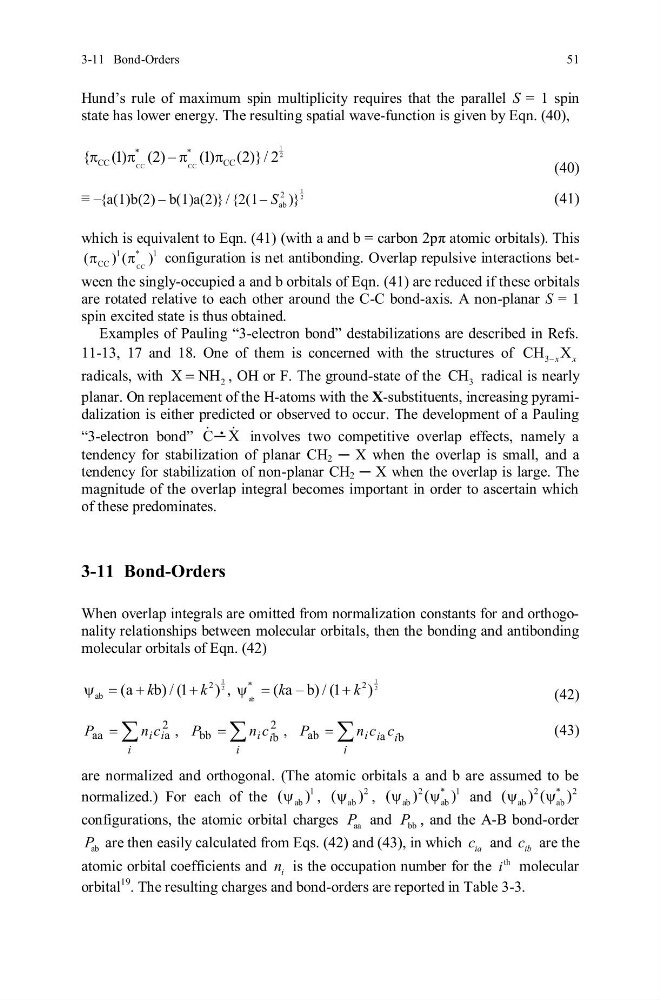
Hund’s rule of maximum spin multiplicity requires that the parallel S = 1 spin
state has lower energy. The resulting spatial wave-function is given by Eqn. (40),
1
2
CC
CC
*
*
CC
CC
{ (1) (2) –
(1) (2)} / 2
(40)
≡ –
1
2
2
ab
{a(1)b(2) – b(1)a(2)} / {2(1 – )}
S
(41)
which is equivalent to Eqn. (41) (with a and b = carbon 2pπ atomic orbitals). This
CC
1
*
1
CC
(
) ( )
configuration is net antibonding. Overlap repulsive interactions between the singly-occupied a and b orbitals of Eqn. (41) are reduced if these orbitals
are rotated relative to each other around the C-C bond-axis. A non-planar S = 1
spin excited state is thus obtained.
Examples of Pauling “3-electron bond” destabilizations are described in Refs.
11-13, 17 and 18. One of them is concerned with the structures of
3
CH X
x
x
radicals, with
2
X NH
, OH or F. The ground-state of the
3
CH radical is nearly
planar. On replacement of the H-atoms with the X-substituents, increasing pyramidalization is either predicted or observed to occur. The development of a Pauling
“3-electron bond” C ─ X involves two competitive overlap effects, namely a
tendency for stabilization of planar CH 2 ─ X when the overlap is small, and a
tendency for stabilization of non-planar CH 2 ─ X when the overlap is large. The
magnitude of the overlap integral becomes important in order to ascertain which
of these predominates.
3-11 Bond-Orders
When overlap integrals are omitted from normalization constants for and orthogonality relationships between molecular orbitals, then the bonding and antibonding
molecular orbitals of Eqn. (42)
1
1
2
2
ab
2
*
2
ab
(a b) / (1
) ,
( a – b) / (1
)
k
k
k
k
(42)
i
i
i
i
i
i
i
i
i
i
c
c
n
P
c
n
P
c
n
P
b
a
ab
2
b
bb
2
a
aa
,
,
(43)
are normalized and orthogonal. (The atomic orbitals a and b are assumed to be
normalized.) For each of the
1
ab
( )
,
2
ab
( )
,
2
* 1
ab
ab
( ) ( )
and
2
* 2
ab
ab
( ) ( )
configurations, the atomic orbital charges aa
P and bb
P , and the A-B bond-order
ab
P are then easily calculated from Eqs. (42) and (43), in which ia
c and ib
c are the
atomic orbital coefficients and i
n is the occupation number for the
th
i molecular
orbital
19
. The resulting charges and bond-orders are reported in Table 3-3.
.
51
Hund’s rule of maximum spin multiplicity requires that the parallel S = 1 spin
state has lower energy. The resulting spatial wave-function is given by Eqn. (40),
1
2
CC
CC
*
*
CC
CC
{ (1) (2) –
(1) (2)} / 2
(40)
≡ –
1
2
2
ab
{a(1)b(2) – b(1)a(2)} / {2(1 – )}
S
(41)
which is equivalent to Eqn. (41) (with a and b = carbon 2pπ atomic orbitals). This
CC
1
*
1
CC
(
) ( )
configuration is net antibonding. Overlap repulsive interactions between the singly-occupied a and b orbitals of Eqn. (41) are reduced if these orbitals
are rotated relative to each other around the C-C bond-axis. A non-planar S = 1
spin excited state is thus obtained.
Examples of Pauling “3-electron bond” destabilizations are described in Refs.
11-13, 17 and 18. One of them is concerned with the structures of
3
CH X
x
x
radicals, with
2
X NH
, OH or F. The ground-state of the
3
CH radical is nearly
planar. On replacement of the H-atoms with the X-substituents, increasing pyramidalization is either predicted or observed to occur. The development of a Pauling
“3-electron bond” C ─ X involves two competitive overlap effects, namely a
tendency for stabilization of planar CH 2 ─ X when the overlap is small, and a
tendency for stabilization of non-planar CH 2 ─ X when the overlap is large. The
magnitude of the overlap integral becomes important in order to ascertain which
of these predominates.
3-11 Bond-Orders
When overlap integrals are omitted from normalization constants for and orthogonality relationships between molecular orbitals, then the bonding and antibonding
molecular orbitals of Eqn. (42)
1
1
2
2
ab
2
*
2
ab
(a b) / (1
) ,
( a – b) / (1
)
k
k
k
k
(42)
i
i
i
i
i
i
i
i
i
i
c
c
n
P
c
n
P
c
n
P
b
a
ab
2
b
bb
2
a
aa
,
,
(43)
are normalized and orthogonal. (The atomic orbitals a and b are assumed to be
normalized.) For each of the
1
ab
( )
,
2
ab
( )
,
2
* 1
ab
ab
( ) ( )
and
2
* 2
ab
ab
( ) ( )
configurations, the atomic orbital charges aa
P and bb
P , and the A-B bond-order
ab
P are then easily calculated from Eqs. (42) and (43), in which ia
c and ib
c are the
atomic orbital coefficients and i
n is the occupation number for the
th
i molecular
orbital
19
. The resulting charges and bond-orders are reported in Table 3-3.
.