

3-10 Inclusion of Overlap Integrals in Normalization Constants
49
3-9 Valence-Bond Structures and Bond Properties for H 2
+
, H 2 ,
He 2
+
and He 2
The four simplest molecular system with ground-state valence-bond structures of
the types A · B , A—B , A · B
and A B
are 2
H
, 2
H ,
2
He
and
2
He . For each
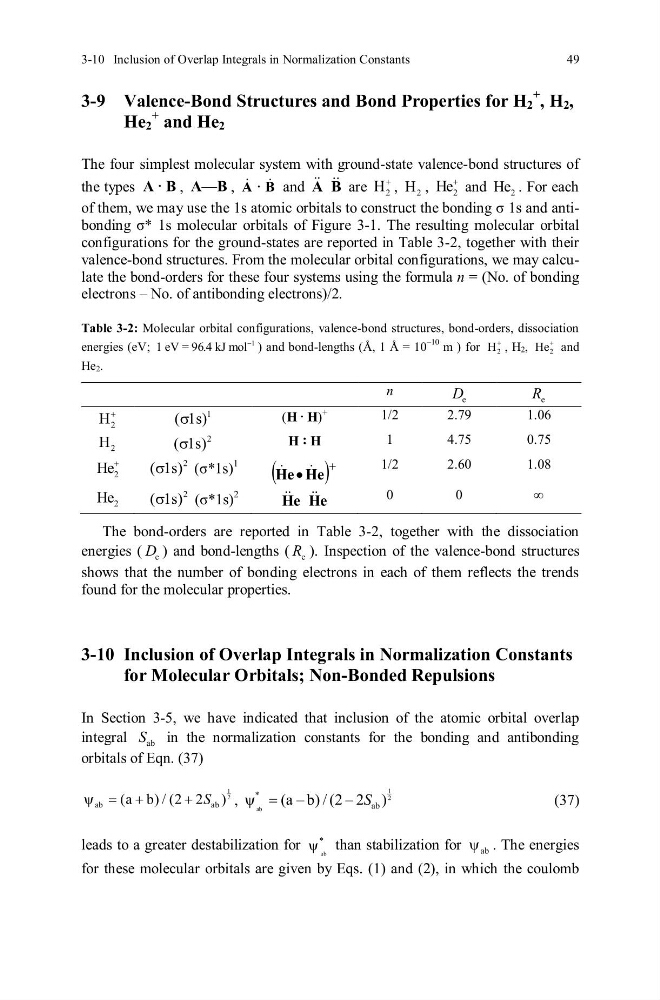
of them, we may use the 1s atomic orbitals to construct the bonding σ 1s and antibonding σ* 1s molecular orbitals of Figure 3-1. The resulting molecular orbital
configurations for the ground-states are reported in Table 3-2, together with their
valence-bond structures. From the molecular orbital configurations, we may calculate the bond-orders for these four systems using the formula n = (No. of bonding
electrons – No. of antibonding electrons)/2.
Table 3-2: Molecular orbital configurations, valence-bond structures, bond-orders, dissociation
energies (eV;
1
1 eV = 96.4 kJ mol
) and bond-lengths (Å, 1 Å = 10
–10 m ) for 2
H
, H2,
2
He
and
He2.
n
e
D
e
R
2
H
1
( 1s)
(H H)
+
1/2
2.79
1.06
2
H
2
( 1s)
H : H
1
4.75
0.75
2
He
2
( 1s)
(σ*1s)
1
e
H
e
H
1/2
2.60
1.08
2
He
2
( 1s)
(σ*1s)
2
e
H
e
H
0
0
∞
The bond-orders are reported in Table 3-2, together with the dissociation
energies ( e
D ) and bond-lengths ( e
R ). Inspection of the valence-bond structures
shows that the number of bonding electrons in each of them reflects the trends
found for the molecular properties.
3-10 Inclusion of Overlap Integrals in Normalization Constants
for Molecular Orbitals; Non-Bonded Repulsions
In Section 3-5, we have indicated that inclusion of the atomic orbital overlap
integral ab
S in the normalization constants for the bonding and antibonding
orbitals of Eqn. (37)
1
2
ab
ab
(a b) / (2 2 )
S
,
1
2
ab
*
ab
(a – b) / (2 – 2 )
S
(37)
leads to a greater destabilization for
ab
*
than stabilization for ab
. The energies
for these molecular orbitals are given by Eqs. (1) and (2), in which the coulomb
49
3-9 Valence-Bond Structures and Bond Properties for H 2
+
, H 2 ,
He 2
+
and He 2
The four simplest molecular system with ground-state valence-bond structures of
the types A · B , A—B , A · B
and A B
are 2
H
, 2
H ,
2
He
and
2
He . For each
of them, we may use the 1s atomic orbitals to construct the bonding σ 1s and antibonding σ* 1s molecular orbitals of Figure 3-1. The resulting molecular orbital
configurations for the ground-states are reported in Table 3-2, together with their
valence-bond structures. From the molecular orbital configurations, we may calculate the bond-orders for these four systems using the formula n = (No. of bonding
electrons – No. of antibonding electrons)/2.
Table 3-2: Molecular orbital configurations, valence-bond structures, bond-orders, dissociation
energies (eV;
1
1 eV = 96.4 kJ mol
) and bond-lengths (Å, 1 Å = 10
–10 m ) for 2
H
, H2,
2
He
and
He2.
n
e
D
e
R
2
H
1
( 1s)
(H H)
+
1/2
2.79
1.06
2
H
2
( 1s)
H : H
1
4.75
0.75
2
He
2
( 1s)
(σ*1s)
1
e
H
e
H
1/2
2.60
1.08
2
He
2
( 1s)
(σ*1s)
2
e
H
e
H
0
0
∞
The bond-orders are reported in Table 3-2, together with the dissociation
energies ( e
D ) and bond-lengths ( e
R ). Inspection of the valence-bond structures
shows that the number of bonding electrons in each of them reflects the trends
found for the molecular properties.
3-10 Inclusion of Overlap Integrals in Normalization Constants
for Molecular Orbitals; Non-Bonded Repulsions
In Section 3-5, we have indicated that inclusion of the atomic orbital overlap
integral ab
S in the normalization constants for the bonding and antibonding
orbitals of Eqn. (37)
1
2
ab
ab
(a b) / (2 2 )
S
,
1
2
ab
*
ab
(a – b) / (2 – 2 )
S
(37)
leads to a greater destabilization for
ab
*
than stabilization for ab
. The energies
for these molecular orbitals are given by Eqs. (1) and (2), in which the coulomb