

48
Chapter 3 Wave-Functions and Valence-Bond Structures for 1-Electron Bonds, …
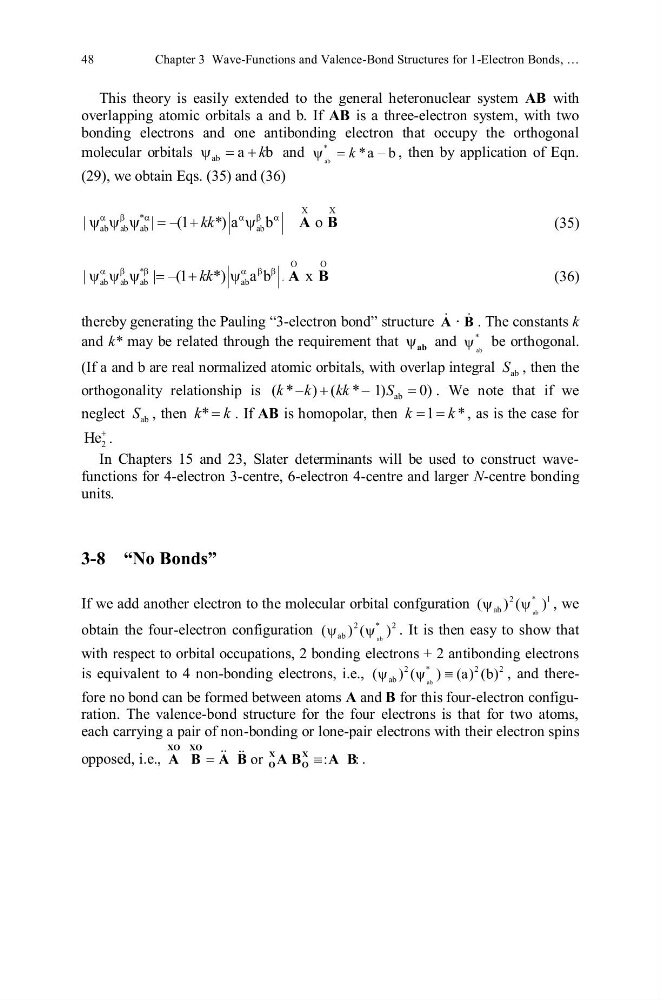
This theory is easily extended to the general heteronuclear system AB with
overlapping atomic orbitals a and b. If AB is a three-electron system, with two
bonding electrons and one antibonding electron that occupy the orthogonal
molecular orbitals ab a b
k and
ab
*
*a – b
k
, then by application of Eqn.
(29), we obtain Eqs. (35) and (36)
*
ab ab ab
ab
|
| –(1
*) a
b
o
kk
A B
X
X
|
| –(1
*) a
b
o
A B
(35)
*
ab ab ab
ab
|
| –(1
*)
a b A o B
kk
O
O
|
| –(1
*)
a b
x
A B
(36)
thereby generating the Pauling “3-electron bond” structure
A · B . The constants k
and k* may be related through the requirement that ab and
ab
*
be orthogonal.
(If a and b are real normalized atomic orbitals, with overlap integral ab
S , then the
orthogonality relationship is
ab
( * – ) ( * – 1)
0)
k k
kk
S
. We note that if we
neglect ab
S , then *
k k
. If AB is homopolar, then
1 *
k
k
, as is the case for
2
He
.
In Chapters 15 and 23, Slater determinants will be used to construct wavefunctions for 4-electron 3-centre, 6-electron 4-centre and larger N-centre bonding
units.
3-8 “No Bonds”
If we add another electron to the molecular orbital confguration
ab
2
* 1
ab
( ) ( )
, we
obtain the four-electron configuration
ab
2
* 2
ab
( ) ( )
. It is then easy to show that
with respect to orbital occupations, 2 bonding electrons + 2 antibonding electrons
is equivalent to 4 non-bonding electrons, i.e.,
ab
2
*
2
2
ab
( ) ( ) (a) (b)
, and therefore no bond can be formed between atoms A and B for this four-electron configuration. The valence-bond structure for the four electrons is that for two atoms,
each carrying a pair of non-bonding or lone-pair electrons with their electron spins
opposed, i.e.,
or
:
:
XO XO
X
X
O
O
A B A B
A B
A B
.
Chapter 3 Wave-Functions and Valence-Bond Structures for 1-Electron Bonds, …
This theory is easily extended to the general heteronuclear system AB with
overlapping atomic orbitals a and b. If AB is a three-electron system, with two
bonding electrons and one antibonding electron that occupy the orthogonal
molecular orbitals ab a b
k and
ab
*
*a – b
k
, then by application of Eqn.
(29), we obtain Eqs. (35) and (36)
*
ab ab ab
ab
|
| –(1
*) a
b
o
kk
A B
X
X
|
| –(1
*) a
b
o
A B
(35)
*
ab ab ab
ab
|
| –(1
*)
a b A o B
kk
O
O
|
| –(1
*)
a b
x
A B
(36)
thereby generating the Pauling “3-electron bond” structure
A · B . The constants k
and k* may be related through the requirement that ab and
ab
*
be orthogonal.
(If a and b are real normalized atomic orbitals, with overlap integral ab
S , then the
orthogonality relationship is
ab
( * – ) ( * – 1)
0)
k k
kk
S
. We note that if we
neglect ab
S , then *
k k
. If AB is homopolar, then
1 *
k
k
, as is the case for
2
He
.
In Chapters 15 and 23, Slater determinants will be used to construct wavefunctions for 4-electron 3-centre, 6-electron 4-centre and larger N-centre bonding
units.
3-8 “No Bonds”
If we add another electron to the molecular orbital confguration
ab
2
* 1
ab
( ) ( )
, we
obtain the four-electron configuration
ab
2
* 2
ab
( ) ( )
. It is then easy to show that
with respect to orbital occupations, 2 bonding electrons + 2 antibonding electrons
is equivalent to 4 non-bonding electrons, i.e.,
ab
2
*
2
2
ab
( ) ( ) (a) (b)
, and therefore no bond can be formed between atoms A and B for this four-electron configuration. The valence-bond structure for the four electrons is that for two atoms,
each carrying a pair of non-bonding or lone-pair electrons with their electron spins
opposed, i.e.,
or
:
:
XO XO
X
X
O
O
A B A B
A B
A B
.