

3-7 Slater Determinants and the Pauling “3-Electron Bond”
47
tion of
2
He
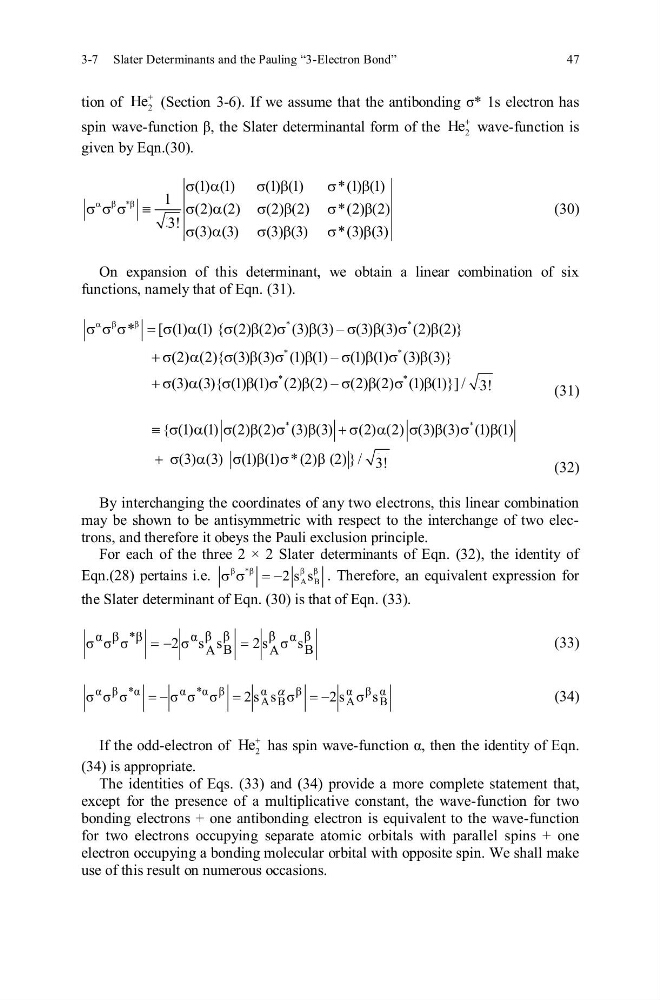
(Section 3-6). If we assume that the antibonding σ* 1s electron has
spin wave-function β, the Slater determinantal form of the
2
He
wave-function is
given by Eqn.(30).
*
(1) (1)
(1) (1)
*(1) (1)
1
(2) (2)
(2) (2)
*(2) (2)
31 (3) (3)
(3) (3)
*(3) (3)
(30)
On expansion of this determinant, we obtain a linear combination of six
functions, namely that of Eqn. (31).
*
*
*
*
*
*
*
[ (1) (1) { (2) (2) (3) (3) – (3) (3) (2) (2)}
(2) (2){ (3) (3) (1) (1) – (1) (1) (3) (3)}
(3) (3){ (1) (1) (2) (2) – (2) (2) (1) (1)}] / 31
(31)
*
*
{ (1) (1) (2) (2) (3) (3)
(2) (2) (3) (3) (1) (1)
(3) (3) (1) (1) * (2) (2) } / 31
(32)
By interchanging the coordinates of any two electrons, this linear combination
may be shown to be antisymmetric with respect to the interchange of two electrons, and therefore it obeys the Pauli exclusion principle.
For each of the three 2 × 2 Slater determinants of Eqn. (32), the identity of
Eqn.(28) pertains i.e.
*
A B
2 s s
. Therefore, an equivalent expression for
the Slater determinant of Eqn. (30) is that of Eqn. (33).
β
B
α
β
A
β
B
β
A
α
β
*
β
α
s
σ
s
2
s
s
σ
2
σ
σ
σ
(33)
α
B
β
α
A
β
B
α
A
β
*α
α
*α
β
α
s
σ
s
2
σ
s
s
2
σ
σ
σ
σ
σ
σ
(34)
If the odd-electron of
2
He
has spin wave-function α, then the identity of Eqn.
(34) is appropriate.
The identities of Eqs. (33) and (34) provide a more complete statement that,
except for the presence of a multiplicative constant, the wave-function for two
bonding electrons + one antibonding electron is equivalent to the wave-function
for two electrons occupying separate atomic orbitals with parallel spins + one
electron occupying a bonding molecular orbital with opposite spin. We shall make
use of this result on numerous occasions.
3!
3!
3!
47
tion of
2
He
(Section 3-6). If we assume that the antibonding σ* 1s electron has
spin wave-function β, the Slater determinantal form of the
2
He
wave-function is
given by Eqn.(30).
*
(1) (1)
(1) (1)
*(1) (1)
1
(2) (2)
(2) (2)
*(2) (2)
31 (3) (3)
(3) (3)
*(3) (3)
(30)
On expansion of this determinant, we obtain a linear combination of six
functions, namely that of Eqn. (31).
*
*
*
*
*
*
*
[ (1) (1) { (2) (2) (3) (3) – (3) (3) (2) (2)}
(2) (2){ (3) (3) (1) (1) – (1) (1) (3) (3)}
(3) (3){ (1) (1) (2) (2) – (2) (2) (1) (1)}] / 31
(31)
*
*
{ (1) (1) (2) (2) (3) (3)
(2) (2) (3) (3) (1) (1)
(3) (3) (1) (1) * (2) (2) } / 31
(32)
By interchanging the coordinates of any two electrons, this linear combination
may be shown to be antisymmetric with respect to the interchange of two electrons, and therefore it obeys the Pauli exclusion principle.
For each of the three 2 × 2 Slater determinants of Eqn. (32), the identity of
Eqn.(28) pertains i.e.
*
A B
2 s s
. Therefore, an equivalent expression for
the Slater determinant of Eqn. (30) is that of Eqn. (33).
β
B
α
β
A
β
B
β
A
α
β
*
β
α
s
σ
s
2
s
s
σ
2
σ
σ
σ
(33)
α
B
β
α
A
β
B
α
A
β
*α
α
*α
β
α
s
σ
s
2
σ
s
s
2
σ
σ
σ
σ
σ
σ
(34)
If the odd-electron of
2
He
has spin wave-function α, then the identity of Eqn.
(34) is appropriate.
The identities of Eqs. (33) and (34) provide a more complete statement that,
except for the presence of a multiplicative constant, the wave-function for two
bonding electrons + one antibonding electron is equivalent to the wave-function
for two electrons occupying separate atomic orbitals with parallel spins + one
electron occupying a bonding molecular orbital with opposite spin. We shall make
use of this result on numerous occasions.
3!
3!
3!