

46
Chapter 3 Wave-Functions and Valence-Bond Structures for 1-Electron Bonds, …
β
A
α
B
β
B
α
A
s
s
s
s
HLVB
(25)
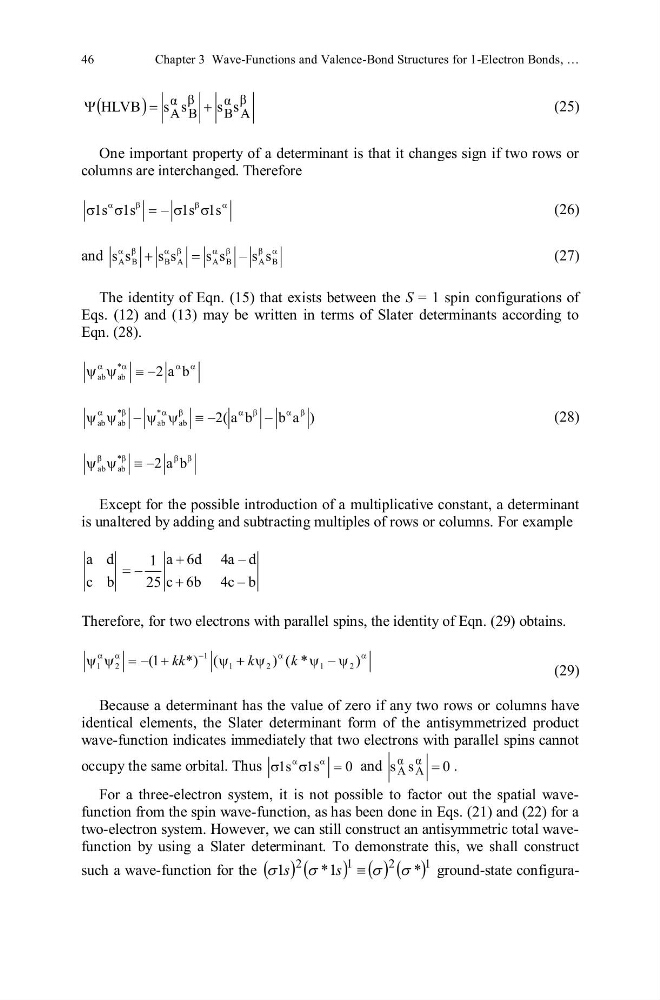
One important property of a determinant is that it changes sign if two rows or
columns are interchanged. Therefore
1s 1s
– 1s 1s
(26)
and A B
B A
A B
A B
s s
s s
s s – s s
(27)
The identity of Eqn. (15) that exists between the S = 1 spin configurations of
Eqs. (12) and (13) may be written in terms of Slater determinants according to
Eqn. (28).
*
ab ab
2 a b
*
*
ab ab
ab
ab
–2( a b – b a )
(28)
*
ab ab
2 a b
Except for the possible introduction of a multiplicative constant, a determinant
is unaltered by adding and subtracting multiples of rows or columns. For example
a d
a 6d 4a – d
1
–
c b
c 6b 4c – b
25
Therefore, for two electrons with parallel spins, the identity of Eqn. (29) obtains.
1
1
2
1
2
1
2
–(1
*) (
) ( * – )
kk
k
k
(29)
Because a determinant has the value of zero if any two rows or columns have
identical elements, the Slater determinant form of the antisymmetrized product
wave-function indicates immediately that two electrons with parallel spins cannot
occupy the same orbital. Thus 1s 1s
0
and
0
s
s
α
A
α
A
.
For a three-electron system, it is not possible to factor out the spatial wavefunction from the spin wave-function, as has been done in Eqs. (21) and (22) for a
two-electron system. However, we can still construct an antisymmetric total wavefunction by using a Slater determinant. To demonstrate this, we shall construct
such a wave-function for the
1
2
1
2
*
1
*
1
s
s
ground-state configura-
Chapter 3 Wave-Functions and Valence-Bond Structures for 1-Electron Bonds, …
β
A
α
B
β
B
α
A
s
s
s
s
HLVB
(25)
One important property of a determinant is that it changes sign if two rows or
columns are interchanged. Therefore
1s 1s
– 1s 1s
(26)
and A B
B A
A B
A B
s s
s s
s s – s s
(27)
The identity of Eqn. (15) that exists between the S = 1 spin configurations of
Eqs. (12) and (13) may be written in terms of Slater determinants according to
Eqn. (28).
*
ab ab
2 a b
*
*
ab ab
ab
ab
–2( a b – b a )
(28)
*
ab ab
2 a b
Except for the possible introduction of a multiplicative constant, a determinant
is unaltered by adding and subtracting multiples of rows or columns. For example
a d
a 6d 4a – d
1
–
c b
c 6b 4c – b
25
Therefore, for two electrons with parallel spins, the identity of Eqn. (29) obtains.
1
1
2
1
2
1
2
–(1
*) (
) ( * – )
kk
k
k
(29)
Because a determinant has the value of zero if any two rows or columns have
identical elements, the Slater determinant form of the antisymmetrized product
wave-function indicates immediately that two electrons with parallel spins cannot
occupy the same orbital. Thus 1s 1s
0
and
0
s
s
α
A
α
A
.
For a three-electron system, it is not possible to factor out the spatial wavefunction from the spin wave-function, as has been done in Eqs. (21) and (22) for a
two-electron system. However, we can still construct an antisymmetric total wavefunction by using a Slater determinant. To demonstrate this, we shall construct
such a wave-function for the
1
2
1
2
*
1
*
1
s
s
ground-state configura-